Hardened Steel vs Brass Nozzle: Which 3D Printer Nozzle Material Is Best?
Choosing the Right Nozzle Material for Your 3D Printer
Most 3D printers ship with a standard brass nozzle, and for good reason — brass is cheap, conducts heat well, and works perfectly for PLA and PETG. But the moment you start printing abrasive filaments like carbon fiber, glass fiber, or glow-in-the-dark materials, that soft brass nozzle wears out fast. The bore widens, extrusion becomes inconsistent, and print quality tanks.
That’s where hardened steel nozzles come in. They resist abrasion far better than brass, but they come with tradeoffs that most guides gloss over. In this comparison, I’ll cover exactly when you need hardened steel, when brass is still the better choice, and whether the newer exotic nozzle materials are worth the premium.
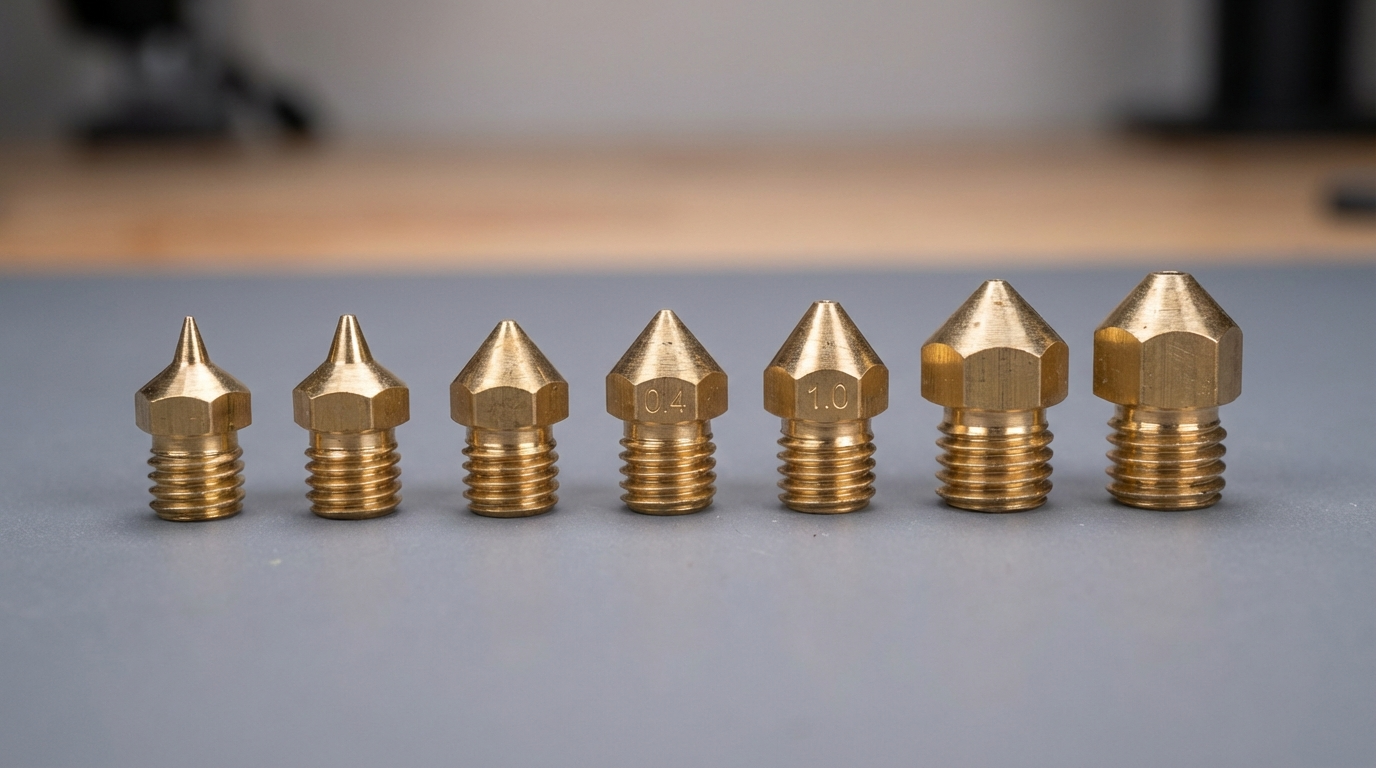
Brass Nozzles: The Default Champion
Brass has been the standard nozzle material since the early days of consumer 3D printing, and it earned that position.
Why Brass Works So Well
- Thermal conductivity: ~120 W/m·K. This is excellent — brass transfers heat from the heater block to the filament quickly and evenly. This means faster melting and more consistent extrusion, especially at higher speeds.
- Non-stick surface. Brass has a naturally low friction coefficient with molten plastics. Filament flows through smoothly without building up deposits inside the nozzle bore.
- Easy to machine. Brass machines cleanly, which means the bore and tip can be manufactured to tight tolerances cheaply. A brass nozzle costs $0.50-2.00.
- Easy to clean. Cold pulls work well with brass, and you can use a wire brush on the outside without damaging the tip.
The Brass Weakness
Brass is soft — about 3 on the Mohs hardness scale. Abrasive filaments act like sandpaper running through the bore at high temperatures. Here’s how fast brass wears with different materials:
- PLA, PETG, ABS: 1000+ hours before noticeable wear
- Wood fill PLA: 200-500 hours
- Glow in the dark: 50-100 hours (strontium aluminate particles are extremely hard)
- Carbon fiber PLA/PETG: 20-50 hours
- Glass fiber nylon: 10-30 hours
When a brass nozzle wears, the 0.4mm bore gradually becomes 0.5mm, then 0.6mm. Your slicer still thinks it’s a 0.4mm nozzle, so extrusion calculations are wrong — you get over-extrusion, blobbing, and dimensional inaccuracy.
Hardened Steel Nozzles: Built to Last
Hardened steel nozzles are made from tool steel that’s been heat-treated to increase hardness. They typically rate 60-65 HRC on the Rockwell scale, compared to about 55-85 HRB for brass (a completely different and much softer range).
The Advantages
- Abrasion resistance: A hardened steel nozzle can print carbon fiber filament for thousands of hours with minimal bore wear. For anyone regularly printing abrasive materials, this alone justifies the cost.
- Longevity: Even with non-abrasive filaments, hardened steel lasts essentially forever. The bore doesn’t gradually widen like brass.
- Cost per hour: A hardened steel nozzle costs $8-15, but lasts 10-50x longer than brass with abrasive materials. The math works out strongly in favor of hardened steel if you print abrasives regularly.
The Tradeoffs
- Thermal conductivity: ~50 W/m·K. This is less than half of brass. The nozzle heats up more slowly and doesn’t transfer heat to the filament as efficiently. In practice, this means:
- You may need to increase nozzle temperature by 5-10°C
- Maximum reliable print speed is slightly lower
- Temperature recovery after retraction is slower
- Filament sticking. Steel has a higher friction coefficient than brass. Some users report more frequent partial clogs, especially with PETG. This is manageable but real.
- Harder to clean. Cold pulls work fine, but the higher friction means debris is harder to flush out completely.
- Cost. 5-10x more expensive than brass. For non-abrasive materials, the extra cost isn’t justified.
Stainless Steel Nozzles: The Middle Ground?
Some manufacturers sell stainless steel nozzles, which sit between brass and hardened steel in both price and performance.
- Thermal conductivity: ~15-25 W/m·K. Significantly worse than both brass and hardened steel. This is the biggest drawback — you’ll notice more temperature-related issues.
- Abrasion resistance: Better than brass but worse than hardened tool steel. Adequate for wood fill and glow-in-the-dark filaments, but CF and GF will still wear it over time.
- Food safety: Stainless steel is food-safe, which matters for specific applications (cookie cutters, food molds). Brass contains lead in some alloys.
Verdict: Stainless steel nozzles are a niche product. Unless you specifically need food-safe printing, go with brass or hardened steel instead — stainless is mediocre at everything rather than excellent at anything.
Ruby-Tipped Nozzles: The Premium Option
Ruby-tipped nozzles (like the Olsson Ruby) use a brass body with a synthetic ruby insert at the tip. This gives you brass-level thermal conductivity with ruby-level abrasion resistance.
Why Ruby Tips Work
- Thermal conductivity: Same as brass (the body IS brass) — no speed or temperature penalties
- Abrasion resistance: Ruby is 9 on the Mohs scale (diamond is 10). It’s essentially impervious to any 3D printing filament
- Best of both worlds: You get the thermal performance of brass with the longevity of hardened steel
The Catch
- Price: $80-100. That’s 40-100x the cost of a brass nozzle. You need to be printing a LOT of abrasive material to justify this.
- Fragile: The ruby insert can crack if you crash the nozzle into the bed. The ruby itself is hard but brittle — it resists wear but not impact.
- Limited sizes: Ruby nozzles are typically only available in 0.4mm and 0.6mm bore sizes.
Tungsten Carbide and Other Exotic Nozzles
Newer entrants to the market include:
- Tungsten carbide: Extremely hard and decent thermal conductivity (~80 W/m·K). Costs $25-50. A strong middle ground between hardened steel and ruby.
- Copper alloy (nickel plated): Best thermal conductivity of any nozzle material (~380 W/m·K). The nickel plating provides moderate abrasion resistance. Great for high-speed printing where heat transfer is the bottleneck.
- Nozzle X (by E3D): A proprietary hardened steel alloy with improved thermal conductivity over standard hardened steel. Costs about $25. One of the most popular premium nozzle options.
Which Nozzle Should You Actually Buy?
Here’s my practical recommendation based on what you’re printing:
Stick with Brass If:
- You only print PLA, PETG, ABS, ASA, or TPU
- You never use filled or glow-in-the-dark filaments
- You want maximum print speed and quality
- You’re on a tight budget
Get Hardened Steel If:
- You regularly print carbon fiber, glass fiber, or glow-in-the-dark filaments
- You don’t want to worry about nozzle wear ever
- You’re willing to accept slightly lower print speed and a 5-10°C temperature bump
- You want a “set it and forget it” nozzle
Consider Nozzle X / Tungsten Carbide If:
- You print a mix of abrasive and non-abrasive filaments
- You want better thermal performance than standard hardened steel
- $25-50 for a nozzle doesn’t bother you
Go Ruby If:
- You print abrasive filaments daily in a production environment
- Maximum quality and speed with abrasive materials is critical
- You’re careful enough not to crash the nozzle into the bed
Installation Tips
Regardless of which nozzle material you choose, installation procedure is the same:
- Heat the hotend to printing temperature before removing the old nozzle. Never try to unscrew a cold nozzle — residual plastic acts like thread-lock.
- Use the correct wrench size. Most nozzles are 6mm hex. Don’t use pliers — they round the flats and make future removal impossible.
- Tighten the new nozzle snugly but not gorilla-tight. About 1-1.5 Nm of torque. Over-tightening can strip the soft brass threads in the heater block.
- Do a hot tighten. Heat to printing temperature, then give the nozzle an extra quarter-turn. Thermal expansion seals the threads and prevents filament leaking between the nozzle and heat break.
- Re-calibrate Z-offset. Different nozzle lengths affect the Z-home position. Always re-home and adjust after a nozzle swap.
Final Verdict
For 90% of 3D printer users, a pack of five brass nozzles for $5 is the smart buy. Swap them out every few hundred hours or whenever print quality degrades. For the 10% who regularly print abrasive materials, a hardened steel nozzle (or the E3D Nozzle X) is the best value — the thermal conductivity penalty is minor and the abrasion resistance is excellent. Ruby-tipped nozzles are a luxury item that’s only justified for serious production use with abrasive filaments. Don’t buy one just because it sounds cool — the money is better spent on filament.