Cheap vs Expensive PLA Filament: Is Premium Worth the Price?
Walk into any 3D printing forum, and you’ll find the same debate raging: is cheap PLA filament worth buying, or should you spend more on premium brands? With spools ranging from $12 to $45+, the price gap is significant — but does expensive filament actually deliver better results?
After years of testing dozens of brands across multiple printers, I’ve developed a clear picture of what you’re really paying for when you choose budget vs. premium PLA. Let’s break it down.
What Makes PLA Filament “Cheap” or “Expensive”?
Before diving into comparisons, it helps to understand what drives the price difference. PLA (polylactic acid) is a thermoplastic derived from renewable resources like corn starch or sugarcane. The base polymer is relatively inexpensive, so what accounts for a 3x price difference between brands?
Raw material quality: Premium brands typically use higher-grade PLA pellets with fewer impurities. Budget manufacturers may use recycled or lower-grade pellets that contain inconsistencies in the polymer chain.
Manufacturing tolerances: This is the big one. Expensive filament is extruded with tighter diameter tolerances — typically ±0.02mm versus ±0.05mm or worse for budget options. That might sound trivial, but it directly impacts print quality.
Additives and colorants: Premium filaments often use better pigments and additives that don’t affect printing characteristics. Cheap colorants can alter the melting point and flow behavior of the plastic.
Quality control: Higher-end brands test every spool for diameter consistency, roundness, and moisture content before shipping. Budget brands may skip some or all of these checks.
Winding quality: Proper spooling prevents tangles — one of the most frustrating issues in 3D printing. Premium brands invest in better winding equipment and processes.
The Real-World Differences I’ve Noticed
Theory is one thing. Here’s what actually happens when you load a cheap spool versus an expensive one into your printer.
Diameter Consistency
I measured 20 random points along spools from several budget and premium brands using digital calipers. The results were telling:
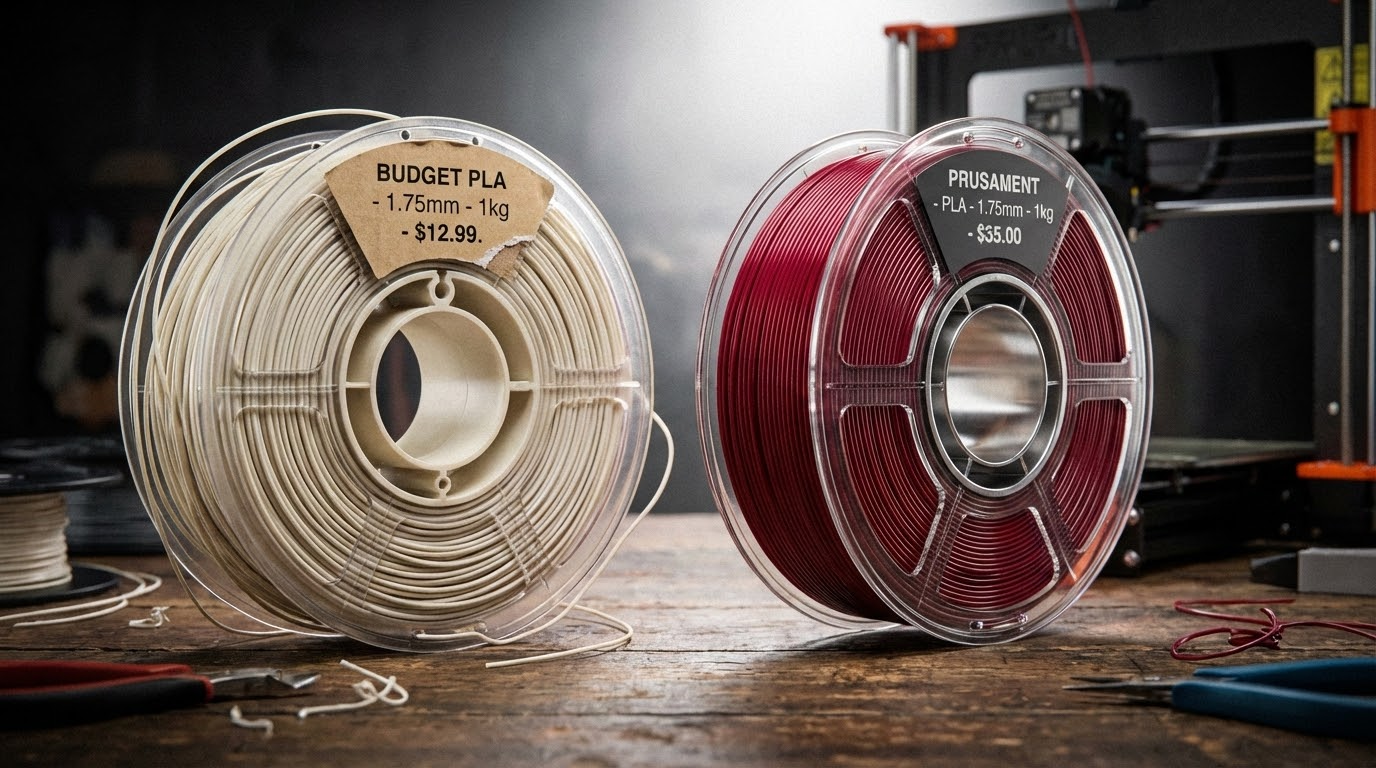
Premium brands (Prusament, Fillamentum, Polymaker) consistently stayed within ±0.02mm of the stated 1.75mm diameter. Budget brands (no-name Amazon sellers, some Alibaba imports) varied by as much as ±0.07mm in extreme cases.
Why does this matter? Your slicer assumes a constant filament diameter. When the actual diameter fluctuates, you get inconsistent extrusion — some layers look perfect, others are under or over-extruded. On detailed prints, this shows up as rough surfaces and visible layer inconsistencies.
Color Consistency
This one surprised me. I printed the same model with two spools of “white” PLA from a budget brand purchased a month apart. The color difference was noticeable — one had a slight yellowish tint while the other was a cooler, bluer white. Premium brands maintain color consistency across production batches, which matters if you’re printing parts that need to match.
Print Quality on Standard Models
For basic prints — phone stands, simple enclosures, decorative items — the difference between cheap and expensive PLA is honestly minimal. If your printer is well-tuned and you’re printing at standard settings (0.2mm layer height, moderate speeds), budget filament produces perfectly acceptable results.
The gap widens on demanding prints. Fine details, long bridges, thin walls, and intricate overhangs all expose the weaknesses of inconsistent filament. If you’re printing miniatures, cosplay parts, or engineering prototypes, quality filament makes a noticeable difference.
Clogging and Jams
In my experience, cheap filament causes 3-4x more clogs than premium filament. The culprits are usually foreign particles in the plastic, inconsistent diameter causing grinding at the extruder, or poor thermal properties leading to heat creep. Each clog means a failed print, wasted time, and potentially wasted filament — which eats into those “savings” quickly.
Moisture Sensitivity
All PLA absorbs moisture from the air, but I’ve found that budget filaments tend to arrive with higher moisture content out of the bag. Some cheap spools I’ve tested crackle and pop during printing right out of the package — a clear sign of moisture contamination. Premium brands typically ship with better vacuum sealing and desiccant packs.
Price vs. Value: The Math
Let’s do some practical math. Say you buy a $15 budget spool versus a $30 premium spool, both 1kg.
If you experience one major clog per budget spool that ruins a 6-hour print using 150g of filament, you’ve effectively lost $2.25 in material plus the time cost. If you have two failed prints due to diameter inconsistency, that’s potentially another $4-5 in wasted plastic.
Suddenly, that $15 spool cost you $21-22 in actual consumed filament to get the same successful prints. The savings shrink dramatically.
That said, if you’re printing large, simple objects where surface quality isn’t critical — like storage bins, jigs, or draft prototypes — budget filament delivers genuine savings with minimal downsides.
The Best Mid-Range Options
Here’s the good news: you don’t have to choose between the cheapest and most expensive options. The mid-range ($18-25 per kg) offers the best value for most users.

eSUN PLA+ ($18-22/kg): Consistently good diameter tolerance, excellent color range, and the “plus” formulation offers slightly better strength than standard PLA. My go-to recommendation for beginners and intermediate users.
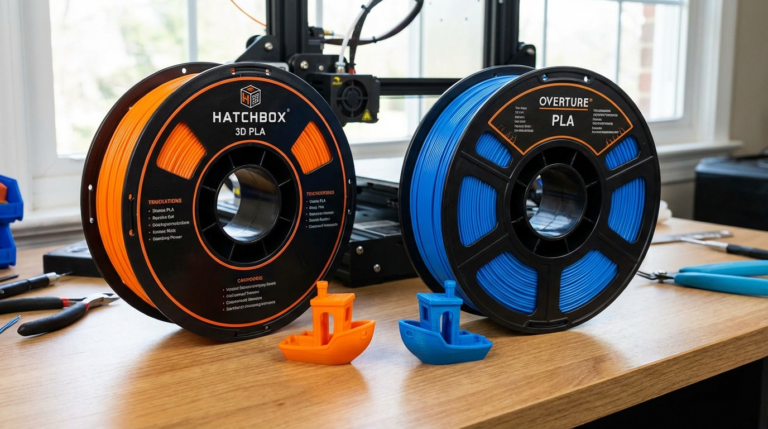
Overture PLA ($16-20/kg): Solid quality control for the price, ships with a build surface sample, and maintains good consistency across colors. Occasionally hits sales that bring it under $15.
Hatchbox PLA ($22-26/kg): A community favorite for good reason. Reliable diameter, good color consistency, and prints well across a wide range of temperatures. Slightly pricier but rarely disappoints.
Polymaker PolyTerra PLA ($20-24/kg): Matte finish, eco-friendly packaging, and excellent print quality. The matte surface hides layer lines better than glossy PLA, which can actually make your prints look better than they are.
When Cheap Filament Makes Sense
Budget filament isn’t always the wrong choice. Here’s when it’s perfectly fine:
Prototyping and iteration: If you’re going through multiple design revisions, spending premium prices on parts destined for the recycling bin doesn’t make sense.
Large functional parts: Bins, brackets, cable organizers — if surface finish doesn’t matter and the geometry is simple, save your money.
Learning and experimenting: New to 3D printing? Buy cheap filament to learn on. You’re going to waste a lot of material dialing in your settings, and that’s fine.
Single-color bulk projects: If you need 10kg of black PLA for a large project, the cost savings of budget filament add up significantly.
When to Invest in Premium Filament
On the flip side, premium filament earns its price in these scenarios:
Miniatures and detailed models: Fine details demand consistent extrusion. Premium filament’s tight tolerances pay off immediately on anything with intricate features.
Client work or gifts: If someone else will see and judge the final product, the improved surface quality and consistency of premium filament is worth the investment.
Multi-day prints: Nothing is worse than a clog 40 hours into a 48-hour print. For long prints, reliability is worth paying for.
Color-critical projects: If you need parts to match across batches, premium brands’ color consistency becomes essential.
Engineering applications: Parts that need to meet dimensional accuracy requirements benefit from filament with predictable shrinkage and consistent diameter.
My Honest Recommendation
After burning through hundreds of spools across the price spectrum, here’s my straightforward advice:
Start mid-range. Brands like eSUN PLA+, Overture, or Hatchbox give you 90% of premium quality at 60-70% of the price. For most people, most of the time, this is the sweet spot.
Keep one premium spool around. When you need a perfect print, reach for Prusament or Fillamentum. Having one “nice” spool for special projects is like having one good knife in the kitchen — it doesn’t need to be everything, but it should be available.
Avoid the absolute cheapest. That $10 spool on Amazon with no brand name and reviews in broken English? Skip it. The failure rate and frustration aren’t worth the $5-8 you save. I’ve learned this lesson the expensive way — through wasted prints, clogged nozzles, and hours of troubleshooting problems that turned out to be filament quality.
The Bottom Line
The difference between cheap and expensive PLA filament is real, but it’s not always as dramatic as enthusiasts claim. For simple prints with forgiving geometry, budget filament works fine. For detailed, demanding, or critical prints, quality filament measurably improves your results.
The most cost-effective approach isn’t picking one extreme — it’s matching your filament choice to your project requirements. Print smart, not expensive.