Best Filament for Outdoor Use: UV Resistant 3D Printing Materials
Why UV Resistance Matters for 3D Prints
You spent hours designing and printing the perfect part — a garden hose holder, a mailbox bracket, a security camera mount. You install it outside, admire your work, and forget about it. Three months later, the once-sturdy part is brittle, discolored, and cracking. Welcome to the world of UV degradation, where sunlight slowly destroys most 3D printing filaments from the molecular level up.
Ultraviolet radiation from the sun breaks down polymer chains in a process called photodegradation. The plastic literally falls apart at the molecular level. Some materials handle this better than others, and knowing which filament to reach for when printing outdoor parts can mean the difference between a part that lasts years and one that fails in weeks.
Filament UV Resistance Rankings
Let’s rank the most common 3D printing filaments by their ability to survive outdoor UV exposure, from worst to best.
PLA — Poor (Weeks to Months)
PLA is the most popular filament, but it’s arguably the worst choice for outdoor use. UV radiation causes PLA to become brittle and chalk on the surface within weeks of direct sun exposure. Beyond UV, PLA has a low glass transition temperature (~60°C), which means it softens and deforms in direct sunlight on hot days. That phone mount you printed for your car dashboard? It’ll be a puddle by July.
PLA’s only saving grace outdoors is that it’s biodegradable — if it falls apart, at least it won’t persist in the environment like other plastics. But that’s not exactly a feature you want in a functional part.
ABS — Fair (Months)
ABS handles UV slightly better than PLA but still degrades significantly over months of exposure. The surface yellows and becomes chalky, and mechanical properties decline. ABS was the go-to material before ASA existed, and many outdoor parts were printed in ABS with varying results. If you paint ABS parts with UV-resistant paint, they can last much longer — the paint acts as a UV barrier for the plastic underneath.
PETG — Moderate (6-12 Months)
PETG has better inherent UV resistance than PLA or ABS, but it’s not immune. After 6-12 months of direct sun exposure, you’ll notice surface hazing and some brittleness. PETG’s real advantage outdoors is its heat resistance (glass transition ~80°C) and moisture resistance — it won’t absorb water and swell like nylon, and it won’t soften on a hot day like PLA.
For outdoor parts that will be partially shaded or where you’re willing to replace them annually, PETG is a reasonable budget-friendly choice.
ASA — Excellent (Years)
ASA (Acrylonitrile Styrene Acrylate) was literally designed for outdoor use. It was developed as a UV-stable alternative to ABS for automotive exterior parts. The styrene component in ABS (which is UV-sensitive) is replaced with acrylate, which shrugs off UV radiation like it’s nothing.
ASA maintains its color, mechanical properties, and surface finish for years in direct sunlight. It prints similarly to ABS — same temperature range, same need for an enclosure to prevent warping, same acetone-smoothable surface. If you’re printing anything that goes outside and needs to last, ASA should be your default choice.
Nylon (PA) — Good to Excellent (Varies)
Nylon’s UV resistance depends on the specific formulation. Basic nylon 6 and 6/6 have moderate UV resistance — better than PLA and ABS, comparable to PETG. But nylon blended with carbon fiber or glass fiber has excellent UV resistance, as the fiber filler absorbs UV radiation before it reaches the polymer matrix.
Nylon’s weakness outdoors is moisture absorption. It swells and softens when wet, which can be a problem in humid climates or rainy environments. If moisture is a concern, go with ASA instead.
Polycarbonate (PC) — Excellent (Years)
Polycarbonate has outstanding UV resistance and is used in applications like greenhouse panels and outdoor lighting covers. It’s also incredibly tough — higher impact resistance than any other common filament. The downside? It’s difficult to print. PC requires very high temperatures (260-310°C nozzle, 100-130°C bed), an enclosed printer, and careful moisture management.
How to Protect Any Filament from UV
Even if you can’t print in ASA or PC, there are ways to extend the outdoor life of prints made from less UV-resistant materials.
UV-Resistant Spray Paint or Clear Coat
The simplest solution. A coat of UV-resistant spray paint or clear coat (like Rust-Oleum UV-resistant clear) creates a physical barrier between sunlight and your print. This works on PLA, ABS, PETG — anything with a surface that paint adheres to. Two to three thin coats give the best protection. Reapply annually for long-term outdoor use.
UV-Stabilized Filament Additives
Some filament manufacturers add UV stabilizers directly to the plastic. Look for filaments specifically marketed as “outdoor” or “UV resistant.” Polymaker’s PolyLite ASA, Prusament ASA, and FormFutura ApolloX are examples of filaments formulated with extra UV protection. They cost more than basic filaments but are worth it for outdoor applications.
Strategic Placement
Not all “outdoor” means “full sun.” A part mounted under an eave, on the north side of a building, or under a tree canopy receives a fraction of the UV exposure compared to a south-facing surface in direct sun. If you can position your prints to minimize direct UV exposure, even PLA can last a reasonable time outdoors.
Design for Replacement
Sometimes the pragmatic approach is to accept that outdoor prints are consumable. Design them for easy replacement — use screws instead of permanent adhesive, make the part quick to print, and keep the STL file organized. Replacing a $2 PLA part annually is sometimes more practical than fussing with expensive UV-resistant materials.
Temperature Considerations
UV isn’t the only enemy outdoors. Temperature extremes matter too, and they interact with UV damage to accelerate failure.
Heat
Direct sunlight can heat dark-colored objects to 70-80°C on a hot day. PLA (glass transition ~60°C) will deform. ABS (~105°C) and ASA (~100°C) handle heat well. PETG (~80°C) is borderline — it’ll survive most conditions but may soften in extreme heat on dark surfaces. PC (~150°C) laughs at outdoor temperatures.
Cold
Most filaments become more brittle in cold temperatures. PLA is particularly bad — it can crack from thermal cycling (heating during the day, cooling at night). PETG, ASA, and nylon handle cold better due to their inherent flexibility.
Moisture
Rain, humidity, and condensation affect some filaments more than others. Nylon absorbs water and swells. PLA slowly hydrolyzes in wet conditions. PETG, ASA, ABS, and PC are all largely unaffected by moisture, making them better choices for wet environments.
Print Settings for Outdoor Parts
Regardless of material, outdoor parts benefit from specific print settings that improve durability:
- Higher infill (40-60%): More material means more structural integrity as the outer surface degrades.
- More perimeters (4-6 walls): Thicker walls resist UV penetration better. UV primarily affects the outer 0.1-0.5mm, so thicker walls have more unaffected material behind them.
- Higher layer adhesion: Print at temperatures that maximize interlayer bonding. Slightly higher nozzle temperature and slower speeds improve layer adhesion, which is the weakest point of FDM prints under stress.
- No thin features: Design parts with minimum wall thickness of 3mm for outdoor use. Thin walls degrade through faster and fail sooner.
- Avoid overhangs if possible: Overhangs require supports and leave rough surfaces that collect water and dirt, accelerating degradation.
Real-World Filament Recommendations by Application
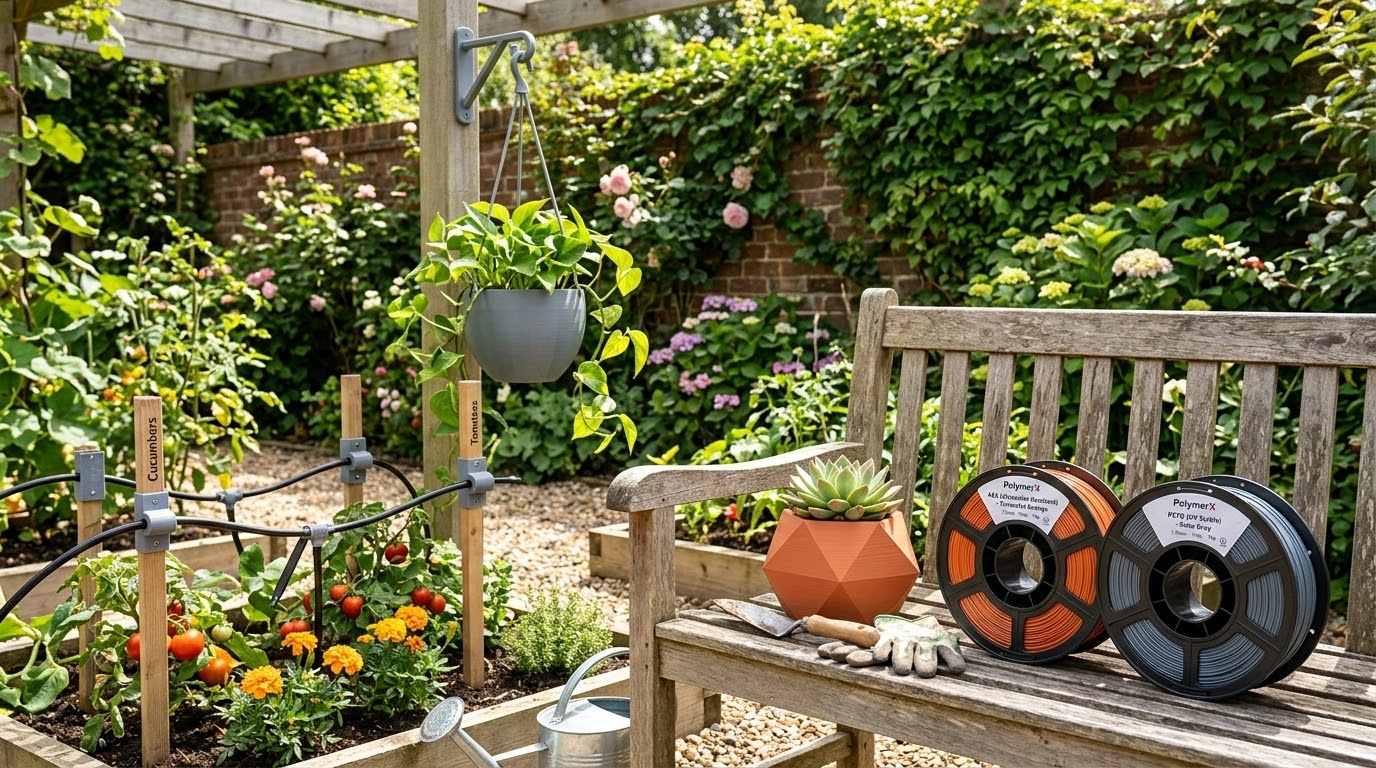
- Garden stakes, plant labels, decorations: PLA is fine — they’re cheap to replace and the biodegradability is actually appropriate.
- Cable clips, wire management outdoors: PETG offers a good balance of ease of printing and outdoor durability.
- Mounting brackets, security camera housings: ASA is the clear winner. Tough, UV-stable, and prints easily with an enclosure.
- Structural parts under load (deck brackets, fence clips): Nylon with carbon fiber filler or polycarbonate for maximum strength and UV resistance.
- Automotive exterior parts: ASA, no question. It’s what the automotive industry uses for the same reason.
The Bottom Line
If you’re printing for outdoor use, stop reaching for PLA. It’s the wrong tool for the job. ASA should be your default outdoor filament — it prints like ABS, costs only slightly more, and handles UV exposure like a champ. For quick-and-dirty outdoor parts where appearance doesn’t matter, PETG with a coat of UV spray paint is a solid budget option.
And regardless of material choice, remember that printing thicker walls and applying UV-resistant coatings will extend the life of any outdoor print. A little extra prep time during printing and finishing pays off in parts that survive seasons instead of weeks.