PETG vs ASA for Outdoor 3D Printing: Which Filament Wins?
The Outdoor Printing Dilemma
You’ve designed a functional part that needs to live outside — maybe a garden hose adapter, a mailbox mount, a security camera bracket, or an enclosure for outdoor electronics. You know PLA won’t survive a summer in the sun. So you’re down to two realistic options: PETG and ASA. Both handle outdoor conditions far better than PLA, but they do it in very different ways.
This comparison will help you pick the right filament for your specific outdoor application, because the answer isn’t always the same.
Material Properties Head-to-Head
UV Resistance
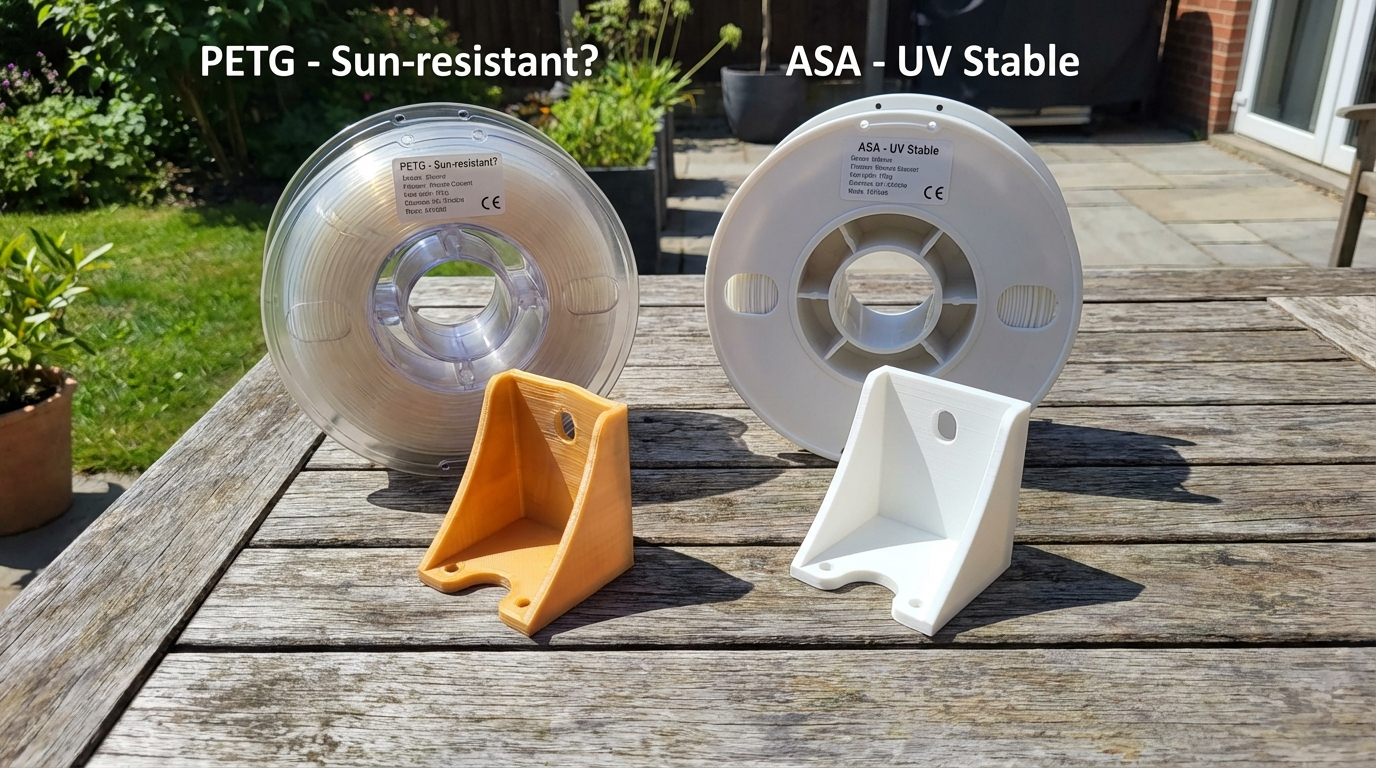
ASA wins decisively here. ASA (Acrylonitrile Styrene Acrylate) was literally designed as a UV-resistant alternative to ABS. The acrylic component in ASA provides excellent protection against ultraviolet degradation. Parts printed in ASA can withstand years of direct sunlight with minimal color fading or material degradation.
PETG has moderate UV resistance — significantly better than PLA, but it will yellow and become brittle over extended sun exposure. In direct sunlight, PETG parts typically start showing degradation after 6-12 months, depending on the color and UV intensity in your region. Adding a UV-resistant clear coat can extend this considerably.
Heat Resistance
Both materials handle heat better than PLA, but there’s a meaningful difference:
- PETG: Glass transition temperature around 80-85°C. It won’t deform in normal outdoor heat, even in hot climates where temperatures reach 40-45°C. However, parts in direct sunlight on a dark surface can reach higher temperatures through radiant heating.
- ASA: Glass transition temperature around 100-105°C. This gives ASA a significant advantage in extreme heat situations. Parts mounted on metal surfaces in direct sunlight, automotive applications, or anything near heat sources benefit from ASA’s higher thermal tolerance.
Moisture Resistance
PETG has the edge here. PETG is highly resistant to moisture absorption — it absorbs roughly 0.2% water by weight, making it one of the most water-resistant common filaments available. This makes it ideal for parts that will be directly exposed to rain, sprinklers, or standing water.
ASA absorbs slightly more moisture at around 0.3-0.5%, though this is still much better than nylon or even ABS. For most outdoor applications, both materials handle moisture perfectly fine, but if your part will be submerged or constantly wet, PETG is the safer choice.
Mechanical Strength
Both PETG and ASA offer good mechanical properties, but with different characteristics:
- PETG: Higher elongation at break (around 20-25%), meaning it bends and flexes before breaking. Better impact resistance at room temperature. Tensile strength around 50-55 MPa.
- ASA: More rigid with lower elongation (around 10-15%). Better at maintaining dimensional stability under stress. Tensile strength around 45-50 MPa. More consistent mechanical properties across temperature ranges.
In practical terms: PETG is more forgiving of impact loads (someone kicking your outdoor bracket), while ASA holds its shape better under sustained mechanical stress (a mount bearing constant weight in heat).
Chemical Resistance
PETG resists a wider range of chemicals than ASA. It handles most common household chemicals, cleaning solutions, and mild acids without issues. ASA is vulnerable to certain solvents — particularly acetone, which actually dissolves it (useful for post-processing, problematic if your part contacts solvents).
For outdoor applications, chemical resistance usually isn’t the deciding factor unless your part will contact specific chemicals like pool chlorine, fertilizers, or automotive fluids.
Printability Comparison
PETG: Easier for Most Users
PETG is significantly easier to print than ASA, making it the better choice if you’re not experienced with high-temperature materials:
- Print temperature: 225-250°C — Most all-metal hotends handle this easily
- Bed temperature: 70-80°C — Standard heated beds work fine
- Enclosure: Not required, though it helps with large parts
- Warping: Minimal — PETG is very forgiving
- Bed adhesion: Excellent on PEI sheets (sometimes too good — use a release agent)
- Odor: Minimal — safe to print in a well-ventilated room
The main printing challenge with PETG is stringing. PETG is inherently stringy, and getting clean retractions takes some tuning. But this is a cosmetic issue, not a structural one.
ASA: Demands More From Your Setup
ASA printing is similar to ABS and requires more controlled conditions:
- Print temperature: 235-260°C — Requires an all-metal hotend
- Bed temperature: 90-110°C — Needs a powerful heated bed
- Enclosure: Strongly recommended — ASA warps badly without stable ambient temperature
- Warping: Significant on large parts without an enclosure
- Bed adhesion: Needs help — ABS slurry, glue stick, or specialized surfaces
- Odor: Noticeable styrene smell — print with ventilation or an enclosure with filtration
If you already have an enclosed printer and experience with ABS, ASA will feel familiar. If you’re coming from PLA-only experience, the learning curve is steeper.
Cost Comparison
PETG is generally 15-25% cheaper than ASA, though prices vary by brand and region:
- PETG: $18-25 per 1kg spool for quality brands
- ASA: $22-32 per 1kg spool for quality brands
Factor in that ASA may require more failed prints due to warping issues (especially while dialing in settings), and the effective cost difference grows. For budget-conscious projects, PETG offers better value in most scenarios.
When to Choose PETG for Outdoor Use
PETG is the better choice when:
- Your part won’t be in direct sunlight for extended periods (shaded areas, under eaves)
- Moisture resistance is the primary concern (rain, water contact)
- You don’t have an enclosed printer
- You want an easier printing experience
- The part needs some flexibility or impact resistance
- Chemical resistance matters
- You’re printing in a shared space (low odor)
Good PETG outdoor applications: irrigation fittings, under-deck cable clips, pond/aquarium components, covered patio furniture parts, protected electronics enclosures, and anything in a shaded or partially covered location.
When to Choose ASA for Outdoor Use
ASA is the better choice when:
- Direct UV exposure is unavoidable (south-facing mounting, no shade)
- Heat resistance is critical (automotive, near heat sources, hot climates)
- Color stability matters over years (signage, visible decorative parts)
- Dimensional stability under temperature cycling is important
- You have an enclosed printer and are comfortable with ABS-like materials
- Post-processing with acetone smoothing would be beneficial
Good ASA outdoor applications: vehicle accessories, solar panel mounts, mailbox numbers and decorations, garden tool handles exposed to full sun, outdoor signage, roof-mounted antenna brackets, and any part that will spend its life in direct sunlight.

The Hybrid Approach
Here’s something many guides don’t mention: you don’t always have to choose one or the other. Consider these strategies:
UV Coating on PETG
If PETG is easier for you to print but your part needs UV resistance, apply a UV-resistant clear coat after printing. Products like Krylon UV-Resistant Clear Coating or automotive-grade UV clear coats add significant UV protection to PETG parts. Reapply every 1-2 years for best results.
Color Choice Matters
Light-colored filaments (white, light gray) degrade more slowly under UV than dark colors. A white PETG part may outlast a black ASA part in direct sunlight simply because it absorbs less solar radiation and stays cooler. If you can choose your color, lighter is always better for outdoor longevity.
Design for Replacement
One advantage of 3D printing is cheap reproduction. If a PETG part degrades after a year in the sun, printing a replacement costs a few dollars and an hour of print time. For non-critical applications, this might be more practical than spending extra time dialing in ASA settings for a single part.
Recommended Brands
Based on my testing of outdoor durability over multiple seasons:
Best PETG for Outdoor Use
- Polymaker PolyLite PETG — Consistent quality, good UV resistance for PETG
- Prusament PETG — Tight tolerances, excellent batch consistency
- eSun PETG — Great value, reliable outdoor performance
Best ASA for Outdoor Use
- Polymaker PolyLite ASA — The gold standard, prints easier than most ASA
- Prusament ASA — Premium quality with excellent UV stability
- FilamentOne ASA Pro — Reduced warping tendency compared to generic ASA
Bottom Line
For most outdoor 3D printing projects, PETG is the practical choice — it’s easier to print, cheaper, handles moisture better, and provides adequate UV resistance for many applications, especially with a protective coating. Choose ASA when UV exposure is constant and unavoidable, heat resistance is critical, or long-term color stability is non-negotiable.
Neither material is objectively “better” — they serve different conditions. The right choice depends on your specific environment, printer capabilities, and how much effort you’re willing to invest in print setup versus post-processing.