Food Safe 3D Printing: Which Filaments Are Safe and How to Seal Your Prints
Can you actually eat off 3D printed plates? Use 3D printed cookie cutters safely? The answer is complicated — and getting it wrong could mean exposing yourself to harmful chemicals or bacteria. In this comprehensive guide, I’ll break down everything you need to know about food safe 3D printing, from choosing the right filament to proper sealing and finishing techniques.
Why Standard 3D Prints Aren’t Food Safe
Before diving into solutions, let’s understand the problems. Standard FDM 3D prints have three major issues when it comes to food contact:
Layer lines trap bacteria. The tiny grooves between layers create microscopic crevices where food particles and bacteria can hide. No amount of washing will fully clean these surfaces. Even prints that look smooth to the naked eye have enough texture to harbor harmful microorganisms.
Most nozzles contain lead. Brass nozzles (the default on nearly every consumer 3D printer) contain small amounts of lead. During printing, trace amounts of lead can transfer to the filament. For occasional cookie cutter use, the exposure is minimal. For items in prolonged food contact, it’s a genuine concern.
Filament additives vary wildly. Even filaments marketed as “food safe” may contain colorants, plasticizers, or other additives that haven’t been tested for food contact. The base polymer might be safe, but the specific formulation matters.
Food Safe Filaments: What Actually Works
PLA (Polylactic Acid)
PLA is derived from corn starch and is generally recognized as safe for food contact in its raw pellet form. However, the 3D printing process adds complications. The filament passes through a brass nozzle, picks up colorants, and creates a porous surface. Natural (uncolored) PLA printed through a stainless steel nozzle is your best starting point for food safe prints.
Pros: FDA-approved base material, easy to print, biodegradable.
Cons: Low heat resistance (deforms above 60°C), not dishwasher safe, still porous without coating.
Best for: Cookie cutters, serving utensils for dry foods, single-use items.
PETG (Polyethylene Terephthalate Glycol)
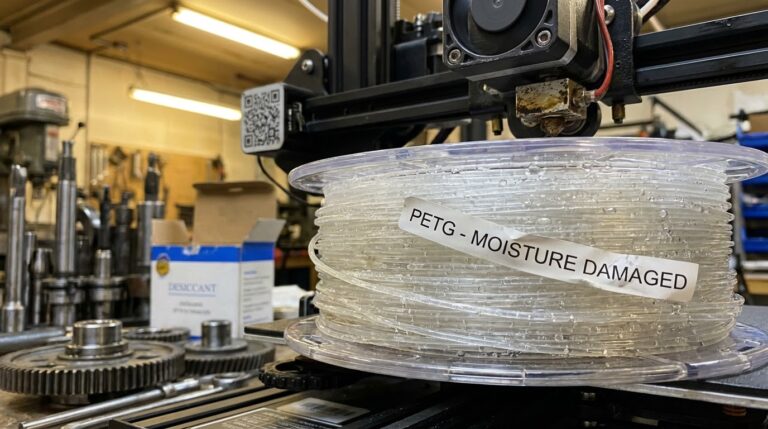
PETG is the 3D printing version of the plastic used in water bottles. Several manufacturers offer specifically FDA-compliant PETG formulations. It handles higher temperatures than PLA and is more chemically resistant.
Pros: FDA-compliant versions available, better heat resistance than PLA, more durable.
Cons: Strings more than PLA, still needs coating for repeated food use, not all PETG is food safe.
Best for: Reusable containers, cups, kitchen tools.
PP (Polypropylene)
Polypropylene is one of the safest plastics for food contact — it’s what most commercial food containers are made from. 3D printable PP filament exists but is notoriously difficult to print. It warps aggressively, doesn’t stick to most bed surfaces, and requires specific settings.
Pros: Excellent chemical resistance, FDA approved, microwave safe, dishwasher safe.
Cons: Extremely difficult to print, severe warping, limited bed adhesion.
Best for: Experienced users who need truly food-safe containers.
Food-Safe Specialty Filaments
Several companies now make filaments specifically designed for food contact:
- Prusament PLA/PETG — Prusa explicitly tests and certifies their natural filaments for food contact under EU regulations.
- FormFutura HDglass — An enhanced PETG designed for food contact applications.
- Extrudr GreenTEC — Bio-based filament with food contact certification.
The Stainless Steel Nozzle Rule
If you’re serious about food safe printing, switch to a stainless steel nozzle. Brass nozzles contain approximately 3.5% lead, which can leach into filament during printing. Stainless steel nozzles eliminate this risk entirely.
The trade-off: stainless steel has lower thermal conductivity than brass, so you may need to print slightly slower or at slightly higher temperatures. Most users find the difference negligible for PLA and PETG.
Hardened steel nozzles are another option, but verify that the specific brand doesn’t use coatings that could be food-unsafe. Standard E3D-style stainless steel nozzles are widely available and affordable.
Making Your Prints Food Safe: Coating Options
Even with food-safe filament and a stainless steel nozzle, the porous layer lines remain a problem. Coating your prints seals the surface and eliminates bacterial traps.
Food-Grade Epoxy
Two-part food-grade epoxy (like ArtResin or Alumilite Amazing Clear Cast) creates a thick, glassy, non-porous coating over your prints. Apply in thin, even coats and let cure fully (usually 72 hours). This is the most reliable sealing method.
Food-Safe Polyurethane
Food-safe polyurethane spray or brush-on creates a durable, clear coating. Look for products certified to FDA 21 CFR 175.300. Apply 3-4 thin coats with light sanding between coats.
Beeswax
For wooden filament prints or PLA items used with dry foods, food-grade beeswax provides a natural, safe coating. It’s not as durable as epoxy but is completely natural and easy to reapply.
Design Considerations for Food Safe Prints
How you design your model matters as much as your material choice:
- Minimize overhangs and complex geometry. Simpler shapes are easier to clean and coat evenly.
- Use thick walls (3-4 perimeters minimum). Thicker walls reduce the chance of water seeping between layers.
- Round all edges and corners. Sharp interior corners trap food and are harder to clean.
- Print with 100% infill. Any trapped air pockets can harbor bacteria and are impossible to clean.
- Orient prints to minimize visible layer lines on food-contact surfaces. Smoother surfaces are safer and easier to seal.
What’s Actually Safe vs. Marketing Hype
Let’s be honest about the levels of food safety in 3D printing:
Genuinely safe: Coated prints from food-grade filament + stainless steel nozzle, used for dry/cold food only, hand washed, inspected regularly for coating damage.
Probably fine: PLA cookie cutters used briefly with dough, PETG utensils used for serving (not cooking), items used once and discarded.
Not recommended: Anything involving hot liquids (above 60°C for PLA), prolonged food storage, acidic foods in uncoated prints, anything used with raw meat, dishwasher use for PLA.
Definitely unsafe: ABS for food contact (contains styrene), prints from unknown filament sources, uncoated prints for wet food storage, prints with visible cracks or coating damage.
Step-by-Step: Making a Food Safe 3D Printed Bowl
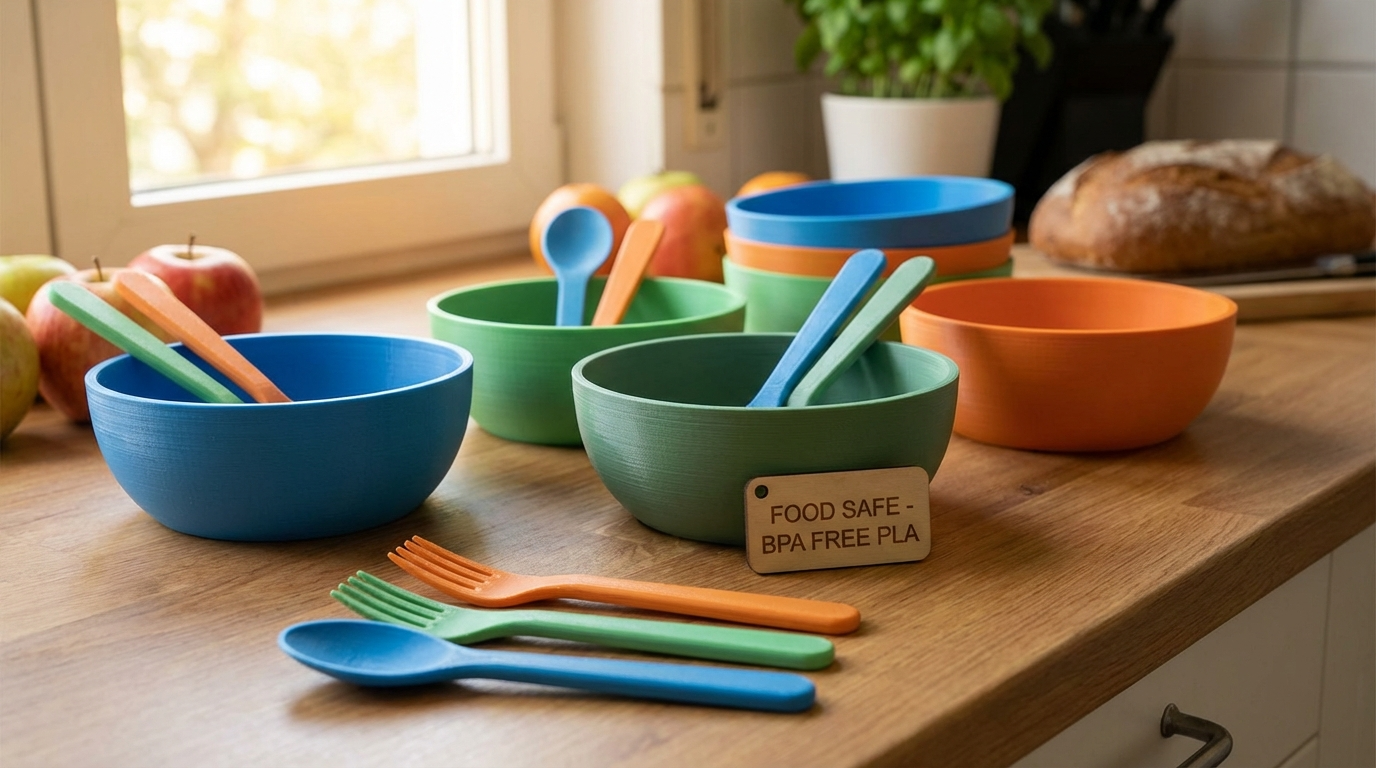
- Design with thick walls (minimum 2.4mm), rounded edges, and simple geometry.
- Print with natural/uncolored PETG on a stainless steel nozzle.
- Use 100% infill, 4 perimeters, and slow outer wall speed for smooth surface.
- Sand the interior with 400, then 800 grit sandpaper.
- Clean thoroughly with isopropyl alcohol.
- Apply 2-3 coats of food-grade epoxy, allowing full cure between coats.
- Final cure for 72 hours before first food contact.
- Hand wash only. Inspect coating before each use.
Final Thoughts
Food safe 3D printing is absolutely possible, but it requires more thought and effort than standard printing. The combination of food-grade filament, stainless steel nozzle, proper design, and food-safe coating covers all the safety bases. For items like cookie cutters or serving utensils with brief food contact, you can get away with less. For reusable containers and bowls, follow the full protocol. When in doubt, use commercial food-safe containers and save your 3D printing for items that don’t need to be eaten off of.