Best 3D Printer for Large Prints in 2026: Top Picks for Every Budget
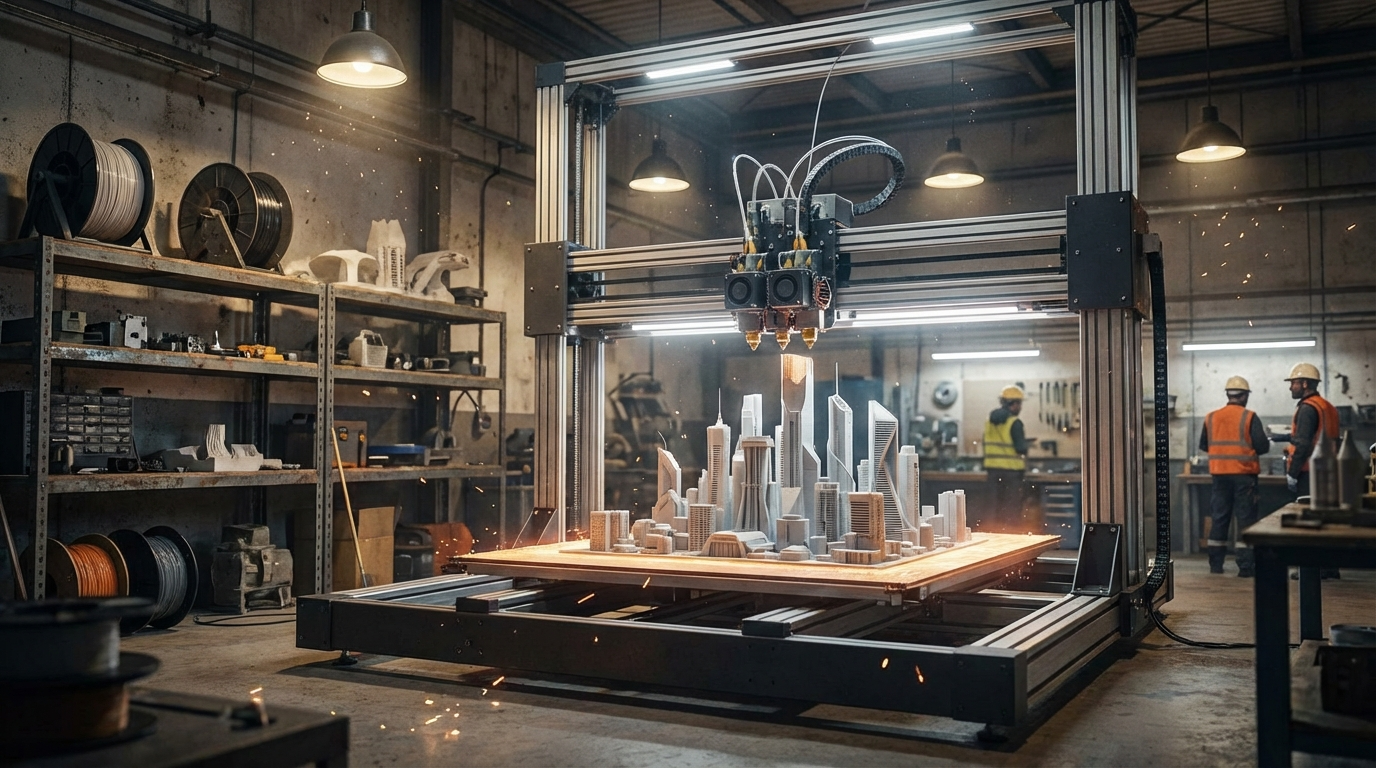
When your projects outgrow a standard 220x220mm build plate, you need a large format 3D printer. Whether you’re printing cosplay armor, architectural models, functional prototypes, or decorative pieces that make a statement, having a bigger build volume changes what’s possible. No more splitting models into pieces and gluing them together — just print the whole thing in one shot.
I’ve tested and researched the best large format 3D printers available in 2026, from budget-friendly machines under $500 to professional workhorses that cost several thousand. Here’s everything you need to know to choose the right one.
What Counts as “Large Format” 3D Printing?
There’s no strict industry definition, but generally a 3D printer is considered “large format” when its build volume exceeds 300x300x300mm in at least two dimensions. Some machines in this guide go well beyond that, with build volumes exceeding 400x400x500mm.
For context, a standard Ender 3 has a 220x220x250mm build volume. A large format printer gives you roughly 2-4x the printable area, which means you can print objects that are genuinely large — full helmets, lamp shades, tool organizers, or structural components.
Key Considerations Before Buying
Build Volume vs. Usable Space
Advertised build volumes can be misleading. Some printers lose usable space to clips, cable chains, or gantry interference at the edges. Always check user reviews for the actual usable build area. A printer advertised as 400x400mm might only give you 380x380mm of reliable printing space.
Frame Rigidity
This is where large format printers separate the good from the great. A bigger printer means longer axes, heavier moving parts, and more potential for vibration and flex. High-quality large format machines use thick aluminum extrusions, dual Z-axis lead screws, and reinforced gantry systems. Cheap large format printers often suffer from frame wobble that causes visible ringing and dimensional inaccuracy.
Heated Bed Uniformity
Heating a 400x400mm bed evenly is significantly harder than heating a 220x220mm one. Temperature variations across the bed cause warping on large prints. Look for printers with AC-heated beds (faster and more uniform) or multiple heating zones. A good large format printer should have no more than 5°C variation across the entire bed surface.
Print Time Expectations
Large prints take a long time. A full-volume print at standard settings can take 40-100+ hours. This means reliability becomes critical — a print failure at hour 60 wastes days of time and significant filament. Power loss recovery, filament runout sensors, and stable firmware are must-have features.
Enclosure
Most large format printers are open-frame, which limits you to PLA and PETG. If you want to print ABS, ASA, or nylon on a large format machine, you’ll need either a factory enclosure or to build/buy one. Enclosing a 400mm+ printer is more complex and expensive than enclosing a standard-size machine.
Best Large Format 3D Printers in 2026
1. Creality K1 Max — Best Overall Value
Build Volume: 300x300x300mm
Price: ~$600-700
Max Speed: 600mm/s
Key Features: Core XY, auto leveling, AI camera, input shaper
The K1 Max is the sweet spot for most users. It’s not the largest printer on this list, but its 300mm cube build volume handles 90% of large print jobs. The Core XY design delivers excellent print quality at high speeds, and the built-in AI monitoring catches failures early. The auto-leveling and input shaping work out of the box, making it surprisingly beginner-friendly for its size.
Best for: Users who want large format capability without sacrificing speed or quality.
2. Artillery Sidewinder X4 Plus — Best Budget Large Format
Build Volume: 300x300x400mm
Price: ~$350-400
Max Speed: 300mm/s
Key Features: Direct drive, auto leveling, WiFi, resume printing
Artillery has been quietly producing excellent large format printers for years. The Sidewinder X4 Plus offers a generous 300x300x400mm build volume at an aggressive price point. The extra Z height (400mm) is valuable for tall prints like vases, sculptures, and vertical components. The direct drive extruder handles flexible filaments well, and the Volcano-style hotend pushes enough plastic for larger nozzles.
Best for: Budget-conscious buyers who need more Z height.
3. Bambu Lab X1E — Best Premium Large-ish Format
Build Volume: 256x256x256mm
Price: ~$1,500
Max Speed: 500mm/s
Key Features: Full enclosure, AMS support, hardened nozzle, chamber heating
The X1E stretches the definition of “large format” with its 256mm cube, but I’m including it because the enclosed, heated chamber and AMS multi-material system make it the best option for printing large engineering parts in ABS, ASA, nylon, and carbon fiber composites. The build quality is exceptional, and the ecosystem of accessories and community support is unmatched.
Best for: Engineering and functional parts that need high-temperature materials.
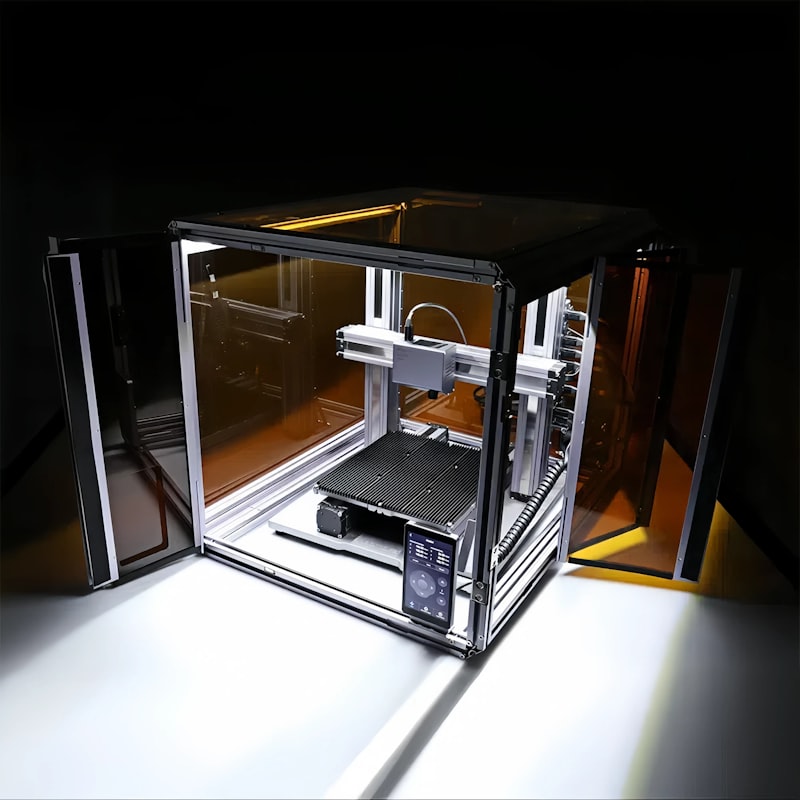
4. Elegoo Neptune 4 Max — Best for Huge Prints on a Budget
Build Volume: 420x420x480mm
Price: ~$450-500
Max Speed: 500mm/s
Key Features: Klipper firmware, auto leveling, dual Z-axis, PEI bed
When you truly need maximum build volume without breaking the bank, the Neptune 4 Max delivers. Its 420x420x480mm build volume is genuinely massive — you can print full-size helmets, large architectural models, and oversized functional parts. The Klipper-based firmware provides input shaping and pressure advance for good quality at speed. The dual Z-axis system keeps the X gantry level across the large build area.
Best for: Users who need maximum print size and don’t mind a larger machine footprint.
5. Voron 2.4 350mm (DIY Kit) — Best for Enthusiasts
Build Volume: 350x350x350mm
Price: ~$800-1,200 (kit)
Max Speed: 500+ mm/s
Key Features: Core XY, fully enclosed, Klipper, community-designed
The Voron 2.4 in its 350mm configuration is the ultimate enthusiast large format printer. You build it yourself from a kit, which means you understand every component and can repair or upgrade anything. The Core XY design with a moving bed (Z only) produces excellent print quality at high speeds. The full enclosure handles ABS and other temperature-sensitive materials perfectly. The active community provides endless modifications and improvements.
Best for: Tinkerers who want a top-tier machine and enjoy the build process.
6. Raise3D Pro3 Plus — Best Professional Option
Build Volume: 300x300x605mm
Price: ~$5,000-6,000
Max Speed: 150mm/s
Key Features: Dual extruder, HEPA filter, enclosed, industrial reliability
For professional and commercial use where reliability trumps everything else, the Raise3D Pro3 Plus is hard to beat. The 605mm Z height is exceptional, the dual extruder system supports soluble supports, and the build quality is industrial-grade. It’s not fast by modern standards, but it’s incredibly reliable — the kind of printer you can start a 72-hour print on and walk away with confidence.
Best for: Professional workshops, makerspaces, and commercial prototyping.
Tips for Successful Large Format Printing
Bed Adhesion Is Critical
Large footprint prints generate enormous warping forces. Use adhesion aids generously — PVA glue stick, hairspray, or specialty adhesion sheets. For ABS, an ABS slurry (ABS scraps dissolved in acetone) brushed onto the bed provides excellent adhesion. Always use a brim or raft for large prints.
Slow Down the First Layer
On a large format printer, the first layer takes more time to complete, and the bed may not be perfectly flat across its entire surface. Slow the first layer to 15-20 mm/s and increase the first layer height to 0.3mm for better squish and adhesion.
Use a Larger Nozzle
Printing a 300mm cube with a 0.4mm nozzle and 0.2mm layers takes forever. Consider upgrading to a 0.6mm or 0.8mm nozzle for large prints. You’ll sacrifice some fine detail but cut print time by 40-60%. For large functional parts, the detail loss is usually invisible.
Monitor Long Prints
Install a camera (USB webcam or IP camera) to monitor prints remotely. Software like OctoPrint with the Obico plugin or Bambu Studio’s built-in monitoring lets you check on 20+ hour prints from your phone. Catching a failure at hour 2 saves a lot more filament than discovering it at hour 30.
Check Your Frame Alignment
Large format printers are more sensitive to frame alignment issues. Before starting important prints, verify that your frame is square (measure diagonals), your gantry is level, and your belts are properly tensioned. A few minutes of maintenance prevents hours of failed prints.
Manage Filament Supply
Large prints consume a lot of filament. A full-volume print can easily use 500g-2kg of material. Make sure you have enough filament loaded before starting a long print, and consider printers with filament runout sensors so the machine pauses when the spool runs out rather than printing air.
Large Format vs. Splitting and Joining
An alternative to buying a large format printer is splitting large models into sections and printing them on a standard-size machine. This approach has some advantages:
- Cost: A standard printer is much cheaper
- Quality: Smaller printers are often more precise due to shorter axes
- Flexibility: You can print different sections in different orientations for optimal strength
However, joining printed sections adds significant post-processing time, introduces weak points at joints, and requires skill with adhesives. For production or repeated prints, a large format machine pays for itself in saved assembly time.
Quick Comparison Table
| Printer | Build Volume | Price | Speed | Enclosed |
|---|---|---|---|---|
| Creality K1 Max | 300x300x300 | ~$650 | 600mm/s | Partial |
| Artillery X4 Plus | 300x300x400 | ~$375 | 300mm/s | No |
| Bambu Lab X1E | 256x256x256 | ~$1,500 | 500mm/s | Yes |
| Elegoo Neptune 4 Max | 420x420x480 | ~$475 | 500mm/s | No |
| Voron 2.4 350 | 350x350x350 | ~$1,000 | 500mm/s | Yes |
| Raise3D Pro3 Plus | 300x300x605 | ~$5,500 | 150mm/s | Yes |
Final Thoughts
The large format 3D printing market has improved dramatically in recent years. You no longer need to spend thousands of dollars for a reliable big-bed printer — machines like the Elegoo Neptune 4 Max and Artillery Sidewinder X4 Plus prove that massive build volumes are accessible at mainstream prices.
For most users, I recommend the Creality K1 Max as the best balance of size, speed, quality, and reliability. If you need truly huge prints and are comfortable with some tinkering, the Elegoo Neptune 4 Max offers unbeatable build volume per dollar. And if money is no object and reliability is paramount, the Raise3D Pro3 Plus is the industrial choice that just works.
Whatever you choose, remember that large format printing requires patience. These are big machines making big things, and that takes time. Plan your prints, monitor them remotely, and enjoy the satisfaction of pulling a massive, single-piece print off the build plate.