Best Budget Resin 3D Printers Under $300 in 2026: Top 5 Picks Compared
Resin 3D printing has come a long way from the days of $500+ machines and toxic-smelling workshops. In 2026, you can get a resin printer that produces jaw-dropping detail for less than the cost of a nice dinner for two. But with dozens of budget options flooding the market, picking the right one is harder than ever.
I’ve tested, researched, and compared the best budget resin 3D printers available right now — all under $300. Whether you’re printing miniatures for tabletop gaming, jewelry prototypes, or dental models, this guide will help you find the right machine without overspending.
Why Choose Resin Over FDM?
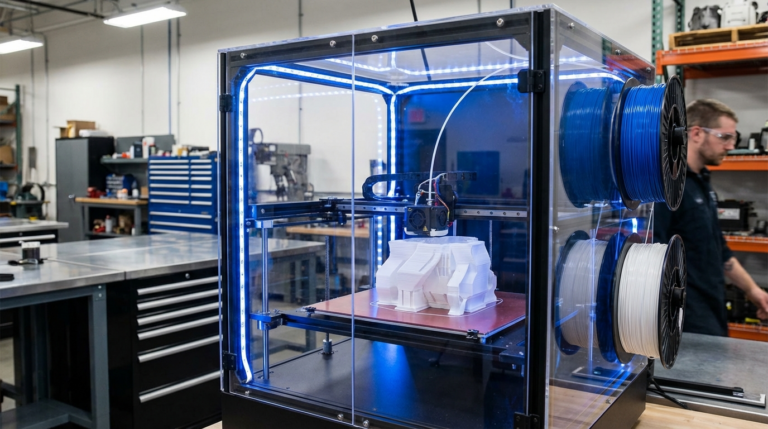
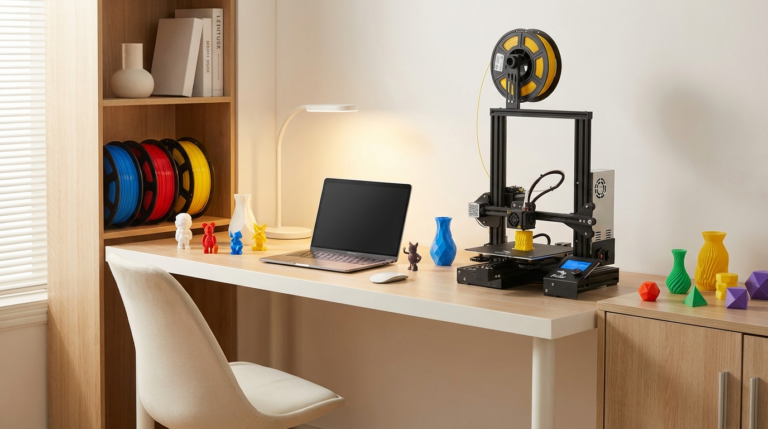
Before we dive into specific printers, let’s address the fundamental question: why resin at all? FDM (filament-based) printers are cheaper to run and less messy, but resin printers win decisively in one area — detail. A typical FDM printer resolves features down to about 0.1–0.2mm. A resin printer? 0.01–0.05mm. That’s an order of magnitude finer.
For miniatures, jewelry, dental models, and anything where surface quality matters more than size, resin is the clear choice. Modern budget resin printers have also largely solved the usability problems that plagued earlier models — faster printing, easier leveling, and better build plate adhesion.
What to Look for in a Budget Resin Printer
Screen Resolution and Type
The LCD screen is the heart of any MSLA resin printer. It masks UV light to cure each layer, and its resolution directly determines print detail. In 2026, you should accept nothing less than a 7K or 8K mono screen in the budget segment. Higher resolution means finer XY detail — an 8K screen on a 10-inch build plate gives you roughly 28µm pixel size, which is exceptional.
Mono vs RGB: All modern resin printers use monochrome (mono) LCD screens. If you somehow find one with an RGB screen, skip it — mono screens are 3–5x faster per layer and last significantly longer (2000+ hours vs 500 hours).
Build Volume
Bigger isn’t always better with resin. Larger build volumes mean longer print times (more area to expose per layer) and more resin consumed on failed prints. For miniatures and small parts, a 6–7 inch diagonal build plate is plenty. If you need to print larger pieces like helmets or figurines, look for 8–10 inch models.
UV Light Source
The shift from single-array LED to COB (Chip-on-Board) light sources has been one of the biggest improvements in budget resin printers. COB provides more uniform light distribution across the build plate, which means more consistent curing and fewer edge artifacts. Many 2026 budget models now include Fresnel lens collimation for even better uniformity.
Z-Axis and Leveling
A dual linear rail Z-axis is the gold standard for stability and precision. Ball-screw Z-axes are the minimum acceptable — avoid printers with plain lead screws, as they introduce wobble. For leveling, look for printers with tilt-and-lock or auto-leveling systems that simplify the setup process.
Best Budget Resin 3D Printers Under $300 in 2026
1. Elegoo Saturn 4 Ultra — Best Overall ($249)
The Saturn 4 Ultra represents everything right about budget resin printing in 2026. It features a 10-inch 12K mono screen with 19µm XY resolution, dual linear rails on the Z-axis, and a tilting release mechanism that dramatically reduces peel forces. Print speed tops out at 150mm/h — fast enough for most hobbyists.
Pros: Excellent detail, large build volume (218 × 123 × 250mm), Wi-Fi connectivity, built-in air filtration, sturdy construction.
Cons: Large footprint, resin vat is proprietary design, firmware updates can be slow.
Best for: Miniature painters, prop makers, and anyone who wants a large-format resin printer without the premium price.
2. Anycubic Photon Mono M7 — Best for Miniatures ($179)
Anycubic has consistently delivered strong budget options, and the Mono M7 continues that tradition. With a 7.04-inch 14K screen delivering a microscopic 18µm XY resolution, it produces some of the finest details available at any price point. The smaller build volume (165 × 72 × 180mm) is a trade-off, but for miniature printing, you rarely need more.
Pros: Incredible detail, fast printing (170mm/h), affordable, compact size.
Cons: Small build volume, no built-in air filtration, basic leveling system.
Best for: Tabletop gamers, jewelry designers, and detail-obsessed hobbyists.
3. Creality Halot-Mage S 14K — Best Value ($199)
Creality’s entry into the budget 14K market delivers remarkable value. The 10.1-inch screen with 14K resolution provides both size and detail. An integrated activated carbon filter, dual Z-axis rails, and a flip-up lid make it practical for daily use. The included Halot Box slicer is decent, though many users prefer switching to Lychee or Chitubox.
Pros: Large build area, 14K resolution, integrated filtration, competitive price.
Cons: Stock slicer could be better, Wi-Fi can be unreliable, slightly slower than competitors.
Best for: Users who want both size and resolution without choosing between them.
4. Phrozen Sonic Mini 8K S — Best Compact ($159)
The Sonic Mini 8K S proves that great things come in small packages. Its 7.1-inch 8K mono LCD delivers 22µm resolution in a package that fits comfortably on a desk. What sets it apart is Phrozen’s excellent build quality — the aluminum body, precision ball-screw Z-axis, and well-designed resin vat all feel premium despite the budget price.
Pros: Excellent build quality, reliable, affordable, compact, strong community.
Cons: Small build volume, no Wi-Fi, basic feature set.
Best for: First-time resin printers and anyone short on space.
5. QIDI iBoxed — Best Enclosed ($289)
QIDI takes a different approach by focusing on the resin printing experience rather than just specs. The iBoxed comes with a fully sealed enclosure, integrated heating (maintaining 25–35°C for consistent curing), HEPA + activated carbon filtration, and a tilting build plate for easy removal. The 10.1-inch 8K screen isn’t the highest resolution on this list, but the overall user experience is unmatched.
Pros: Fully enclosed, heated, excellent filtration, easy to use, good customer support.
Cons: “Only” 8K resolution, heavier and bulkier, priced at the top of our budget range.
Best for: Users who print in living spaces and want minimal mess and odor.
Essential Accessories for Budget Resin Printing
The printer itself is just the beginning. Budget at least another $50–100 for essentials:
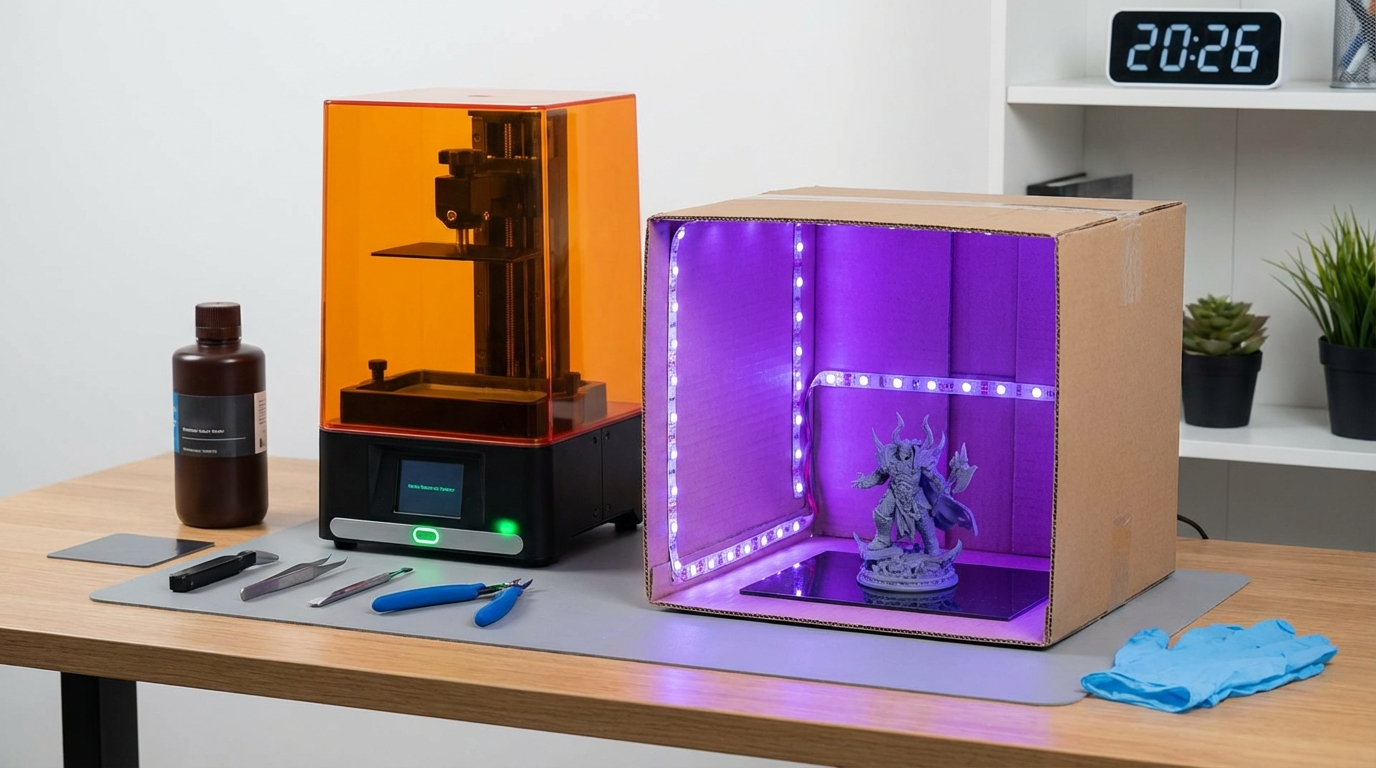
- Wash and cure station — Elegoo Mercury Plus or Anycubic Wash & Cure. These aren’t optional — proper washing and curing is critical for print quality and safety.
- Nitrile gloves — uncured resin is a skin sensitizer. Always wear gloves when handling resin or prints.
- Respirator — if you don’t have a printer with built-in filtration, a P100 respirator is essential.
- IPA or water-washable resin — standard resins require 90%+ isopropyl alcohol for washing. Water-washable resins simplify cleanup but have slightly different mechanical properties.
- FEP film replacements — the flexible film at the bottom of the resin vat wears out every 20–40 prints. Keep spares on hand.
Resin Safety: Don’t Skip This Section
Resin printing requires more safety precautions than FDM. Uncured photopolymer resin is toxic — it can cause skin sensitization (allergic reactions that worsen over time), eye irritation, and respiratory issues. Here’s the non-negotiable safety list:
- Always wear nitrile gloves (not latex — resin penetrates latex)
- Work in a ventilated area or use a printer with carbon filtration
- Never pour uncured resin down the drain — cure it with UV light first, then dispose of the solid
- Keep resin away from children and pets
- Clean spills immediately with IPA
Budget Resin Printer Comparison Table
Here’s a quick comparison of all five recommendations:
- Elegoo Saturn 4 Ultra — $249, 12K, 10″ screen, 150mm/h, best overall
- Anycubic Photon Mono M7 — $179, 14K, 7″ screen, 170mm/h, best for miniatures
- Creality Halot-Mage S 14K — $199, 14K, 10.1″ screen, 130mm/h, best value
- Phrozen Sonic Mini 8K S — $159, 8K, 7.1″ screen, 80mm/h, best compact
- QIDI iBoxed — $289, 8K, 10.1″ screen, 120mm/h, best enclosed
Final Verdict
The budget resin printer market in 2026 is genuinely impressive. Machines that would have cost $500+ two years ago now go for under $200, and the quality ceiling has risen dramatically. For most users, the Elegoo Saturn 4 Ultra offers the best balance of size, speed, detail, and features. If you’re on a tighter budget and primarily print miniatures, the Anycubic Photon Mono M7 punches well above its price.
Whichever you choose, remember that resin printing is a different workflow from FDM. It requires more post-processing, more safety awareness, and more cleanup. But the results — that glassy surface finish and incredible detail — make it absolutely worth it.
New to resin printing entirely? Check out our complete resin vs FDM comparison guide to make sure resin is the right technology for your needs.