Best Filament for 3D Printing Gears and Functional Mechanical Parts
Gears, hinges, cams, and linkages — they’re the bread and butter of functional 3D printing, and they punish bad material choices harder than any decorative print ever will. Pick the wrong filament for your gears and you’ll hear that sickening click-crack sound after a dozen rotations. Pick the right one, and you’ve got a part that laughs at the loads you throw at it.
This guide breaks down every serious filament option for printing gears and mechanical parts, including what actually works under real torque and what’s just marketing hype.
Why Filament Choice Matters More for Gears
A vase or a figurine sits on a shelf and looks pretty. A gear meshes with another gear and transmits force. The difference in material demands is enormous. Gears need:
- Impact resistance — tooth engagement creates repeated shock loads
- Low friction coefficient — meshing surfaces need to slide without binding
- Dimensional accuracy — backlash tolerance on printed gears is already generous; material shrinkage makes it worse
- Fatigue resistance — a gear that survives one rotation needs to survive ten thousand
- Creep resistance — under constant load, some plastics slowly deform over weeks
PLA: The Starting Point (But Not the Finish Line)
PLA is the filament everyone starts with, and for good reason — it prints easily and delivers surprisingly decent dimensional accuracy. For low-load gears that spin slowly and carry minimal torque, PLA can actually work fine.
Where PLA gears work:
- Display models and prototypes
- Hand-cranked mechanisms
- Clock gears (low torque, low speed)
- Proof-of-concept assemblies
Where PLA gears fail:
- Anything motorized above a small servo
- Outdoor applications (heat softening above 55°C)
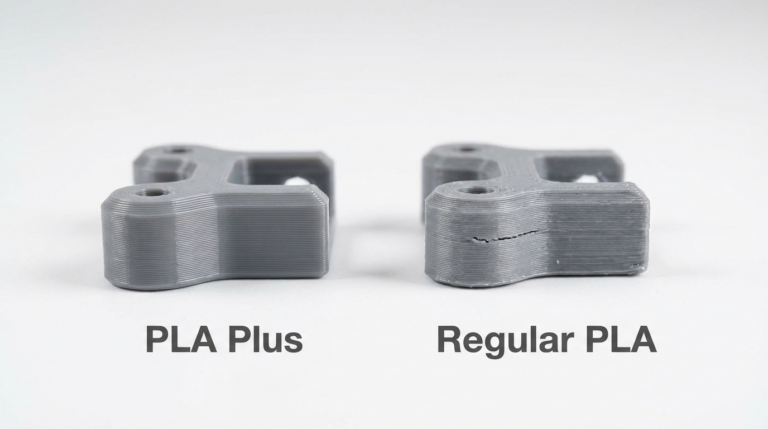
- High-cycle applications — PLA is brittle and cracks under fatigue
- Sustained load — PLA creeps badly over time
If you’re prototyping gear geometry, PLA is perfect. If the gear needs to actually work in service, keep reading.
PETG: The Practical Middle Ground
PETG bridges the gap between PLA’s ease of printing and the toughness needed for real mechanical parts. It’s significantly less brittle than PLA, handles higher temperatures (up to about 75°C before softening), and has naturally lower friction than PLA.
For hobby-level gear applications — robotics projects, custom enclosure mechanisms, camera sliders — PETG is often the sweet spot. It prints without an enclosure, tolerates some moisture exposure, and won’t shatter when a gear tooth catches an unexpected load.
Recommended PETG gear settings:
- Layer height: 0.12–0.16mm for fine tooth profiles
- Walls: 4–6 perimeters for maximum gear strength
- Infill: 60–100% (gears need solid or near-solid cores)
- Print speed: 40–50mm/s for accuracy
- Temperature: 235–245°C nozzle, 75–80°C bed
Nylon (PA6/PA12): The Professional Choice
If you ask any mechanical engineer what plastic they’d pick for a gear, the answer is almost always nylon. There’s a reason injection-molded nylon gears are everywhere — from power tools to automotive timing systems. The same properties translate to 3D printing.
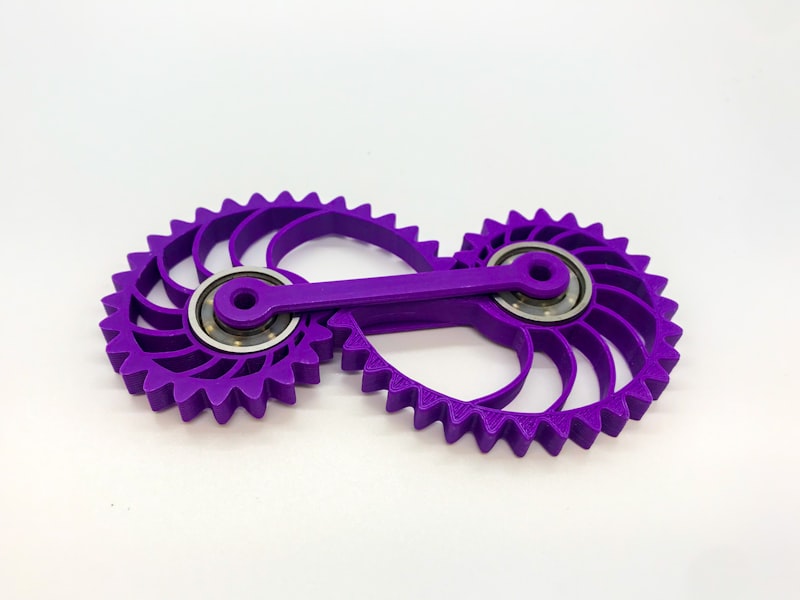
Nylon’s natural lubricity means nylon-on-nylon gear meshes run smoother and quieter than almost any other printed material combination. It absorbs impact loads without cracking, handles sustained loads without excessive creep, and survives temperatures well above what PLA or PETG can manage.
The catch: Nylon is hygroscopic. It absorbs moisture from the air, and wet nylon prints are disasters — bubbling, stringing, weak layer adhesion. You must dry nylon filament before printing and ideally print from a dry box.
Best nylon variants for gears:
- PA6-CF — Carbon fiber reinforced. Stiffer, less warping, better dimensional accuracy. The gold standard for printed gears.
- PA12 — Easier to print than PA6, less moisture sensitive, slightly lower strength but still excellent for gears.
- PA6-GF — Glass fiber reinforced. Good stiffness at a lower cost than carbon fiber variants.
POM (Acetal/Delrin): The Self-Lubricating Champion
POM filament is a relative newcomer to desktop 3D printing, but the material itself has been the go-to for injection-molded gears for decades. Delrin (DuPont’s brand name for POM) has the lowest coefficient of friction of any common engineering plastic, extraordinary fatigue resistance, and excellent dimensional stability.
Printing POM is tricky — it has poor bed adhesion, tends to warp, and requires specific surface treatments. But if you can dial in the settings, POM gears outperform everything else on this list for high-cycle, low-to-medium load applications.
Polycarbonate: When Strength Is Everything
Polycarbonate (PC) is the strongest common FDM filament by a significant margin. If your gears need to handle serious torque — think motorized mechanisms, load-bearing assemblies, or high-speed applications — PC deserves consideration.
The trade-off is printability. PC requires an enclosed printer, bed temperatures of 110–120°C, nozzle temperatures of 270–300°C, and careful attention to warping. It’s not a casual material.
Head-to-Head: Filament Comparison for Gears
Here’s how the major filament options stack up for gear-specific properties:
PLA: Tensile strength 50–60 MPa, heat deflection 55°C, friction coefficient 0.35–0.45, fatigue resistance poor, printability excellent.
PETG: Tensile strength 45–55 MPa, heat deflection 75°C, friction coefficient 0.30–0.40, fatigue resistance moderate, printability good.
Nylon PA12: Tensile strength 45–55 MPa, heat deflection 100°C, friction coefficient 0.20–0.30, fatigue resistance excellent, printability moderate.
Nylon PA6-CF: Tensile strength 70–90 MPa, heat deflection 140°C, friction coefficient 0.15–0.25, fatigue resistance excellent, printability moderate (needs hardened nozzle).
POM: Tensile strength 55–65 MPa, heat deflection 110°C, friction coefficient 0.10–0.20, fatigue resistance outstanding, printability difficult.
PC: Tensile strength 60–70 MPa, heat deflection 130°C, friction coefficient 0.35–0.45, fatigue resistance good, printability difficult (needs enclosure).
Print Settings That Make or Break Gear Performance
Material selection is only half the battle. These print settings are critical for functional gears regardless of which filament you choose:
Layer Height
Use 0.12mm or 0.16mm layers for gears. Thinner layers create smoother tooth surfaces, which reduces friction and wear. A 0.20mm layer height might be fine for prototyping, but for functional gears, go finer.
Wall Count
Gear teeth are essentially thin walls. Most slicer infill patterns won’t adequately fill a gear tooth — the perimeters (walls) are what provide the strength. Use 4–6 walls minimum. For small module gears, the teeth might be entirely walls with no infill, which is exactly what you want.
Infill
For the gear body (hub and web), 50–100% infill is appropriate depending on load. For anything under significant torque, just go 100%. The weight penalty is negligible on small parts, and the strength gain is substantial.
Print Orientation
Always print gears flat — with the gear face parallel to the build plate. Printing a gear on its side means every tooth has layer lines running perpendicular to the load, which is the weakest possible orientation. Flat printing puts the layer adhesion plane parallel to the tooth shear loads, which is vastly stronger.
Post-Processing Tips for Printed Gears
Even well-printed gears benefit from a little cleanup:
- Remove elephant foot — Sand or file the bottom edge to prevent binding on the first layer bulge
- Ream the bore — Print the center hole 0.1–0.2mm undersize and ream or drill to final dimension for a precision fit
- Lubricate — A light application of PTFE dry lubricant or white lithium grease dramatically reduces wear and noise
- Run-in period — New printed gears benefit from running under no load for a few minutes to burnish the tooth surfaces
The Bottom Line
For most hobbyists building robots, custom mechanisms, or replacement parts, PETG gets the job done. It’s accessible, forgiving to print, and tough enough for medium-duty gear applications.
If you’re building something that needs to last — a production tool, a high-cycle mechanism, or anything with real torque — nylon PA6-CF is the answer. Yes, it’s harder to print and requires a hardened nozzle. Yes, you need to keep it dry. But the performance gap between nylon CF gears and everything else is massive.
And for the dedicated few willing to fight the printability challenges, POM is the ultimate gear material — just be prepared to earn those results.