Bowden vs Direct Drive Extruder: Which Is Better for Your 3D Printer?
Choosing between a Bowden tube and direct drive extruder is one of the most impactful decisions you’ll make when setting up or upgrading your 3D printer. Each design has distinct advantages and trade-offs that affect print quality, speed, material compatibility, and maintenance. Let’s break down exactly what makes these two extruder types different and help you decide which one belongs on your machine.
How Extruders Work: The Basics
Before diving into the comparison, let’s clarify what we’re actually comparing. Every FDM 3D printer needs an extruder — the mechanism that grips filament and pushes it through a heated nozzle. The extruder consists of two main parts: the cold end (motor and gear assembly that grips the filament) and the hot end (heater block and nozzle that melts it).
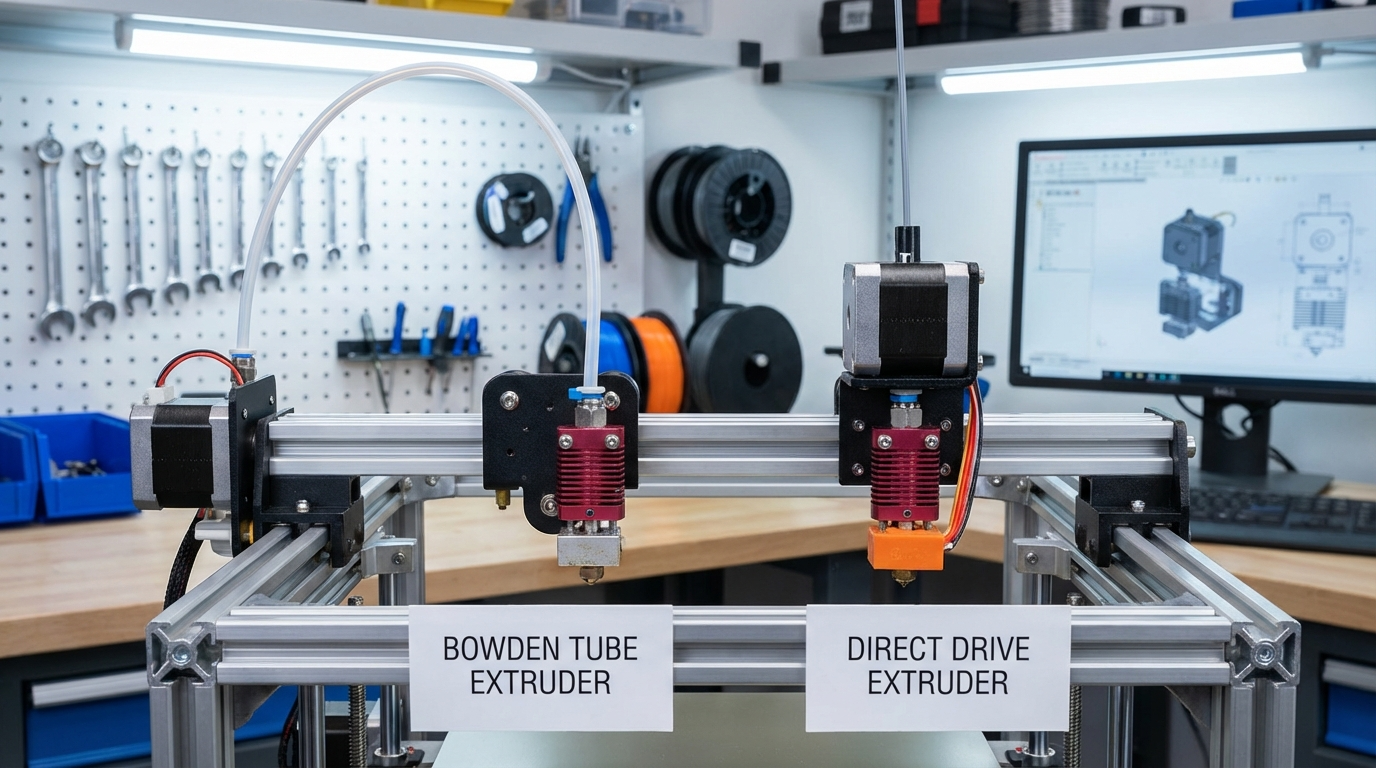
The difference between Bowden and direct drive comes down to where the cold end sits relative to the hot end. That’s it. But this seemingly simple positioning choice has enormous downstream effects on everything from print quality to which materials you can use.

Bowden Tube Extruders Explained
In a Bowden setup, the extruder motor sits on the printer’s frame — separate from the print head. Filament travels from the motor through a PTFE (Teflon) tube, often 30-60 cm long, before reaching the hot end mounted on the moving carriage.
This design was popularized by printers like the Creality Ender 3 series and remains extremely common in budget and mid-range FDM machines. The name comes from the Bowden cable mechanism used in bicycle brakes, which operates on a similar principle of transmitting force through a flexible tube.
Advantages of Bowden
- Lighter print head. With the heavy stepper motor mounted on the frame, the carriage carrying just the hot end weighs significantly less. Less mass means less inertia, which allows faster acceleration and deceleration without ringing or ghosting artifacts.
- Higher print speeds. The reduced moving mass directly translates to faster, cleaner prints at high speeds. This is why many speed-focused printers use Bowden setups.
- Simpler wiring. Fewer wires need to route to the moving print head, reducing cable management complexity and potential failure points from cable fatigue.
- Lower cost. Bowden setups use fewer components on the carriage, keeping manufacturing costs down — a key reason they dominate the budget printer market.
Disadvantages of Bowden
- Retraction challenges. The long PTFE tube between motor and nozzle creates a significant amount of \”play\” in the filament path. This means retractions need to be longer (4-7mm typical) and slower to effectively prevent stringing and oozing.
- Flexible filament struggles. Soft materials like TPU can buckle, compress, or jam inside the Bowden tube. While not impossible to print, flexible filaments require extremely slow speeds and careful tuning with Bowden setups.
- PTFE tube maintenance. The Bowden tube wears over time, especially near the hot end where heat can degrade the PTFE. Regular tube replacement (every 3-6 months with heavy use) is necessary to maintain print quality.
- Less responsive extrusion. The compliance in the long filament path means the extruder responds slower to commands. Fine detail and precise extrusion control suffer compared to direct drive.
Direct Drive Extruders Explained
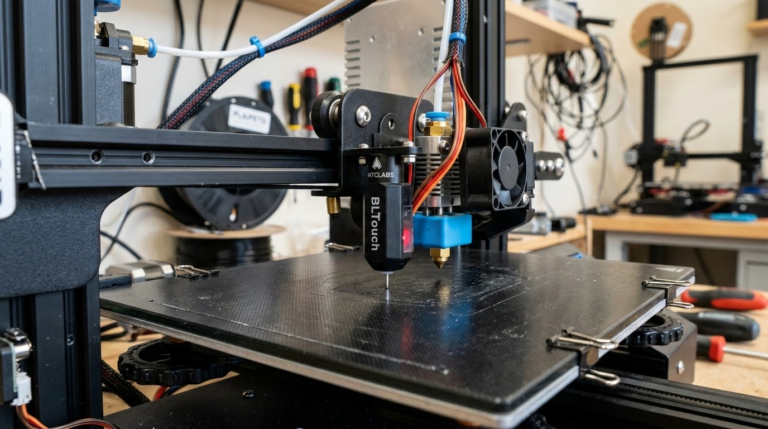
In a direct drive configuration, the extruder motor mounts directly on top of (or very close to) the hot end on the moving carriage. The filament path from motor to nozzle is extremely short — typically just 2-5 cm with minimal or no PTFE tube involved.
Direct drive has become increasingly popular with printers like the Prusa MK4, Bambu Lab X1, and many Voron builds. The design prioritizes extrusion precision and material versatility over raw speed.

Advantages of Direct Drive
- Superior retraction performance. The short filament path means retractions of just 0.5-2mm are sufficient to prevent stringing. Less retraction distance also means less chance of heat-creep clogs.
- Flexible filament compatibility. TPU, TPE, and other flexible materials print reliably because there’s almost no space for the filament to buckle or compress.
- Better extrusion control. The tight coupling between motor and nozzle means more precise volumetric extrusion. This shows up as cleaner details, better layer consistency, and reduced oozing artifacts.
- Wider material range. Beyond flexibles, direct drive handles abrasive filaments (carbon fiber, glow-in-the-dark) and high-temperature materials (nylon, polycarbonate) more reliably.
- Less maintenance. No long PTFE tube to replace. The simplified filament path has fewer failure points.
Disadvantages of Direct Drive
- Heavier print head. The stepper motor adds 200-400 grams to the moving carriage, increasing inertia and potentially causing ringing at high speeds.
- Speed limitations. To avoid quality issues from the heavier head, you may need to print slower or invest in input shaping (Klipper) to compensate.
- More complex carriage. Additional wiring and mounting hardware on the moving head increases complexity and potential cable wear.
Head-to-Head: Key Comparison Points
Let’s compare the two designs across the factors that matter most to everyday printing:
Print quality at moderate speeds (40-80mm/s): Direct drive wins slightly due to better extrusion control, but the difference is small for PLA and PETG. Both produce excellent results when properly tuned.
Print quality at high speeds (100-300mm/s): Bowden has the advantage here due to lower moving mass. However, modern direct drive printers with input shaping (like Bambu Lab machines) have largely closed this gap.
Material versatility: Direct drive wins decisively. If you want to print TPU, nylon, or other challenging materials without constant tuning headaches, direct drive is the clear choice.
Maintenance burden: Direct drive requires less routine maintenance. Bowden tubes are a consumable that needs periodic replacement, and the longer filament path creates more potential jam points.
Cost: Bowden is cheaper to manufacture and implement, which is why it dominates the sub-$200 printer market. Direct drive conversions for Bowden printers typically cost $30-80.
Noise: Roughly equivalent, though Bowden setups can produce more noise from the tube rattling during fast retractions.
Converting Bowden to Direct Drive
If you own a Bowden printer and want direct drive benefits, conversion kits are widely available for popular models like the Ender 3 series. The most popular options include:
- Creality Sprite extruder: Drop-in replacement for many Creality printers. Dual-gear design with good TPU compatibility. Around $35-50.
- Micro Swiss NG: Premium all-metal direct drive with excellent thermal performance. About $70-90.
- Orbiter 2.0: Lightweight planetary gear extruder that minimizes the weight penalty of direct drive. Approximately $50-65.
- 3D-printed mounts: Free designs on Printables and Thingiverse let you mount your existing Bowden motor directly on the carriage. Requires some mechanical skill but costs nothing beyond printed parts and hardware.
After converting, you’ll need to update your retraction settings (reduce distance to 0.5-2mm), recalibrate e-steps, and possibly adjust acceleration limits in your firmware to account for the increased head weight.
Which Should You Choose?
The answer depends entirely on what you prioritize:
Choose Bowden if:
- You primarily print PLA and PETG
- Speed is your top priority
- You’re on a tight budget
- You don’t plan to print flexible filaments
- You have a CoreXY printer where head weight matters more
Choose Direct Drive if:
- You want to print TPU and other flexible materials
- You value print quality over raw speed
- You print with a wide variety of materials
- You want lower maintenance
- You’re willing to tune acceleration settings for optimal results
For most hobbyists who are buying their first or second printer in 2026, I’d lean toward direct drive. The technology has matured to the point where the speed penalty is minimal (especially with input shaping), and the material versatility and reduced maintenance make it the better long-term investment. But if you already own a Bowden printer that’s working great for PLA, there’s no urgent need to switch — a conversion makes sense only when you hit a limitation that Bowden can’t solve.
The Bottom Line
Neither design is objectively \”better.\” Bowden tubes are a proven, cost-effective solution that excels at speed. Direct drive offers precision and versatility that Bowden can’t match. The best extruder is the one that matches your printing habits, material preferences, and performance expectations. Understand the trade-offs, pick what fits your workflow, and tune accordingly.