PLA+ vs Regular PLA: What’s the Real Difference?
Walk into any 3D printing forum and you’ll eventually see someone ask: “Is PLA+ actually better than regular PLA, or is it just marketing?” It’s a fair question. The “+”, “Pro”, and “Plus” labels get slapped on filament spools without any industry standard behind them. In this article, I’m breaking down the real differences between PLA+ and standard PLA, backed by practical testing experience and the science behind the formulations.
What Exactly Is PLA+?
Standard PLA (Polylactic Acid) is a bioplastic derived from renewable resources like corn starch or sugarcane. It’s the most popular 3D printing filament because it’s easy to print, doesn’t require a heated bed or enclosure, and produces minimal warping.
PLA+ (also called PLA Pro, PLA Enhanced, or Tough PLA by different manufacturers) is standard PLA modified with additives to improve specific properties. The exact formulation varies by brand — and that’s the tricky part — but most PLA+ filaments include one or more of the following:
- Impact modifiers: Rubber-like particles or other polymers blended in to reduce brittleness
- Plasticizers: Chemicals that increase flexibility and reduce the tendency to crack
- Crystallization agents: Nucleating agents that promote a more uniform crystal structure during cooling
- Other polymer blends: Some manufacturers blend PLA with polyhydroxyalkanoates (PHA) or polycaprolactone (PCL) for added toughness
Head-to-Head: PLA vs PLA+
Print Quality
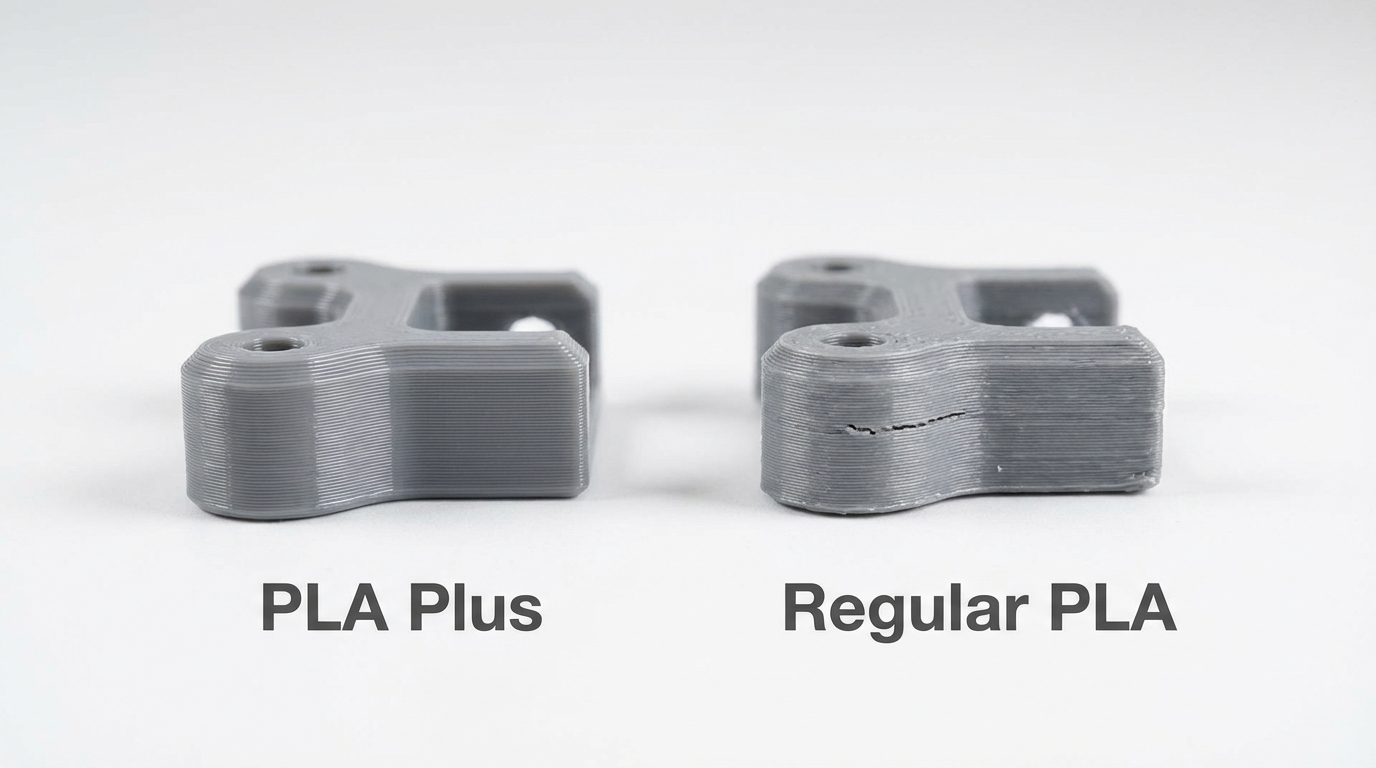
In my experience, standard PLA and PLA+ produce nearly identical print quality when dialed in correctly. Both deliver crisp details, clean overhangs, and smooth surfaces. If anything, some PLA+ formulations print slightly better because the additives improve melt flow consistency, leading to marginally smoother surfaces and fewer minor artifacts.
That said, I’ve also encountered PLA+ spools that produced more stringing than the same brand’s standard PLA. The additives that improve toughness can sometimes make retraction behavior slightly different. It’s a wash overall.
Strength and Toughness
This is where PLA+ is supposed to shine, and in most cases, it does. The key distinction is between strength (resistance to breaking under load) and toughness (ability to absorb energy before fracturing).
Standard PLA is actually quite strong in terms of tensile strength — it handles static loads well. But it’s brittle. Drop a PLA part on a hard floor or subject it to a sudden impact, and it shatters like glass. PLA+ addresses this specific weakness. The impact modifiers give parts more “give” before they break, making them suitable for functional applications where sudden forces are expected.
In practical terms, expect roughly:
- Tensile strength: Similar or slightly lower than standard PLA (the additives can marginally reduce pure tensile strength)
- Impact resistance: 3–10x better than standard PLA (this is the big win)
- Flexural strength: Generally improved — parts bend more before snapping
- Layer adhesion: Often improved, meaning better Z-axis strength
Heat Resistance
Both standard PLA and PLA+ have similar glass transition temperatures, typically around 55–65°C. Neither is suitable for high-temperature applications without post-processing (like annealing). Some PLA+ formulations have a slightly higher Tg due to their additives, but don’t count on PLA+ surviving in a hot car any better than regular PLA.
Ease of Printing
Both are easy to print. Typical settings for each:
- Nozzle temperature: PLA 190–215°C / PLA+ 200–230°C (PLA+ often prefers the higher end)
- Bed temperature: 50–60°C for both (or even unheated for PLA)
- Print speed: 40–70 mm/s for both
- Cooling: Full fan for both (though some PLA+ blends tolerate slightly reduced cooling)
- Retraction: Similar settings, though PLA+ may need slightly longer retraction distance
Cost
PLA+ typically costs 10–30% more than standard PLA from the same manufacturer. Premium brands charge more for the “plus” label, while budget brands like eSUN and SUNLU offer PLA+ at prices barely above their standard PLA. Here’s a rough price comparison (per 1kg spool, as of early 2026):
- Budget PLA: $15–20
- Budget PLA+: $18–24
- Premium PLA: $25–35
- Premium PLA+: $28–40
Brand-by-Brand: How PLA+ Varies
Here’s where things get interesting. Because there’s no standard for what “PLA+” means, different brands deliver wildly different products under the same label.
eSUN PLA+: One of the most popular budget options. Noticeably tougher than eSUN’s standard PLA, with good layer adhesion and a slight matte finish. Prints well at 205–215°C. Excellent value for money and widely considered the benchmark for PLA+.
Overture PLA Pro: Very similar to standard PLA in feel and appearance, with a modest improvement in impact resistance. Some users report it’s more of a “premium PLA” than a true PLA+. Consistent diameter and spool quality.
Hatchbox PLA+: Not always available, but when it is, it’s solid. Better toughness than their standard PLA with no sacrifice in print quality. Slightly higher price point than eSUN.
Polymaker PolyTerra PLA: While not marketed as PLA+, this blend includes a “mineral filler” that gives it properties similar to PLA+, including reduced brittleness and a distinctive matte finish. Also partially bio-based and comes on recycled cardboard spools.
Prusament PLA: Prusa doesn’t make a “PLA+” but their standard PLA has tighter tolerances (±0.02mm) than most PLA+ offerings. Sometimes the base material quality matters more than the “+” label.
When to Choose PLA+ Over Standard PLA
Choose PLA+ when:
- You’re printing functional parts that might experience impacts or drops
- Layer adhesion strength matters (parts under Z-axis stress)
- You want a general-purpose filament that’s slightly more forgiving
- You’re printing clips, snaps, or parts that flex during assembly
- The price difference is small enough that you don’t mind paying extra
Stick with standard PLA when:
- You’re printing decorative items, models, or prototypes
- Maximum detail and sharpest edges matter more than toughness
- You’re on a tight budget and printing large volumes
- You need the widest color selection (standard PLA typically has more options)
- You want predictable post-processing (sanding, painting, gluing)
The Honest Answer: Is PLA+ Worth It?
For most people printing functional parts, yes. The improvement in impact resistance alone makes PLA+ worthwhile for anything that might get dropped, bumped, or stressed during use. The small price premium is well justified for functional applications.
For decorative printing, miniatures, or high-detail work, standard PLA is just fine. You’re not gaining anything meaningful from the “+” additives in those use cases.
And here’s my honest take: the brand matters more than the “+” label. A high-quality standard PLA from Prusament or Polymaker will outperform a cheap PLA+ from an unknown brand. The “+” label doesn’t automatically mean better — it means different. Make sure “different” aligns with what you actually need from the material.
My Recommendation
If you want one spool of PLA+ to try, grab a roll of eSUN PLA+. It’s affordable, widely available, comes in tons of colors, and genuinely delivers on the toughness promise. Print it at 210°C with 60°C bed temperature and standard retraction settings. You’ll feel the difference the first time you try to snap a test piece in half.
From there, experiment with other brands and see which formulation works best for your specific printer and use case. The world of modified PLAs is expanding fast, and there’s a good chance the perfect filament for your projects is already out there — whether it has a “+” in the name or not.