TPU on Drones — Where Flexible Filament Belongs in a Frame and How to Print It
Why TPU shows up everywhere in serious drone builds
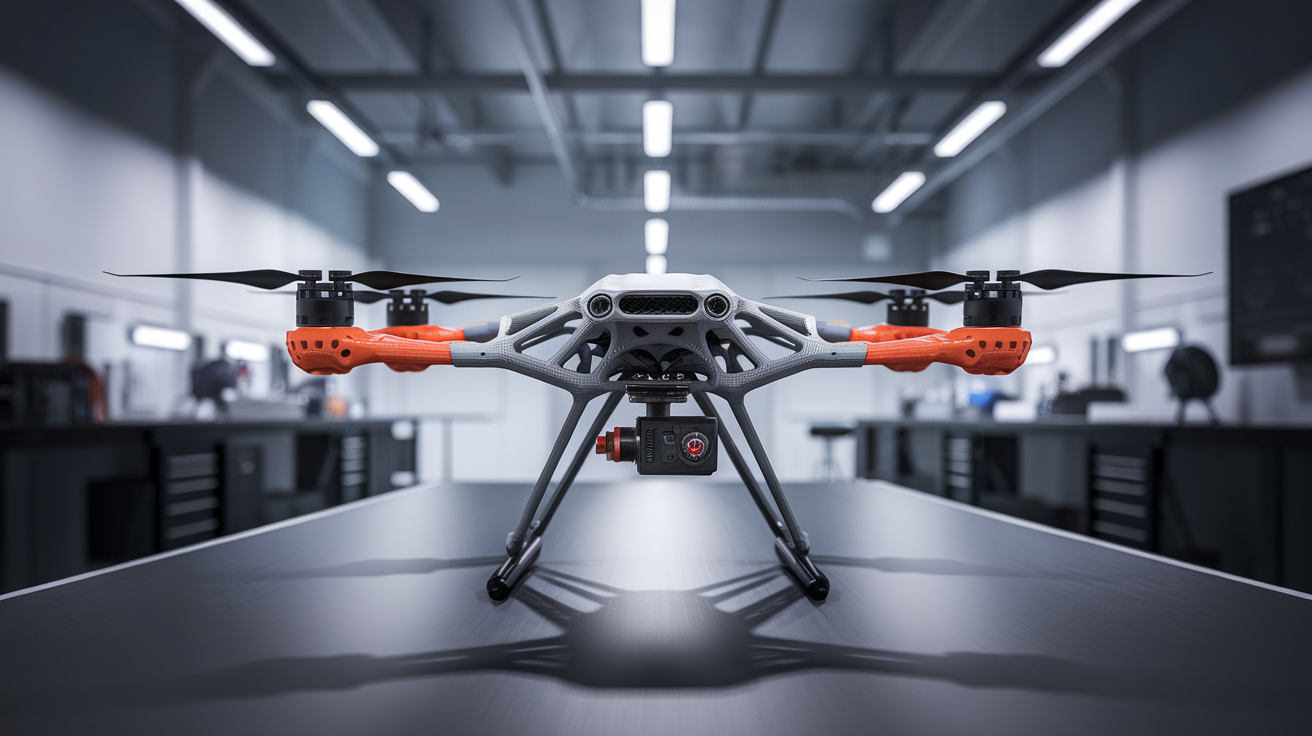
Open the body of any FPV racing drone, freestyle quad, or sub-250-gram cinematic drone built since about 2022, and you will find TPU components in places carbon fiber and aluminum used to live. Antenna mounts, camera mounts, GoPro mounts, motor wire protectors, battery straps, landing gear feet, prop guards, lipo soft mounts — almost every part of a drone that touches the ground, takes a hit, or carries a sensitive component is now printed in TPU. The reason is mechanical, not aesthetic: TPU absorbs vibration and impact in ways that rigid materials cannot, and its failure mode (deform and recover) is dramatically friendlier than carbon fiber’s failure mode (snap into sharp shards).
The shift to TPU was not driven by hobby printers. It was driven by professional drone manufacturers discovering that the long-term reliability of a quad depends less on the stiffness of its frame than on the damping of its sensitive components. A flight controller bolted rigidly to a carbon fiber arm transmits every motor vibration into the gyroscope. A flight controller mounted on a TPU damper isolates those vibrations and produces cleaner gyro data, which the flight controller then turns into smoother PID response and longer motor life. The hobby printer community followed once the test results were public and the design files became free to download.
Where TPU belongs and where it does not
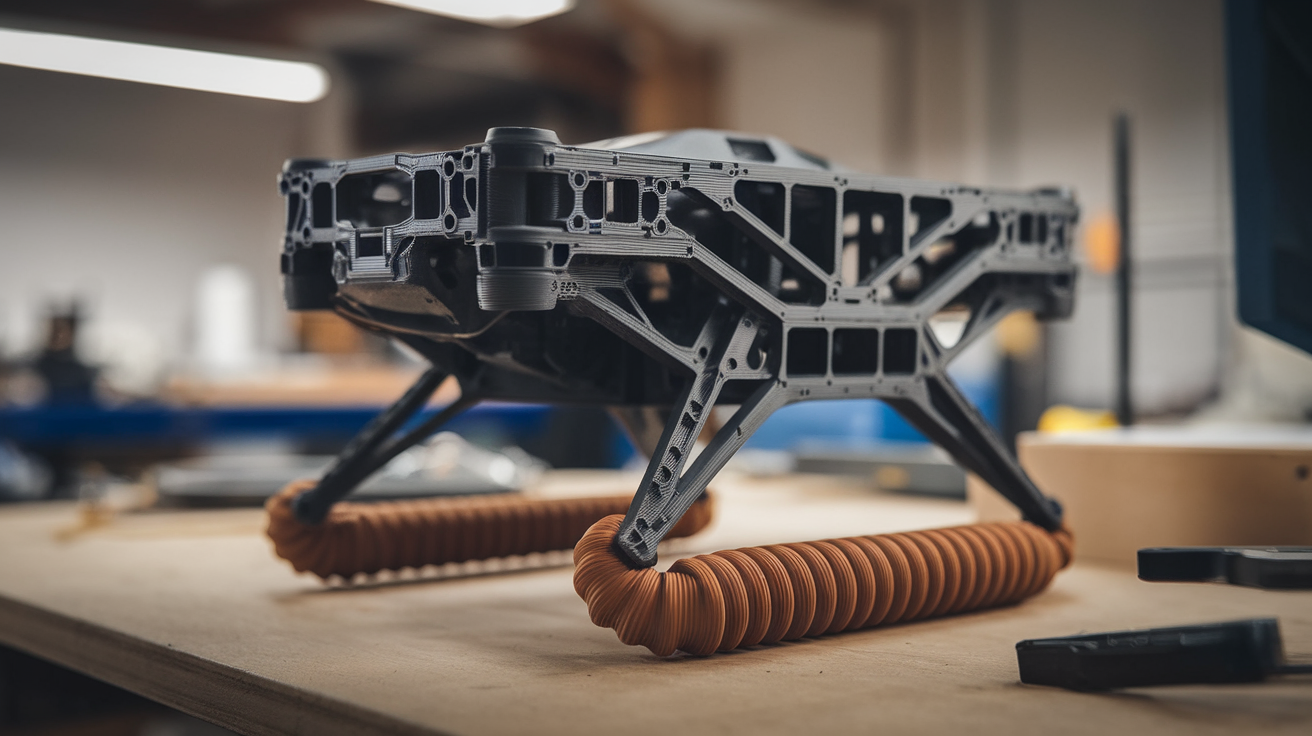
TPU is not a replacement for the rigid frame of a drone. The arms, the top plate, and the bottom plate of any racing or freestyle quad must be carbon fiber or rigid composite — TPU does not have the bending stiffness needed to keep motors aligned or to resist torsional flex from aggressive maneuvers. The places where TPU belongs are the secondary structures: the parts whose job is to mount, protect, or damp other components rather than carry the primary loads of flight.
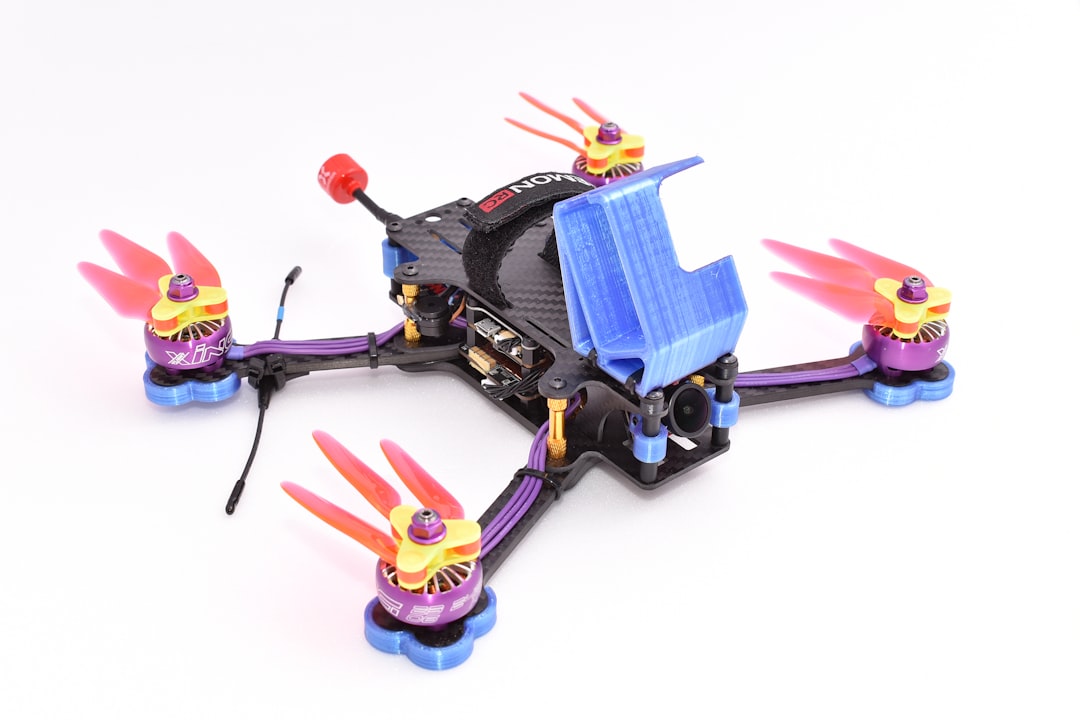
The classic TPU components on a typical 5-inch freestyle quad include: the GoPro or action camera mount (so a crash deforms the mount rather than the camera); the antenna mount and pigtail protector (so a stray prop strike does not shear the antenna off); the camera mount for the FPV camera (which absorbs prop wash vibration that would otherwise blur the video); the battery strap or battery cradle (which holds a lipo without crushing it); soft motor wire protectors (which prevent wire chafing without rigidly clamping the wires); and the landing gear feet, where the impact of a hard landing is absorbed by deformation rather than transmitted into the frame.
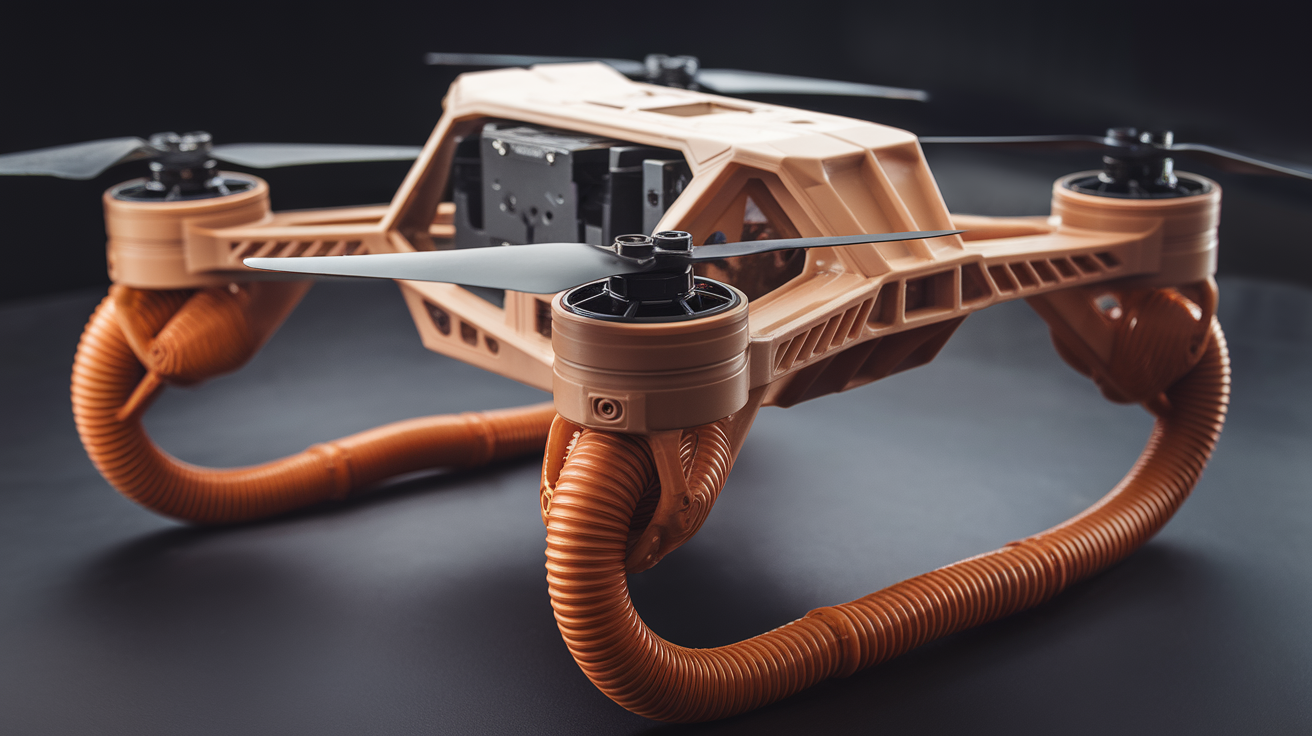
For sub-250-gram cinematic drones (the cinewhoop class), TPU also commonly appears as the duct material itself — the entire ducted prop guard is printed in soft TPU so that a wall strike at speed deforms the duct rather than ricocheting the drone. This is a use case rigid materials simply cannot fill; a hard plastic duct that hits a wall hard either breaks or sends the drone bouncing unpredictably, while a TPU duct absorbs the impact and lets the drone recover in place.
Choosing TPU shore hardness for the application
TPU is not one material. It is a family of polyurethanes that span a wide range of hardness, indicated by Shore A or Shore D values. The hardness range that matters for drone applications is roughly Shore 60A (very soft, like a soft eraser) to Shore 95A (relatively firm, like a hockey puck), with a few specialty materials at Shore 70D (very firm, approaching rigid plastic).
For vibration damping mounts (camera, FC, GPS), the preferred range is Shore 80A to 90A. Softer than 80A and the mount sags under the component’s own weight; harder than 90A and the damping is no better than rigid plastic. Most published drone TPU damper designs are tuned for 85A as a reasonable middle.
For landing gear feet and prop guards, the preferred range is Shore 90A to 95A. The gear has to support the drone’s weight on landing without crushing flat, but still deform on impact. 95A is the most common choice because it survives repeated landings without permanent deformation while still absorbing significant impact energy.
For ducts on cinewhoops, the preferred range is Shore 70A to 80A. The ducts need to be soft enough that a wall strike deforms the duct rather than bouncing the drone, but firm enough to maintain prop clearance during normal flight. The choice of duct hardness has a measurable effect on flight characteristics, with softer ducts producing slightly better impact recovery at the cost of slightly more induced drag.
For battery straps and similar tension members, the preferred range is Shore 85A to 95A. A strap softer than 85A stretches under load and lets the battery shift in flight, which is dangerous. A strap firmer than 95A loses its grip-and-hold behavior and tends to slip off rather than hold.
Print settings that make drone TPU parts actually fly
TPU prints differently from rigid filaments, and drone parts are unforgiving of the most common TPU printing mistakes. The settings that produce reliable drone parts are slow, careful, and biased toward dimensional accuracy at the cost of print time.
Print speed should be in the twenty to thirty-five millimeter per second range for any structural drone part. Faster than that, the TPU’s elastic recovery during deposition produces dimensional variability that matters when the part is bolted to a frame with M2 or M3 hardware. The bolt holes need to land within roughly 0.1mm of nominal, and slow printing is the reliable path there.
Retraction should be minimal — typically 1.0 to 1.5 millimeters at most for direct-drive setups, and zero for bowden setups. TPU’s elasticity means that aggressive retraction does not pull material back the way the slicer expects; instead, it stretches the filament inside the bowden tube and produces blobs and stringing on the next extrusion. Most experienced TPU printers recommend turning retraction off entirely and accepting some stringing that gets cleaned up post-print.
Layer adhesion is critical because drone parts see cyclic loading. A delamination failure under flight loads is a crash. Print temperature should be at the higher end of the recommended range (typically 230 to 245 degrees C for 95A TPU) to ensure full layer fusion. Cooling fan should be reduced or off for the first three to five layers, then ramped to fifty to seventy-five percent for the remainder. A cool TPU print fails in ways a properly heat-soaked TPU print does not.
Infill should be either 100 percent (solid TPU) or use TPU-specific patterns like gyroid or honeycomb at 30 to 50 percent. Sparse linear infill produces parts that are weak in the wrong direction. Solid infill is overkill for most parts but is the right choice for landing gear feet and other high-impact components.
Designing for TPU instead of forcing TPU into a rigid design
The biggest mistake new TPU drone-builders make is taking a rigid-material design and printing it in TPU. The geometry that works for nylon or carbon fiber is not the geometry that works for TPU. TPU parts that perform well are designed around three principles: thicker walls, larger bolt clearances, and continuous geometry that uses TPU’s elasticity rather than fighting it.
Wall thickness in TPU should be at least 1.6 millimeters (four perimeters at 0.4mm) for any structural part, and 2.4mm or more for impact-bearing parts. Thin TPU walls flex too much under load and produce a part that feels squishy rather than supportive. Drone designers use a rule of thumb that any TPU wall should be at least twice the thickness of the equivalent rigid-material wall.
Bolt holes need a clearance of 0.3 to 0.5 millimeters around nominal bolt diameter, much more than rigid materials need. The reason is that TPU compresses around the bolt under tightening, and a too-tight hole produces either a crushed and weakened bolt boss or a bolt that strips out the threads as the TPU cold-flows. Using a metal washer on the head side of every bolt is also good practice because it spreads the clamping load over a larger area of TPU.
The geometry that uses TPU’s elasticity well includes integrated flexure springs (a thinned section that bends in a controlled way), bellows shapes (concertina folds that compress and recover), and honeycomb damping inserts (a pattern of voids that selectively damps vibration in chosen directions). Open-source drone repositories on Printables and Thingiverse contain hundreds of examples; the productive learning path is to download a known-good design, print it, fly it, and study why the geometry works.
The flight test that proves a TPU part is good
A TPU part that prints cleanly and bolts up neatly may still be a bad part. The only test that matters is the flight test, and there are two specific things to look at: gyro noise and crash survival. Both can be measured with the data the flight controller already records.
Gyro noise shows up in the blackbox log as the high-frequency content of the gyro signal during steady flight. A drone with a properly damped FC and camera mount produces a noise floor in the gyro signal that the PID filters can easily handle. A drone with a rigid mount or a poorly tuned TPU mount produces noise that the filters struggle with, manifesting as twitchy flight, motor heat, and reduced battery life. Tools like PIDtoolbox process the blackbox log and show the noise content visually; a good TPU damper reduces the noise visibly compared to rigid mounting.
Crash survival is the other end of the test. After a typical hard crash from a known altitude, examine the TPU parts. Good parts deform on impact and recover within minutes to hours (TPU has visco-elastic recovery, so a deformed part returns to shape over time). Bad parts either tear (insufficient layer adhesion or wrong material), stay deformed (too soft or too thin), or transmit the impact into the frame and break a more expensive component. The right TPU choice and the right design produce parts that take the hit and let the drone fly again on the next charge.
The cost case that closes the argument
TPU drone parts are cheap, fast to print, and easy to iterate. A typical 5-inch quad uses about twenty grams of TPU across all its dampers, mounts, and protectors — perhaps a dollar of material at retail prices. The same set of parts in carbon fiber or aluminum costs ten to thirty times as much, takes longer to source, and is harder to customize. For any pilot who crashes regularly (which is every pilot who is improving), the ability to print a replacement camera mount in fifteen minutes is the difference between a hobby that grows and a hobby that stalls every time something breaks.
The drone hobby has converged on TPU for these parts because the alternative was always more expensive, slower, and more brittle. The hobby printer, with a single spool of 95A TPU and a reasonable slicer profile, equipped to make this work is the same printer that prints the rest of the drone’s accessories. Once the printer is in place and the profile is tuned, replacing a damaged TPU part is faster than ordering it online — and the printed part can be tweaked to match exactly what the build needs.