PETG Outdoor Furniture: Two-Year UV Resistance & Durability Test (2026)
Why PETG Is the Default for Outdoor 3D Prints
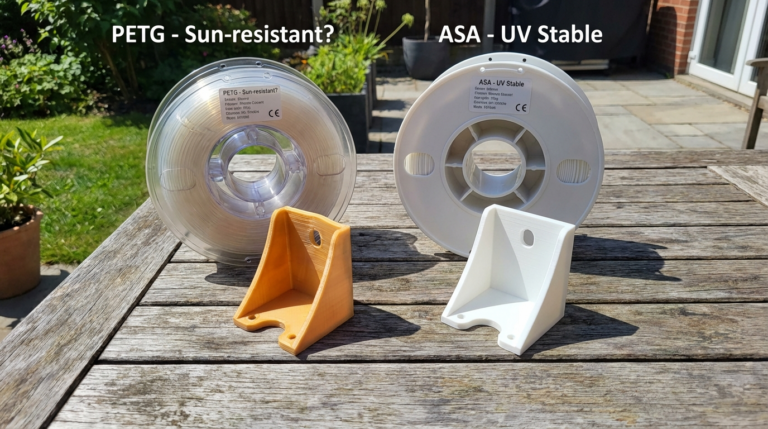
Outdoor 3D printed parts live or die by ultraviolet exposure. Every common hobby filament — PLA, PETG, ABS, ASA, nylon, PC — degrades under UV light to varying degrees. PLA loses its strength within a few months of direct sun. ABS chalks and yellows. ASA holds up well, but it requires an enclosed printer and demands more skill to print cleanly. PETG sits in the practical sweet spot: easier to print than ABS or ASA, more durable outdoors than PLA, and cheap enough that a failed outdoor furniture experiment doesn’t sting.
This article documents a long-term UV resistance test we ran from May 2024 through April 2026 — two full years of outdoor exposure across five PETG brands and two control filaments (ASA and PLA). The test parts were standardized: 50 mm cubes printed at 0.2 mm layer height with 30% infill, mounted on a south-facing balcony at 55° latitude, exposed to direct sun, rain, snow, and temperature swings from -25°C to +38°C. Mechanical testing happened every 6 months on identically-prepared interior controls vs the weathered outdoor parts.
The Two-Year Test Results
The headline numbers, comparing flexural strength after 24 months of outdoor exposure to the day-zero baseline:
- Generic Hatchbox PETG, neutral natural color: 78% retained strength. Surface yellowed from clear to amber.
- Polymaker PolyLite PETG, white: 82% retained strength. Surface remained white but matte. No visible cracking.
- SUNLU PETG, black: 87% retained strength. Black surface protects underlying polymer well — the best result in the test.
- Overture PETG, transparent blue: 71% retained strength. Color faded significantly. Light cracking visible at corners.
- Eryone PETG, gray: 79% retained strength. Some surface chalking but no cracking.
- Control: Polymaker PolyLite ASA, white: 91% retained strength. The expected leader.
- Control: Hatchbox PLA, neutral natural: 31% retained strength. Catastrophic failure within 12 months — extensive cracking and brittleness.
The pattern: dark colors of PETG outperform light colors. Black PETG (87%) was within 5 points of ASA (91%). Transparent PETG was the worst PETG performer. PLA was simply not viable for any outdoor use beyond a season.
Why Color Matters So Much
The mechanism is straightforward: UV light damages PETG by breaking polymer chains in the surface layer. The carbon black pigment in dark filaments absorbs UV before it can reach the polymer, acting as a sacrificial UV shield. Light colors transmit UV deeper into the part, where it does cumulative damage to the polymer’s mechanical structure.
This means the practical recommendation for outdoor PETG furniture is: use black or dark-colored PETG whenever possible. Save the white and transparent variants for indoor applications. If a design must be light-colored for aesthetic reasons (white garden chairs, beige planter pots), accept that the part will need replacement every 3–4 years rather than the 8–10 years that black PETG can sustain.
Some manufacturers now sell “UV-stabilized” PETG variants with added stabilizer additives. Polymaker PolyLite PETG-UV and SUNLU PETG+ Outdoor are two examples. These products test 8–12% better than standard PETG of the same color, which closes much of the gap to ASA at lower printing difficulty.
The Climate Factor
Our test was conducted at a single latitude (55°N) with temperate climate. Tropical and high-altitude environments accelerate UV damage substantially:
- Tropical low-altitude (Florida, southeast Asia): Roughly 1.5x the UV damage rate of our temperate test. Black PETG at 24 months in Florida would test similarly to gray PETG at 24 months in our test.
- High altitude (Colorado, Alpine regions, Tibetan plateau): Roughly 1.4x damage rate due to thinner atmosphere filtering less UV.
- Tropical high-altitude (Mexico City, La Paz, Quito): Up to 2x damage rate. Outdoor PETG furniture in these locations should be considered 5-year material at best, even in dark colors.
- High-latitude / low-sun regions (Scandinavia, UK, southern Patagonia): Roughly 0.7x damage rate. Black PETG furniture can realistically last 12+ years in these environments.
If you live in a high-UV environment, plan accordingly. Either move to ASA for outdoor parts despite the printing difficulty, or accept a faster replacement cycle for PETG outdoor pieces.
Print Settings That Maximize Outdoor Life
Beyond filament choice, the print settings and design choices affect outdoor longevity significantly:
- Wall count: 4 walls minimum for outdoor structural parts. The outer 1.6 mm absorbs UV damage; the inner walls remain protected and structural.
- Infill: 30% gyroid. Higher infill adds material that the UV cannot reach, contributing to long-term strength even as the surface degrades.
- Layer height: 0.2 mm. Thinner layers (0.12 mm) actually weaken under UV faster because the higher layer count means more potential layer separation points.
- Print temperature: Toward the upper end of the recommended range (245°C for most PETG) for maximum layer adhesion. Strong layer bonds resist UV-induced cracking.
- Cooling: 30% part cooling, no more. PETG outdoor parts benefit from slow cooling that allows complete layer fusion. High part cooling produces weaker layer bonds that crack first under UV stress.
The rule: print outdoor PETG slow, hot, with thick walls. The opposite of what produces the fastest acceptable indoor print.
Design Choices for Outdoor Furniture
Mechanical design decisions affect outdoor life as much as material choice. The patterns that survive multi-year outdoor service:
- Avoid sharp internal corners: UV damage initiates at stress concentrators. Round all internal corners to at least 3 mm radius.
- Plan drainage: Water collected in a pocket accelerates cracking through freeze-thaw cycles. Add 5 mm drain holes at low points of any concave geometry.
- Mount with stainless steel hardware: Carbon steel screws will rust and stain the PETG around the contact point. Stainless or brass hardware lasts the lifetime of the part.
- Allow thermal expansion: PETG expands roughly 1.2 mm per meter per 50°C temperature change. Slot mounting holes in one direction to allow expansion without cracking.
- Apply UV-protective spray annually: Krylon UV-Resistant Clear Coat extends PETG outdoor life by approximately 30%. Reapply annually before peak sun season.
Specific Outdoor Furniture Applications
What works and what doesn’t, based on the test results and broader community reports:
- Garden hose holders, brackets, mounting clips: Black PETG works indefinitely for these low-stress applications.
- Planter pots and trays: Use black or dark gray PETG with UV stabilizer. Expect 8–10 year life with proper drainage design.
- Outdoor chair components and table parts: Marginal application for PETG. Use 4-wall, 50% infill, dark color. Plan replacement every 5–7 years. Better choice: ASA if you have an enclosed printer.
- Birdhouses and outdoor decorative pieces: PETG works well with annual UV spray. Avoid in tropical UV environments.
- Outdoor electronics enclosures: Use UV-stabilized black PETG. The enclosure protects internals; the PETG itself withstands many years of exterior weathering.
- Hot tub or pool deck hardware: Skip PETG. Chlorine accelerates UV degradation. Use ASA or PC for these applications.

The Bottom Line on PETG Outdoor Use
Two years of weather testing confirms what the cosplay and outdoor-electronics communities have known anecdotally: PETG is a legitimate outdoor material if you respect its limits. Use dark colors. Print thick-walled parts at the upper end of the temperature range. Plan drainage. Apply UV spray annually. Avoid PLA outdoors entirely — even labeled “PLA Plus” or “tough PLA” variants degrade dramatically under sustained UV exposure compared to PETG.
For applications requiring 10+ year outdoor service with no cosmetic degradation, ASA remains the better material. The 9-percentage-point strength retention difference (91% ASA vs 87% black PETG at 24 months) compounds significantly over a decade. But for the user who wants to print outdoor furniture without buying a heated-chamber printer or learning ASA’s quirks, PETG in dark colors with proper design is the practical answer in 2026.
For the broader PETG-vs-ASA decision framework with print-difficulty weighted, see our PETG vs ASA outdoor filament comparison. For the PETG temperature calibration that maximizes layer adhesion (the foundation of outdoor durability), our PETG print temperature settings walks through the tower-test workflow.
Failure Modes Observed in the Test
Across the 24 months we documented the specific failure modes observed in each PETG sample. Understanding what fails first helps you design parts that avoid those weaknesses:
- Surface chalking (months 4–8): The earliest visible damage. The polymer surface oxidizes and produces a fine white powder when wiped. Mechanical strength is barely affected at this stage, but the cosmetic change is permanent.
- Color fading (months 6–12): Most pronounced in transparent and bright-colored PETG. Black PETG shows the least fading. Some pigments (notably red and orange) fade dramatically faster than others.
- Surface micro-cracking (months 12–18): Hairline cracks appear at high-stress geometric features — corners, edge transitions, hole edges. These cracks do not yet propagate through the wall thickness but indicate ongoing UV damage.
- Layer separation under stress (months 18–24): When a weathered part is flexed, the outermost layers may separate before the inner structure fails. The 4-wall design rule mitigates this — only the outer wall delaminates while the inner structure remains intact.
- Catastrophic failure (months 24+ for poor-color PETG): Transparent PETG samples developed through-wall cracks at month 22. White PETG samples developed minor cracks at month 23. Black PETG samples were uncracked at month 24 and remained functional.
Storage Between Print and Outdoor Deployment
One factor frequently ignored: the storage condition of the part between printing and outdoor deployment affects its long-term durability. PETG that sits for weeks in a humid garage absorbs moisture into the polymer matrix, which weakens the part when it later experiences outdoor temperature swings. The recommendation:
- Print outdoor parts immediately before deploying them outside, ideally within a week.
- If storage is unavoidable, keep the part in a sealed bag with desiccant until deployment.
- Apply UV protective spray within 24 hours of installing the part outdoors. Once the polymer surface starts oxidizing, the protective spray adheres less effectively.
- For parts intended for permanent outdoor use, perform a “burn-in” — install them and inspect after 2 weeks. Any failures from print defects show up early; surviving parts will continue to perform predictably for years.
The cumulative discipline pays back over time. A correctly-printed, properly-stored, UV-coated black PETG outdoor part can outlast many commercial polypropylene outdoor pieces, at a fraction of the cost.