Polycarbonate vs Nylon vs PEEK: Filament Strength & Heated Chamber Comparison (2026)
Three Engineering Filaments, Three Different Worlds
Polycarbonate, nylon, and PEEK occupy the engineering tier of the FDM filament hierarchy — the materials that produce parts strong enough to replace machined plastic and aluminum components in real industrial applications. They share the property of demanding more from a printer than PLA or PETG, but they are not interchangeable. Each one solves a different engineering problem and fails badly when applied outside its strength zone.
This article compares the three across the metrics that matter for engineering use: tensile strength, glass transition temperature, dimensional stability under load, chemical resistance, moisture sensitivity, and the printer requirements (chamber temperature, hot end temperature, drying schedule) needed to actually produce parts. By the end you should know which one to specify for a given functional part — or whether a more accessible filament like PETG-CF would do the job at a fraction of the printer cost.
Polycarbonate (PC): The Toughness Champion
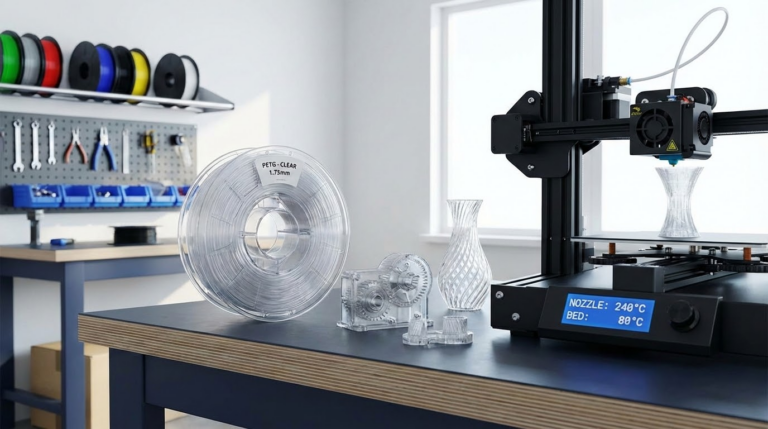
Polycarbonate’s reason for existing is impact resistance. Tensile strength sits around 65 MPa — slightly higher than PETG — but its impact toughness is 8–12x higher than ABS and 25x higher than PLA. Drop a PC part on concrete and it bends; drop a PLA equivalent and it shatters. PC also has a glass transition temperature of 145°C, the highest of any filament practical for hobby printers.
The trade-offs:
- Print temperature: 270–310°C, requiring an all-metal hot end (PTFE-lined hot ends will degrade and contaminate the melt at these temps).
- Bed temperature: 110–120°C with PEI or BuildTak, plus glue stick or hairspray for release.
- Chamber temperature: 60–80°C for warp-free parts. Without a heated chamber, large PC prints curl off the bed by hour two.
- Moisture sensitivity: Severe. PC must be dried at 80°C for 6+ hours before each print and kept in a heated dry box during printing. Wet PC produces brittle, cloudy, weak parts.
Use PC for: drone frames, RC car bodies, machine guards exposed to impact, transparent parts requiring strength (PC is naturally clear), and any structural part that experiences both heat and shock loading.
Nylon (PA6, PA12, PA-CF): The Wear-Resistant Workhorse
Nylon’s reason for existing is friction. Among engineering plastics, nylon is the slipperiest — gears, bearings, sliding wear surfaces, and chain links printed in nylon outlast equivalents in any other filament. Tensile strength varies by grade: PA6 sits at 60 MPa, PA12 at 50 MPa, and chopped-fiber PA-CF jumps to 90 MPa with massively improved stiffness and dimensional stability.
Glass transition temperature is moderate (60–80°C) but practical heat resistance is much higher because nylon’s crystalline structure stays mechanically functional well above its Tg — usable up to 120°C for short durations, 90°C continuous.
The trade-offs:
- Print temperature: 240–270°C. Most all-metal hot ends handle this without a special upgrade.
- Bed temperature: 70–90°C with garolite (G10) bed surface. Standard PEI does not bond to nylon reliably.
- Chamber temperature: 30–50°C beneficial but not strictly required for small parts. Large nylon prints (above 150 mm in any axis) will warp without an enclosure.
- Moisture sensitivity: Extreme. Nylon absorbs water from the air faster than any common filament. A spool left open for 12 hours in a 50% humidity room is already too wet to print cleanly. Drying at 80°C for 8+ hours is mandatory before every print session.
Use nylon for: gears, bushings, wear pads, hinges, snap-fit joints that need to flex repeatedly, and any part that experiences repetitive sliding contact with another surface.
PEEK (Polyether Ether Ketone): The Aerospace Material
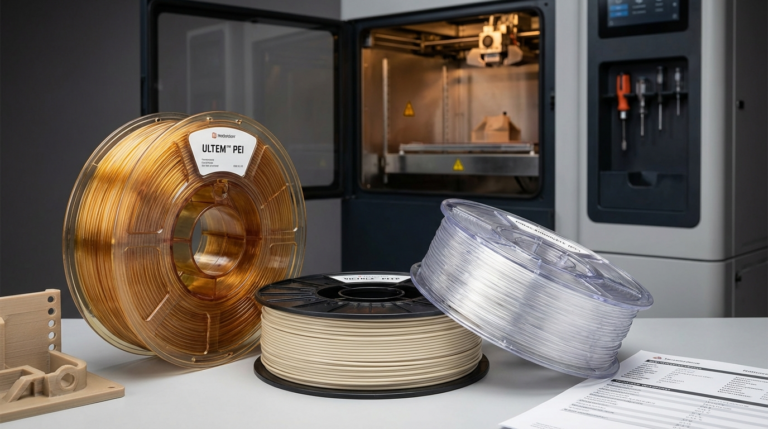
PEEK exists at the top of the engineering plastic pyramid. Its tensile strength reaches 100 MPa, glass transition temperature is 143°C, continuous service temperature is 250°C, and it resists virtually every solvent and acid except concentrated sulfuric acid. PEEK is the material used for medical implants, aerospace brackets, and oil-and-gas seals — applications where failure means catastrophic outcomes and replacement is impossible mid-mission.
The trade-offs are extreme:
- Print temperature: 380–450°C. This requires a specialized high-temperature hot end (E3D Volcano with copper block, Phaetus Dragon HF, or industrial assembly). Standard hot ends physically cannot reach these temperatures.
- Bed temperature: 120–150°C with PEI sheet. Lower bed temperatures cause warping that ruins prints within minutes.
- Chamber temperature: 90–135°C — non-negotiable. PEEK without a heated chamber crystallizes incorrectly and produces weak, brittle parts. The only printers that can handle PEEK reliably are industrial machines (Intamsys Funmat HT, Apium P220, Roboze Argo) costing $20,000+.
- Filament cost: $200–400 per kg, roughly 20x the price of standard PETG.
Use PEEK for: implantable medical devices, aerospace brackets in engine bays, downhole oil and gas tools, and parts that experience continuous service at temperatures above 200°C. For any application below 150°C and outside medical/aerospace, the price-performance ratio favors PC or nylon variants over PEEK.
Heated Chamber Requirements
The single decision that determines whether you can print these three filaments at all is whether your printer has a heated chamber:
- No chamber heating: Forget PC for parts above 100 mm. Nylon works for small parts. PEEK is impossible.
- Passive enclosure (insulated walls, no active heater): PC and nylon work for medium parts (up to 200 mm). PEEK still impossible.
- Actively heated chamber, 60°C capable: PC and nylon work for any size print. PEEK still requires a specialized printer with 90°C+ chamber.
- Industrial high-temp chamber, 120°C+: PEEK becomes viable.
Most hobby-tier printers (Bambu, Prusa, Sovol) are in the passive-enclosure category. The Bambu X1C has a heated bed that warms the chamber to about 35–40°C ambient — sufficient for PC small-to-medium parts and nylon, not sufficient for reliable large PC or any PEEK.
The Direct Comparison Matrix
For a single-glance comparison:
- Cost per kg (2026): PC $35–55, Nylon (PA12) $40–60, PA-CF $80–120, PEEK $200–400.
- Tensile strength: PC 65 MPa, Nylon 60 MPa (PA-CF 90 MPa), PEEK 100 MPa.
- Impact resistance: PC excellent, Nylon good, PEEK fair (stiff but tough).
- Heat resistance: PC 145°C Tg, Nylon 60–80°C Tg (110°C usable), PEEK 143°C Tg / 250°C usable.
- Chemical resistance: PC poor (cracks under most solvents), Nylon good, PEEK exceptional.
- Wear/friction: PC poor (high friction), Nylon excellent, PEEK good.
- Hobby printer compatibility: PC marginal, Nylon good, PEEK requires specialized hardware.
When Each Material Wins
The selection rules that emerge from real engineering use:
- Drone frames and impact-loaded structures: PC. The toughness is uncatchable by nylon, and the hardware demands are within reach of an enclosed Bambu X1C.
- Gears, bearings, sliding wear surfaces: Nylon (PA12 for general use, PA-CF if dimensional stability under load matters).
- Outdoor structural parts in cold climates: PC. Nylon absorbs moisture and weakens; PC handles temperature swings without dimensional drift.
- Parts in continuous chemical exposure: Nylon for solvents, PEEK for acids.
- Aerospace, medical implants, oil and gas: PEEK, no substitute exists.
- Any part below 80°C continuous service that does not need PC’s specific impact resistance: Skip these three entirely. PETG-CF or polycarbonate-blended PETG hits 90% of the use cases at 30% of the cost and 10% of the printing difficulty.
The Practical 2026 Recommendation
For engineering filament work in 2026, the smart progression is: start with PETG and PETG-CF for everything you can. Move to nylon when wear or friction becomes the limit. Move to PC when impact toughness or temperature resistance becomes the limit. Reserve PEEK for the narrow band of applications where no other material works — that is roughly 1% of engineering FDM work, and 99% of the time you are better off in PC or nylon at one-tenth the cost.
If you are buying a new printer specifically to handle these materials, the realistic options in 2026 are: Bambu X1C ($1,200, handles PC and nylon well, marginal for large PC), Prusa XL with HT extruder ($2,500, handles PC and nylon excellently), or Intamsys Funmat HT ($30,000, handles PEEK). Anything at lower price points is going to fight you with these filaments rather than help.
For deeper guidance on the carbon-fiber variants of these materials, see our carbon fiber filament 3D printing guide. For the foundational nylon workflow including the bed surface and drying details, our nylon 3D printing settings tips guide covers the calibration steps that make the difference between a usable nylon print and a brittle one.
Drying Schedules: The Step Most People Skip
All three of these filaments are hygroscopic, but the consequences of skipping the drying step differ:
- PC drying: 80°C for 6 hours minimum. Wet PC produces visibly cloudy parts and audible popping during printing. Strength loss in wet PC parts: roughly 30%.
- Nylon drying: 80°C for 8–12 hours. Nylon absorbs water faster than PC and shows the consequences faster — wet nylon prints feature visible bubbles in walls, severe stringing, and a brittle finished part. Strength loss: 40–60%.
- PEEK drying: 150°C for 4 hours, ideally in a vacuum oven. Industrial PEEK printers integrate drying chambers; hobby attempts at PEEK without proper drying produce parts with mechanical properties closer to PETG than to actual PEEK.
The drying step is where most failed engineering filament prints go wrong. A spool of nylon left in its open box for two weeks in normal humidity is unprintable until properly dried. The investment in a heated dry box (Sunlu S2, eSUN eBOX, or a DIY food-dehydrator-based unit) pays back within a single failed print’s worth of filament cost.
Layer Adhesion vs Annealing
One overlooked aspect of these engineering filaments is post-print annealing. PC, nylon, and PEEK can all be annealed in an oven after printing to crystallize the polymer further and improve interlayer strength. The procedures:
- PC annealing: 130°C for 4 hours in a household oven. Improves heat deflection temperature by 15–20°C and tensile strength by 5–10%.
- Nylon annealing: 90–110°C for 6–8 hours. Reduces hygroscopicity and improves crystallinity. Increases dimensional stability significantly.
- PEEK annealing: 200°C for 4 hours in a controlled atmosphere oven. Without proper annealing, PEEK parts retain only 40–60% of their potential strength. This step is mandatory for industrial PEEK applications.
Annealed parts shrink slightly (1–3% for nylon, less for PC, more for PEEK). Compensate by scaling the print up before slicing, or accept the dimensional change. For functional parts where strength is the constraint, annealing is the difference between a usable engineering part and one that fails the first time it sees real load.