Hardened Steel vs Brass Nozzle: Which 3D Printer Nozzle Material Is Best?
Your 3D printer came with a brass nozzle. It works fine for PLA and PETG. But then you start hearing about hardened steel nozzles, ruby-tipped nozzles, and titanium-coated options — and suddenly a $2 component becomes a purchasing decision that requires research. Is a hardened steel nozzle worth the upgrade? Will it actually improve your prints, or is it a solution looking for a problem?
I’ve run thousands of hours across both brass and hardened steel nozzles on multiple printers. Here’s the honest comparison, including the trade-offs that most guides conveniently skip over.
Brass Nozzles: The Default for a Reason
Brass has been the standard nozzle material since the early days of desktop 3D printing, and it earned that position through genuine merit — not just because it’s cheap.
Why Brass Works So Well
Thermal conductivity: This is brass’s superpower. Brass conducts heat at approximately 109 W/m·K — roughly 4 times better than stainless steel and 5 times better than hardened tool steel. This matters because your nozzle needs to transfer heat from the heater block to the filament quickly and evenly. Better thermal conductivity means more consistent melt, fewer cold spots, and better overall print quality at higher speeds.
Smooth bore: Brass machines beautifully, producing a very smooth internal bore with low friction. Filament slides through with minimal resistance, which means your extruder has to work less hard and you get more consistent extrusion.
Cost: Quality brass nozzles cost $1-3 each. At that price, replacing them is maintenance rather than an investment decision. Most experienced printers keep a dozen on hand and swap them without a second thought.
Material compatibility: Brass works perfectly with PLA, PETG, ABS, ASA, TPU, and most standard filaments. For the vast majority of hobby printing, a brass nozzle handles everything you throw at it.
Where Brass Falls Short
Abrasive filaments destroy brass. This is the big one. Carbon fiber, glass fiber, glow-in-the-dark (which contains strontium aluminate particles), metal-fill, and wood-fill filaments all contain hard particles that wear through brass quickly. A brass nozzle printing carbon fiber PETG might last 10-20 hours before the hole has enlarged noticeably. The nozzle diameter grows from 0.40mm to 0.50mm or more, and suddenly your dimensional accuracy and fine detail capability are gone.
Wear over time even with standard filaments. Even pure PLA slowly wears brass nozzles over hundreds of hours. You might not notice it as dramatically as with abrasives, but after 500+ hours of printing, a brass nozzle will have measurably more wear than when it started.
Hardened Steel Nozzles: The Abrasion-Proof Upgrade
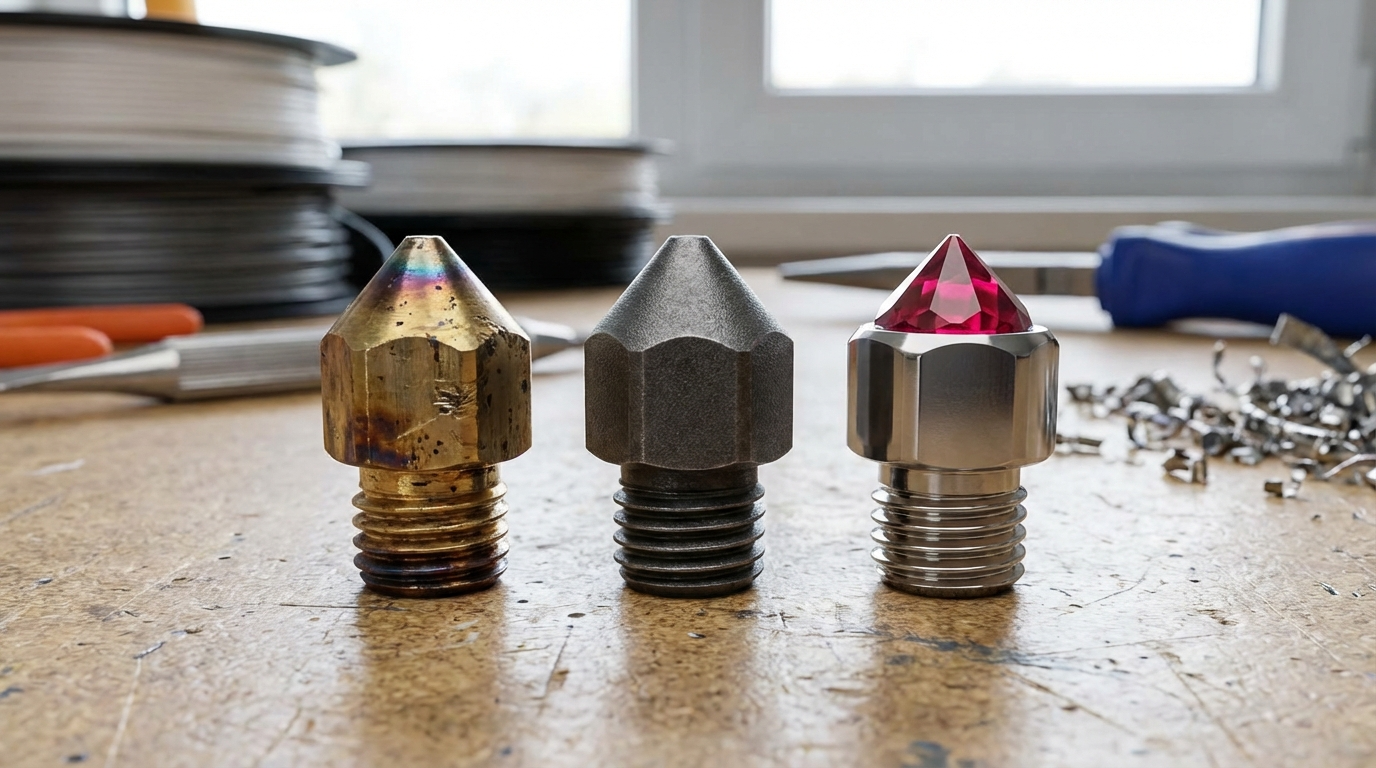
Hardened steel nozzles are made from tool steel (typically A2 or similar alloys) that’s been heat-treated to increase hardness significantly beyond brass. Where brass sits around 100-150 HV on the Vickers hardness scale, hardened steel nozzles reach 400-700 HV. This makes them dramatically more resistant to abrasive wear.
The Advantages
Abrasion resistance: A hardened steel nozzle printing carbon fiber filament might last 500+ hours before showing significant wear. That’s 25-50x longer than brass. If you regularly print any abrasive material, hardened steel pays for itself immediately.
Longevity with all materials: Even with standard PLA, a hardened steel nozzle will maintain its dimensions virtually forever under normal use. You’ll never need to replace it due to wear — only due to clogs or damage.
Print quality consistency: Because the bore doesn’t change over time, your prints stay dimensionally consistent from the first print to the thousandth. This matters for production work where tolerance consistency is important.
The Trade-Offs (What Most Guides Don’t Tell You)
Worse thermal conductivity: Here’s the big one. Hardened steel has roughly 20-25% the thermal conductivity of brass. That means heat transfers from your heater block to the filament significantly slower. In practice, this means:
- You may need to print 5-15°C hotter to achieve the same melt quality
- Maximum reliable print speed may decrease — the filament doesn’t melt as completely at high speeds
- You might see more stringing because the nozzle retains heat longer (thermal inertia)
- Under-extrusion can appear at speeds that worked fine with brass
Rougher internal bore: Steel doesn’t machine as smoothly as brass. The bore has slightly more friction, which creates marginally more resistance against the filament. On most printers, this difference is negligible, but on marginal setups (small motors, long Bowden tubes), it can contribute to extrusion issues.
Cost: Quality hardened steel nozzles run $8-15 each. Not bank-breaking, but enough that you think twice before replacing them. Cheap hardened steel nozzles ($3-5 from no-name brands) often have poor bore quality and inconsistent hardness — spend the extra few dollars for reputable brands like E3D Nozzle X, Slice Engineering Vanadium, or BondTech CHT hardened variants.
Slower heat-up: Steel nozzles take slightly longer to reach target temperature. Not a huge deal, but noticeable during startup.
Head-to-Head Comparison
| Property | Brass | Hardened Steel |
|---|---|---|
| Thermal conductivity | Excellent (109 W/m·K) | Poor (20-25 W/m·K) |
| Abrasion resistance | Low | Very high |
| Typical cost | $1-3 | $8-15 |
| Max print speed (same quality) | Higher | 10-20% lower |
| Bore smoothness | Excellent | Good |
| Lifespan (PLA/PETG) | 200-500 hours | Essentially unlimited |
| Lifespan (CF/GF filaments) | 10-20 hours | 500+ hours |
| Temperature offset needed | None (baseline) | +5-15°C |
| Best for | Standard filaments, speed | Abrasives, production use |
Other Nozzle Materials Worth Knowing About
Nickel-Plated Copper
Copper has even better thermal conductivity than brass (385 W/m·K), and the nickel plating provides moderate abrasion resistance. This is the “best of both worlds” option — excellent heat transfer with decent wear resistance. E3D’s Nozzle X and some Slice Engineering nozzles use copper-alloy bases with hard coatings. Price: $15-25.
Ruby-Tipped Nozzles
These use a brass body with a synthetic ruby insert at the tip where the wear actually happens. The ruby is extremely hard (Mohs 9, second only to diamond) and provides outstanding abrasion resistance while the brass body maintains good thermal performance. Downside: they’re $80-100 each, and if you crash your nozzle into the bed, the ruby can crack. A niche option for serious production use with abrasive materials.
Tungsten Carbide
The newest entry in the nozzle market. Tungsten carbide is harder than hardened steel and has better thermal conductivity. It’s positioned as a premium option that addresses hardened steel’s thermal disadvantages. Price: $20-40. Early reviews are positive, but long-term data is limited.
My Recommendation: The Practical Approach
After years of testing different nozzle materials, here’s what I actually do:
- Keep a stock of brass nozzles ($1-2 each) for everyday PLA, PETG, and ABS printing. They’re cheap enough to replace regularly, and their superior thermal performance gives you the best print quality and speed.
- Keep one or two hardened steel nozzles for any time you’re printing carbon fiber, glass fiber, glow-in-the-dark, or metal-fill filaments. Swap to steel before loading abrasive material, swap back to brass when you’re done.
- Don’t overthink it. If you’ve never printed abrasive filaments and don’t plan to, a brass nozzle is all you need. Period. The thermal performance advantage of brass is real and measurable.
The exception is if you’re doing production work where nozzle changes mean downtime. In that case, a high-quality coated copper nozzle (like the E3D Nozzle X or ObXidian) gives you the thermal performance of copper with the wear resistance of hardened steel. It’s the premium option, but for production, the consistency and longevity justify the cost.
Nozzle Maintenance Tips (Both Types)
Regardless of material, these habits extend nozzle life and maintain print quality:
- Do cold pulls regularly. Every spool change or whenever you notice print quality declining.
- Tighten while hot. Always tighten the nozzle when the hotend is at printing temperature. Thermal expansion means a nozzle tightened cold will be loose when hot, causing leaks.
- Don’t use steel wire brushes on brass nozzles. Use a brass brush instead — steel scratches brass and can damage the tip geometry.
- Keep a labeled nozzle organizer. Track which nozzles you’ve used with which materials. A nozzle that’s been used with carbon fiber shouldn’t go back to printing pristine PLA without a thorough cleaning.
- Replace brass nozzles proactively. Every 200-300 print hours or when you notice a decline in fine detail quality. They’re cheap enough that preventive replacement beats troubleshooting mysterious quality issues.
The nozzle is a small part that makes a big difference. Choose the right material for your filaments, maintain it properly, and you’ll eliminate an entire category of print quality issues.