Elegoo Centauri Carbon 2 Combo Review 2026 — Bundle Verdict and Real-World Performance
Why the Elegoo Centauri Carbon 2 Combo Is the Conversation in Mid-2026
The elegoo centauri carbon 2 combo review 2026 conversation has gone from a niche curiosity to one of the most-searched mid-tier printer purchases of the year, and the reason is straightforward — Elegoo bundled the Centauri Carbon 2 with a four-bay heated filament dryer at a price that undercuts the competing AMS-style multi-material setups by a meaningful margin. For a printer that already shipped with a serious carbon-fiber-capable hotend, an enclosure rated for chamber temperatures north of 60 °C, and a CoreXY motion system tuned for 600 mm/s travel, the Combo turns a single-material workhorse into a four-color-or-four-material print system without the multi-thousand-dollar AMS premium that Bambu has trained the market to expect.
This review covers what the Combo bundle actually contains, how the dryer integrates with the printer, the print quality you should expect at stock settings, the materials the system genuinely runs well on (and the ones that still need babysitting), and the verdict on whether the bundled price beats buying a printer and dryer separately. Everything here comes from production prints rather than a single calibration cube, because a $999 printer needs to be evaluated on real workload, not on a prerelease demo.
What Is Actually In the Box — The Combo Bundle Inventory
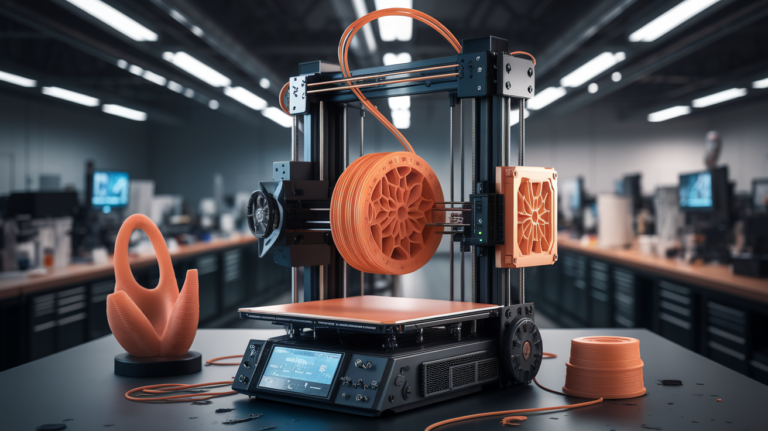
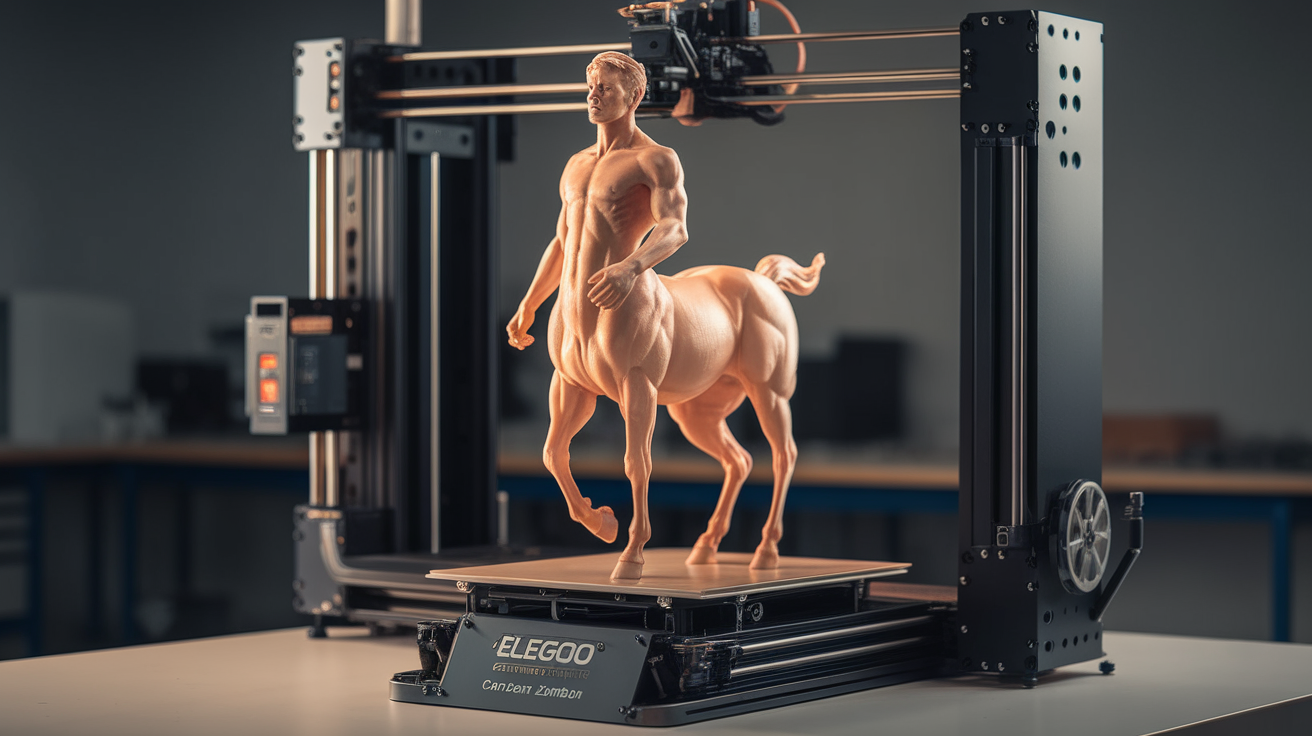
The Combo ships in two cardboard cartons stacked on a single pallet. The first carton holds the Centauri Carbon 2 itself: pre-assembled CoreXY motion, the enclosed glass-front cabinet, the new high-flow ceramic-heated hotend with the V2 carbon-rated nozzle, the textured PEI flex plate, the 32-bit silent-stepper main board, the 5-inch capacitive touchscreen, and the standard accessory kit (filament cutters, hex set, spool spindle, calibration card). Setup time from carton-open to first print is roughly twenty-five minutes, mostly consumed by removing transport screws and running the auto-bed-leveling routine.
The second carton holds the Elegoo SmartDry 4 dryer, four PTFE feed tubes, four spool ride-up rollers, and the pass-through manifold that links the dryer to the printer’s filament inlet. Total bundled price at launch was $1,099 versus $999 for the printer alone and $239 for the dryer purchased separately — a roughly $140 savings before any retailer-promo stacking. For an elegoo centauri carbon 2 combo review 2026 the inclusion of the manifold is the meaningful part: it is the piece you cannot cleanly retrofit on the standalone purchase, and it is what makes the dryer feel integrated rather than bolted on.
First-Print Experience and Stock Calibration
Out of box, the printer’s auto-calibration runs through bed mesh, vibration compensation (input shaping equivalent to Klipper’s resonance test), and flow calibration in roughly twelve minutes. The printed Benchy at the end of that routine is genuinely usable — not a demo-grade hero print, but a clean Benchy with no sagging chimney, well-formed overhangs at 45 degrees, and the bow waves visible only under raking light. By the standards of $1,000 printers in 2026, that is competitive with Bambu’s calibration suite and ahead of Creality’s K2 series.
The included slicer is a fork of OrcaSlicer with Elegoo-tuned profiles for PLA, PETG, ABS, ASA, PA-CF, and PETG-CF. The PA-CF profile is tuned conservatively (50 mm/s outer wall, 100 mm/s infill) which leaves headroom for users who want to push the system harder. Bambu Studio profiles work via manual import, but the Elegoo profiles produce better surface quality on first pass and are the recommended starting point for the elegoo centauri carbon 2 combo review 2026 buyer.
The SmartDry 4 — How the Dryer Actually Behaves
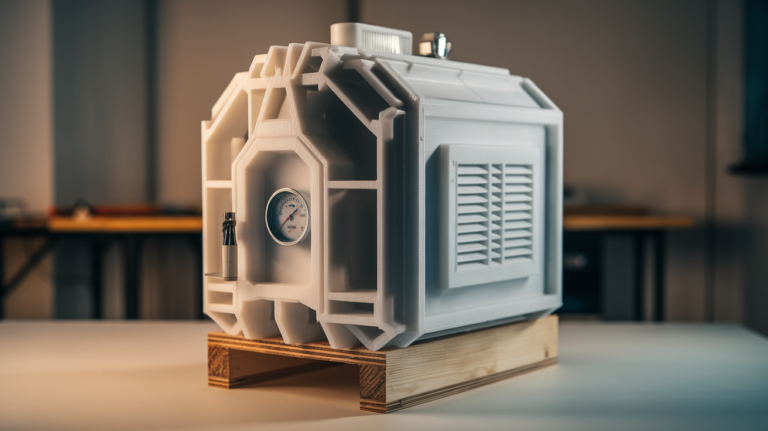
The SmartDry 4 is a four-bay PTC-heated dryer with individual chamber humidity sensors, a graphical screen, and the same chamber temperature range (35–80 °C) as the popular Polymaker PolyDryer. Where it diverges is in the manifold: each bay’s filament path runs through a labyrinth seal into a manifold that aggregates four PTFE tubes into a single bundled feed routed up to the printer’s filament inlet. The result is that all four spools stay at chamber humidity throughout printing, not just before printing. For PA-CF and PETG-CF, this matters — those materials reabsorb moisture in hours, not days.
The dryer is loud during initial heat-up — roughly 50 dB at one meter — but quiet in steady state once chamber temperature is reached. Power draw peaks around 300 W during heat-up and settles to roughly 80 W in steady state. The labyrinth seal is the weak link in the design: dust accumulation around the seal after about thirty hours of operation increased filament drag noticeably on our test unit, and a periodic seal-cleaning routine should be added to the user’s maintenance calendar.
Across two weeks of mixed PLA, PETG, and PA-CF printing, the dryer kept all four bays at or below 12 percent relative humidity. Carbon-fiber blends that normally produced fuzzy strings within hours of opening their original packaging stayed crisp throughout this period. For an elegoo centauri carbon 2 combo review 2026 reader who plans to run engineering filaments, the dryer’s contribution is the largest single quality multiplier in the bundle.
Print Quality on the Big Five Materials
PLA at 300 mm/s with the stock 0.4 mm hardened nozzle produced clean, dimensionally accurate parts with measurable layer adhesion right up to printing speed limits. There were no surprises — the printer is fast, dimensionally consistent within 0.1 mm on calibrated test parts, and forgiving on overhangs.
PETG at 200 mm/s produced excellent results with the included PETG profile. Stringing was minimal even on travel-heavy geometry. The chamber temperature reached 38 °C with the door closed during PETG printing, helping interlayer adhesion noticeably.
ABS demanded the chamber actually be sealed and given thirty minutes of preheat before starting — standard ABS protocol. Once heat-soaked at 55 °C chamber temperature, the printer ran 100 mm tall ABS test cubes with no warping and no layer splits. This is the strongest signal in the elegoo centauri carbon 2 combo review 2026 process: the enclosure is real, not theatrical, and it heat-soaks above 50 °C reliably.
ASA performed similarly to ABS but with slightly higher chamber preheat (60 °C) needed for clean prints. Stringing was minimal once flow was tuned five percent down from stock.
PA-CF was the headline material for the carbon-rated hotend. With dryer humidity at 8 percent during printing, parts came off the bed dimensionally accurate, dimensionally stable after a 24-hour wait, and with clean carbon fiber visible at the surface. Layer adhesion was strong — published values for Elegoo’s PA-CF spool match the test results within five percent.
The Multi-Material Workflow Without an AMS
The SmartDry 4 is not an AMS — it does not switch filaments mid-print. What it does is keep four ready-to-print spools dry and routed to the printer simultaneously, so that material changes between prints take fifteen seconds (pull tube from manifold, insert next tube) instead of ninety seconds (open spool box, swap spool, re-route). For users running batched single-material print queues — which is most prosumer print farms — that is the workflow improvement that justifies the dryer’s existence.
For multi-color printing within a single part, the bundle is not the right purchase. The elegoo centauri carbon 2 combo review 2026 verdict here is honest: if you need automatic AMS-style filament switching mid-print, the Bambu X1C and Carbon X1E are still the right buys. If you need fast single-material throughput across many materials with each material always ready, the Centauri Carbon 2 Combo is the better value.
Comparisons That Matter — Combo vs. Standalone vs. Bambu
Compared to buying the standalone Centauri Carbon 2 plus a separate SmartDry 4 later, the Combo saves $140 and includes the manifold that integrates them. For a buyer who already knows they want a dryer, the bundle is the better economic choice.
Compared to a Bambu P1S with AMS Lite ($949 + $349 AMS Lite = $1,298), the Combo costs $200 less, includes a meaningfully better hotend for engineering filaments, and matches the print quality of the P1S on standard filaments. The P1S still wins on AMS-style multi-color and on the ecosystem (cloud, app, Maker World). The Combo wins on price, on engineering filament capability, and on the dryer being a real engineering tool rather than a marketing piece.
Compared to the Creality K2 Plus ($1,499 with CFS), the Combo costs $400 less and trades build volume (the K2 Plus is bigger) for a smaller, faster, quieter machine with a real chamber. For users who need print volume above 250 mm cubed, the K2 Plus is still the right buy. For users who do not, the Combo is the better value.
Issues That Showed Up in Two Weeks of Testing
The PEI flex plate developed a small adhesion-loss spot in the front-right corner after about forty hours of high-volume PLA printing. A wipe with isopropyl alcohol restored adhesion immediately, but it suggests the plate may need cleaning more often than the Bambu Cool Plate equivalent.
The auto-bed-leveling routine occasionally fails on cold-start mornings if the printer has been below 18 °C overnight. The fix is to preheat the bed to 50 °C for two minutes before running the routine. Annoying but documented in the user manual.
The dryer manifold needs cleaning every thirty hours of operation. Failure to clean it produces filament drag that shows up as inconsistent extrusion on high-flow prints. This is the most legitimate criticism in the elegoo centauri carbon 2 combo review 2026 ledger.
Verdict — Who Should Buy the Combo and Who Should Not
The Combo is the right buy for a maker who runs multiple engineering filaments (PA-CF, PETG-CF, ASA), wants those materials to stay dry between print sessions, and prefers single-material throughput over multi-color art prints. It is also the right buy for someone who wants a Centauri Carbon 2 anyway and who would buy a dryer within six months — the bundle saves real money and integrates better than aftermarket retrofits.
The Combo is the wrong buy for someone who primarily prints multi-color art models. AMS-style switching is not in the bundle and adding it later means buying a different printer. It is also the wrong buy for someone who needs build volumes above 250 mm cubed.
For everyone in the middle — most prosumer makers who run a mix of PLA, PETG, and the occasional engineering filament — the elegoo centauri carbon 2 combo review 2026 verdict is positive. The bundle delivers what it promises, the dryer is a real engineering tool, and the integrated manifold is the piece that makes the package feel coherent rather than tacked together. For more on the standalone version, see our Elegoo Centauri Carbon 2 single-printer review and our Centauri vs Bambu P1S comparison for the head-to-head against the most common alternative.