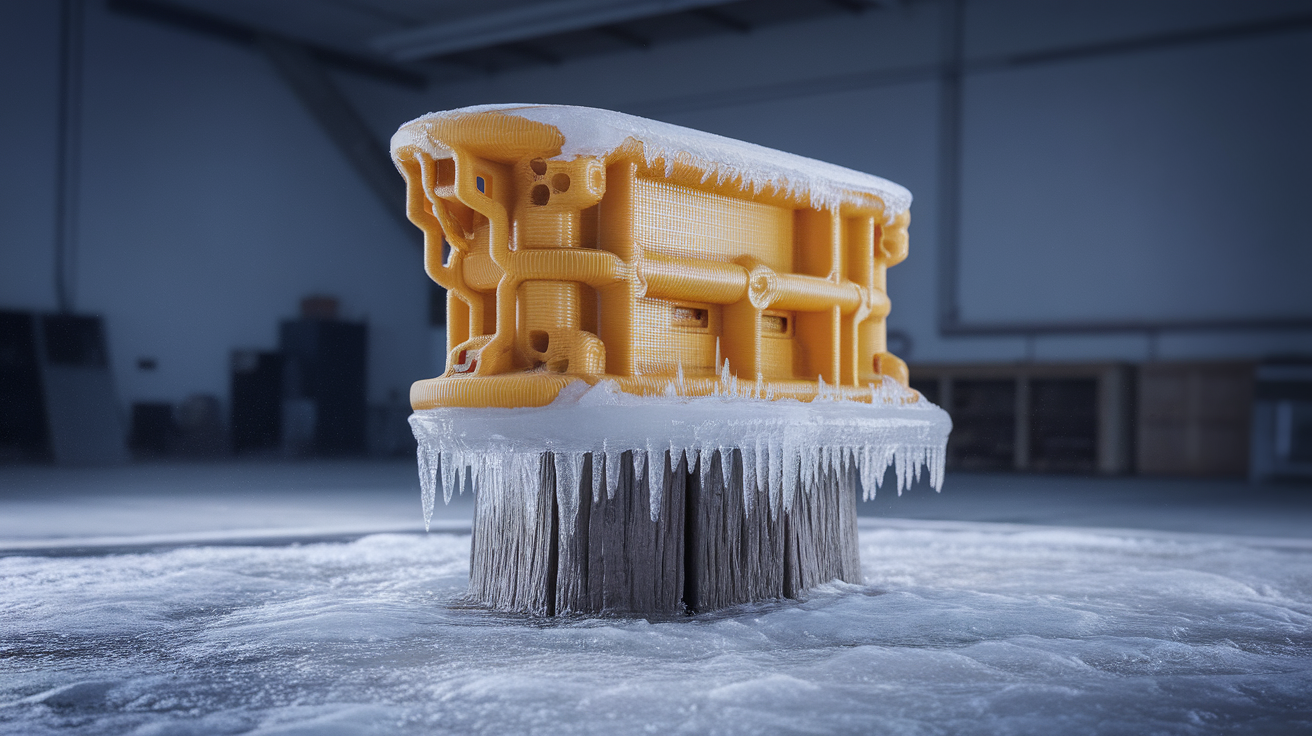
High-Temperature Filament for Outdoor Brackets in 2026: Surviving Freeze-Thaw Winter Cycling
Freeze-Thaw Is a Different Failure Mode From Heat or UV
Most outdoor-filament guides in 2026 focus on UV resistance, sustained heat resistance, or moisture absorption as independent failure modes. The combination of all three over a winter season — repeated cycles of cold-soak, water ingress, freezing, and thaw — is a fourth failure mode that gets less attention than it deserves. Outdoor brackets, planter hangers, garden tool mounts, security camera housings, and any printed part that lives outside through a freezing winter face freeze-thaw as the dominant failure mode, and the filament picks that work well for sustained outdoor heat (PETG, ASA) are not always the right picks for freeze-thaw survival.
This guide documents the 2026 understanding of how high-temperature filaments perform under freeze-thaw cycling, which materials survive winter outdoor service best, and the sealing and design strategies that extend the service life of any outdoor printed part. The data is drawn from community winter-deployment reports and laboratory cycling tests across North American and European climates.
Why Freeze-Thaw Specifically Damages Printed Parts
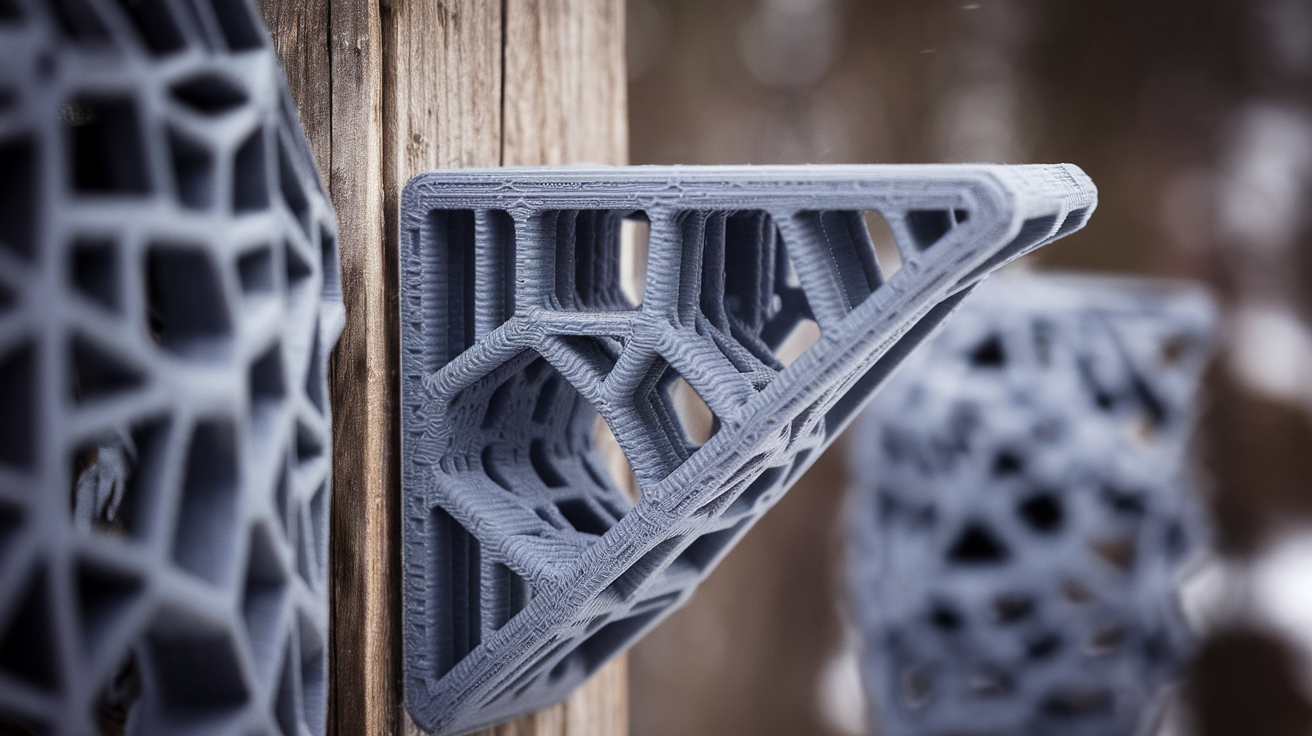
The mechanism behind freeze-thaw damage is straightforward but specific to layer-built parts. Water enters the print through the small voids at layer interfaces — the gaps between adjacent extruded layers that even well-tuned slicer profiles leave at the 5-15 micron scale. The water freezes, expanding roughly 9 percent in volume as it transitions to ice. The expansion forces the layer interface apart, opening a slightly larger void on the thaw. The next freeze-thaw cycle widens the gap further. Over a winter of 50-100 freeze-thaw events, the cumulative damage propagates a microscopic void into a visible delamination crack.
This mechanism is largely absent in injection-moulded plastics because moulded parts have no layer interfaces. It is the dominant outdoor failure mode for printed plastics, more so than UV degradation or sustained heat exposure. A printed PETG bracket that survives a hot summer fine can crack along multiple layer lines after a single hard winter.
The damage rate is a function of moisture absorption and water-ingress paths. Materials that absorb less moisture and prints with fewer layer-line gaps survive longer. This is where the high-temperature filaments — PC, PA-CF, PEI, and to a lesser extent ASA — earn their place outdoors despite their primary marketing being heat resistance.
Polycarbonate Performance in Freeze-Thaw
Polycarbonate (PC) is the best-performing common outdoor filament for freeze-thaw survival in 2026. PC absorbs moisture more slowly than nylon, has higher impact resistance than PETG or ASA, and the inherent material toughness means that the small amount of water that does enter the layer interfaces causes less crack propagation per cycle. A printed PC bracket properly sealed and oriented for minimal water ingress survives multi-year winter cycling in most climates.
The downside of PC is the printing process. PC requires 270-290 C nozzle and 100-110 C bed in an enclosed chamber, which means most desktop printers cannot run PC at all. The hot end has to be full-metal, the chamber temperature has to be actively elevated for parts taller than 60 mm to avoid warping, and the moisture absorption during storage is significant enough that drying the filament before every print is mandatory. For shops that can run PC, it is the right pick for demanding outdoor brackets; for shops that cannot, the practical alternatives below are reasonable substitutes.
PC alloys (PC-ABS, PC-PETG, PC-PBT) are intermediate. They print at lower temperatures than pure PC (240-260 C in most cases), retain most of the freeze-thaw advantage of PC, and cost less. PC-ABS specifically is the lowest-hassle outdoor-bracket pick available on most desktop printers in 2026.
Nylon Performance Is More Complicated Than It Looks
Pure PA6 nylon and PA12 nylon are tempting outdoor picks because of their toughness and chemical resistance, but the moisture absorption issue makes them more freeze-thaw vulnerable than PC. PA6 absorbs roughly 3 percent water by weight at saturation; PA12 absorbs around 1.5 percent. Both are dramatically higher than PC’s roughly 0.3 percent. The absorbed water expands during freezing more than the same volume of dry plastic, which means an unsealed nylon bracket sees more freeze-thaw damage than a PC bracket of the same geometry under the same conditions.
The fix for nylon outdoor parts is post-print sealing. A two-coat application of marine-grade epoxy on the exterior surface prevents most water ingress and lets nylon’s mechanical advantages dominate over its moisture vulnerability. CF-Nylon (PA-CF, PA12-CF) sees the same moisture issue and benefits from the same sealing approach. The combination of CF-Nylon mechanical performance and epoxy sealing produces some of the most durable outdoor printed brackets available in 2026.
Glass-filled nylon (PA-GF, PA12-GF) is the related but distinct pick where dimensional stability under freeze-thaw matters more than impact resistance. The glass fibres restrain the matrix expansion during moisture absorption and freezing, which preserves part geometry better than unfilled or CF-filled nylon. For brackets that need to maintain tight fit with metal hardware through multiple winters, glass-filled nylon plus surface sealing is the right combination.
PETG and ASA: Often Sufficient, Sometimes Not
PETG and ASA are the workhorses of outdoor 3D printing and handle freeze-thaw acceptably in moderate climates but not in severe ones. The threshold is roughly the -10 C / +30 C summer-winter range that defines moderate continental climate. Brackets printed in PETG or ASA in that climate band survive multi-year outdoor service with manageable degradation. The same prints in -25 C / +35 C climates (Canadian prairie winter, northern European continental) see meaningfully shorter service lives.
The reason is that PETG and ASA both retain less ductility at very low temperatures than PC or nylon. At -20 C and below, both materials become more brittle, which makes the freeze-thaw-induced cracks propagate faster on each cycle. A PETG bracket that gives three winters of service in Pennsylvania might give one winter in Saskatchewan. The cold-climate solution is to upgrade to PC, PC-ABS, or sealed nylon rather than continuing with PETG or ASA.
The slicer-side fix for PETG and ASA outdoor parts is to use thicker walls (4-6 perimeters versus the typical 3) and higher infill (40-60 percent versus 20-30 percent) to reduce the total layer-interface area exposed to water ingress. The trade is print time and material cost, both of which are usually acceptable for one-off outdoor parts.
Sealing Strategies That Actually Work
Post-print sealing is the most reliable single intervention that extends freeze-thaw service life across every filament category. The four sealing approaches that work in 2026 differ in cost, complexity, and effectiveness.
The cheapest is automotive clear-coat sprayed in three thin passes over a primed surface. This adds a 50-100 micron sealed layer on the exterior of the print and meaningfully reduces water ingress. The coating wears off after two to three winters of outdoor exposure and needs renewal, but the cost is low enough that periodic renewal is acceptable.
The middle option is marine epoxy applied as a two-component brush-on coating. The epoxy bonds aggressively to most printed plastics (PETG, ASA, ABS, nylon, PC), forms a 200-400 micron continuous seal, and survives 5-10 years outdoors without renewal. The labour is real — the application is messy, the cure time is 12-24 hours, and the finish is glossy in a way that some prints look wrong with. For brackets that prioritise function over appearance, marine epoxy is the right pick.
The high-end option is vapour-deposited silica or fluoropolymer coatings applied as a service. The seal is essentially perfect, the appearance change is minimal, and the cost is roughly $30-80 per coated part depending on size. For high-value outdoor prints (security camera housings, scientific instrument enclosures) the coating service is worth the cost; for general garden hardware it usually is not.
Design Strategies for Freeze-Thaw Survival
The design choices that improve freeze-thaw survival are as important as the material choice. Orienting the print so that the layer lines run perpendicular to the gravity-drainage direction lets any water that does enter the print drain out rather than pool at layer interfaces. A bracket designed with the long axis vertical during printing but installed horizontally during service often outperforms the same bracket printed in the installation orientation.
Avoiding flat-topped horizontal surfaces is the second design rule. Any horizontal surface on an outdoor print collects standing water, which freezes and damages the print at concentrated points. Sloped surfaces or domed tops shed water effectively and reduce the freeze-thaw exposure at the worst points. A 5-degree slope on what would otherwise be a flat top surface eliminates most standing-water damage.
The third rule is to design drainage paths into any enclosed volume. A printed planter, security camera housing, or hose mount with sealed interior cavities trap moisture from condensation and humidity even without direct rainfall. A 3-5 mm drainage hole at the lowest point of any enclosed volume lets the moisture escape rather than freeze. For aesthetic reasons the drainage hole can be hidden on the back or bottom of the print without affecting function.
Material Picks by Common Outdoor Application
For outdoor security camera housings, PC-ABS sealed with automotive clear coat is the right pick for moderate climates and CF-Nylon with marine epoxy is the right pick for severe climates. The application demands dimensional stability for the camera lens alignment and impact resistance against wind-driven debris.
For planter hangers and garden tool mounts, PETG with thicker walls and clear coat is acceptable for moderate climates and PC-ABS unsealed is the right pick for severe climates. These applications tolerate some dimensional drift and rarely see impact loads.
For solar panel mounting brackets and outdoor electronics enclosures, glass-filled nylon with marine epoxy is the right pick because of the combination of UV resistance, dimensional stability, and fastener-load capacity these applications demand.
For decorative outdoor pieces (yard art, signs, mailbox accessories), PETG with clear coat is fine for moderate climates. Severe climates push toward PC-ABS or sealed nylon. For any decorative piece intended to last multiple winters without visible degradation, the upgrade to a higher-performance base material is justified by the labour cost of replacement.