High-Temperature Filament Explained: The Three Tiers and What Each One Is For in 2026
What “high temperature” actually means on a filament spec sheet
High-temperature filament is loose terminology for any 3D printing material whose finished prints survive sustained operation above PLA’s softening point. PLA loses dimensional stability at around 55-60°C, which is the inside of a parked car on a moderately warm day. Any filament that performs meaningfully better than that gets called “high temperature” by some manufacturer. The phrase therefore covers everything from PETG (glass transition around 80°C) up through engineering polymers like PEEK and ULTEM that survive 250°C continuous use. Knowing where on this spectrum your project lives is the difference between buying the right filament and overspending on capabilities you will not use.
The two numbers to look at on any spec sheet are glass transition temperature (Tg) and heat deflection temperature (HDT). Tg is the temperature at which the polymer transitions from rigid to rubbery; below Tg the part keeps its shape, above it the part softens and deforms under load. HDT is a more practical metric — the temperature at which a sample bar deflects under a standard load — and is usually slightly lower than Tg for polymers like PETG and significantly lower for unfilled engineering polymers. For most use cases, the HDT is what you actually care about because it predicts when a part starts to deform under its own structural loads.
One caveat: the “max temperature” claims on filament marketing pages are often misleading. A filament with a Tg of 105°C is not safe at 105°C continuous use under load. The real safe operating temperature is usually 30-50°C below the Tg, depending on stress level and exposure duration. When you read a marketing claim of “withstands 110°C,” interpret it as “survives brief peaks at 110°C with negligible load.” Plan your designs around the conservative number, not the marketing one.
The three high-temperature filament tiers
Tier one is the easy-to-print high-temp polymers: PETG, ASA, ABS. These print on any printer above $300, require enclosed builds for ABS and ASA, and survive 70-90°C continuous use. They cover the vast majority of “I need it to handle a hot car interior” use cases without forcing the user to buy a different printer or learn new techniques.
Tier two is the engineering-grade polymers: nylon, polycarbonate (PC), and PC-ABS blends. These survive 100-130°C continuous use and have better mechanical properties than tier one (strength, impact resistance, fatigue life). They require an enclosed printer with a hot end rated above 280°C and a heated bed above 100°C, and they are dramatically more sensitive to moisture absorption than tier-one polymers. Plan on a filament dryer running continuously for these materials.
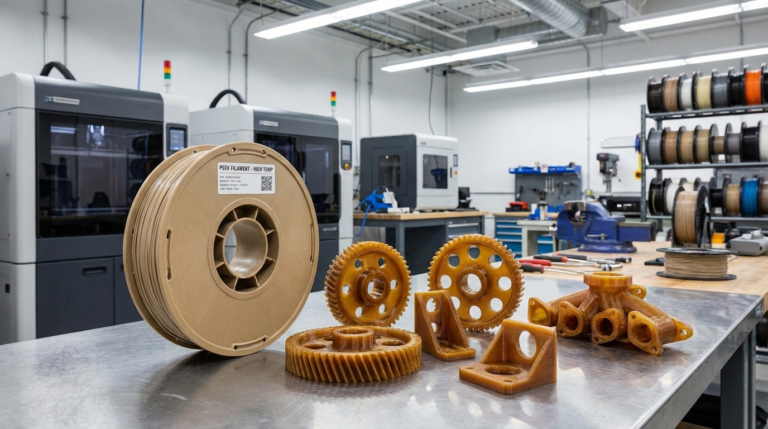
Tier three is the high-performance engineering polymers: PEEK, PEKK, ULTEM, and high-temperature carbon-fibre composites. These survive 150-250°C continuous use, have aerospace-grade mechanical properties, and require a fully heated chamber printer with a hot end above 400°C and bed above 150°C. The hardware required to print tier three is what most users do not have — a proper PEEK-capable printer in 2026 starts at $5,000 and goes up. Tier three filament is for users who already have the machine.
Tier one in detail: PETG, ASA, ABS
PETG is the most accessible high-temperature filament in 2026. Glass transition around 80°C, prints on any printer at 230-240°C nozzle and 70-80°C bed, no enclosure required. Heat deflection in the 70-75°C range under modest load makes it suitable for outdoor parts, automotive interior components (with caution about long sun exposure), and equipment cabinets that warm up but do not exceed 70°C. PETG is the right answer when “high temperature” means “PLA softens too much and I need 20-30 degrees more headroom”.
ASA is the outdoor specialist. Tg around 105°C, HDT in the 90-95°C range, and crucially much better UV stability than PETG or ABS. For parts that live outdoors in sunlight, ASA holds its shape and colour for years where PLA, PETG, and ABS all yellow and embrittle. Printing requires an enclosed printer because ASA warps aggressively with airflow, and the styrene fumes are unpleasant in unventilated spaces. Print at 240-250°C nozzle and 100-110°C bed.
ABS is the legacy high-temp material. Similar Tg and HDT to ASA but with worse UV stability and worse layer adhesion. Prints in the same temperature range as ASA and requires the same enclosed setup. The reason ABS is still on the market in 2026 is post-processing — acetone vapor smoothing produces a glossy finish on ABS that no other filament achieves. For parts where appearance after finishing matters, ABS remains relevant. For raw printed parts that will be used as-is, ASA is generally a better choice because of UV stability.
Tier two in detail: Nylon, PC, PC-ABS
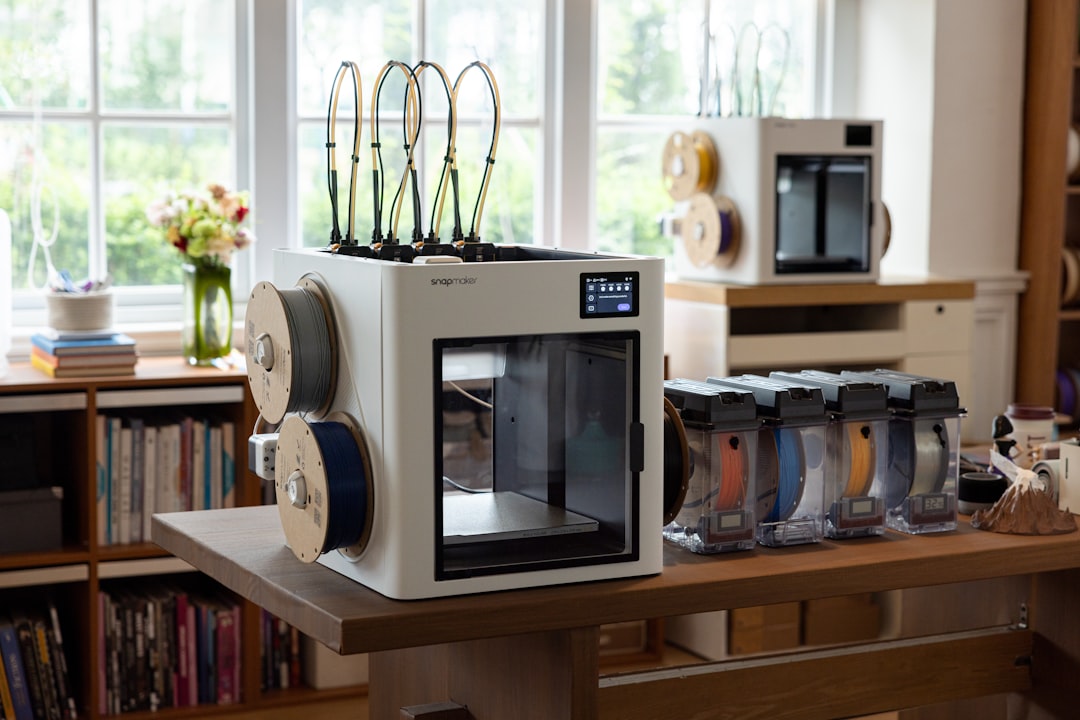
Nylon (PA6 or PA12 are the common 3D printing variants) has excellent mechanical properties — high impact resistance, good fatigue life, low friction surfaces — and Tg around 50-60°C unfilled. Wait, that does not sound high-temperature. The reason nylon is in this tier is that nylon parts often run with carbon-fibre or glass-fibre fill, which dramatically raises the effective heat deflection temperature to 150-180°C while improving stiffness. PA-CF and PA-GF are the high-temperature workhorses for industrial functional parts.
Polycarbonate (PC) has a Tg around 145-150°C and HDT around 125-130°C. It is the strongest commonly-printed thermoplastic with respect to heat resistance, with finished parts surviving 110-120°C continuous use under modest load. The catch is print difficulty: PC requires 280-300°C nozzle, 110°C bed minimum, fully enclosed chamber, and aggressive moisture management. A wet PC spool produces parts with no layer adhesion at all; a dried PC spool prints layer-bonded engineering parts.
PC-ABS blends are the practical compromise: easier to print than pure PC, with HDT around 100-110°C. They print at 260-270°C nozzle and behave more like ABS in terms of warping and chamber requirements. For users who want PC-like properties without the full PC printing difficulty, PC-ABS is a reasonable middle ground at the cost of some peak heat resistance.
Tier three: PEEK, PEKK, ULTEM (briefly)
PEEK has continuous use temperatures up to 250°C, HDT around 152°C unfilled and 320°C with carbon-fibre fill. It is used in aerospace fittings, medical implants, and high-temperature electrical insulators. Printing requires a chamber heated to 130°C+, hot end at 420-440°C, and very specific cooling profiles. Material cost is $200-$500 per kilogram. Hardware cost is $5,000+ for a printer that can actually run PEEK in production.
PEKK is similar in performance, slightly different in chemistry, and slightly more printable than PEEK at the cost of slightly lower thermal performance. ULTEM (PEI) is the third option in this tier with Tg around 215°C and HDT around 200°C. For users who genuinely need parts surviving sustained 200°C operation, these are the materials. For everyone else, this paragraph is a curiosity rather than a buying guide.
Which printer can handle which tier
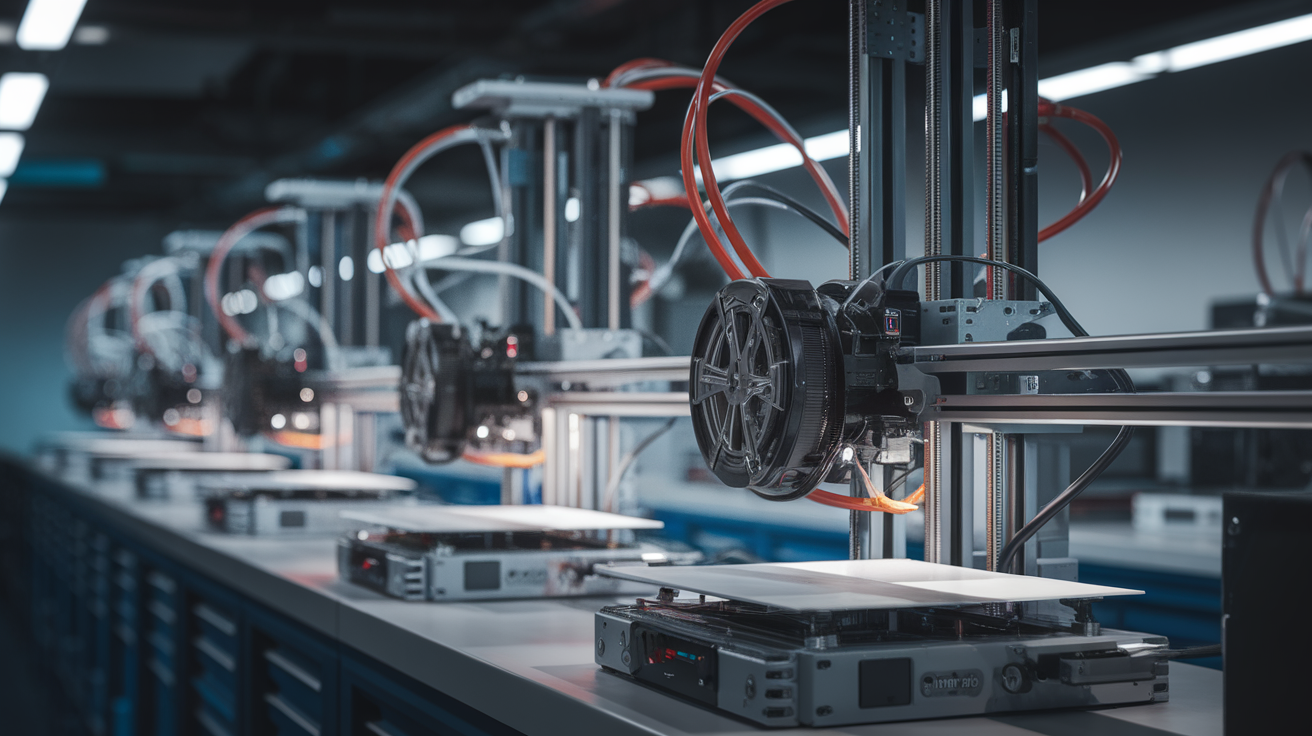
Any direct-drive printer with a 230°C+ hot end and 80°C+ bed handles tier-one PETG. For ABS and ASA add an enclosure (a Bambu P1S, X1C, or any printer with a chamber works; an Ender 3 with a custom enclosure is acceptable). For nylon (unfilled) you need 260-270°C and a dry spool; most modern hot ends manage this. For PC-ABS expect 270-280°C and a tight enclosure to keep warpage in check.
For pure PC and PA-CF/PA-GF you need an “engineering-grade” printer: 290-310°C hot end, 110°C bed, hardened nozzle (the carbon and glass fibre will eat a brass nozzle in a single spool). Bambu Lab X1C, Prusa XL, Voron 2.4 with high-temp upgrades, and Ankermake X-Series with chambered builds all qualify. Pricing for a competent tier-two printer in 2026 is $1,500-$3,500.
For tier three, again, this is a specialist purchase. The Stratasys F123, Roboze ARGO, Apium P-series, and similar industrial machines are what tier-three users buy. There is no consumer-tier path into PEEK printing in 2026 that produces reliable parts; attempts to retrofit Voron or BambuLab printers with high-temp chambers usually result in either marginal print success or thousands of dollars spent achieving what an industrial printer does cleanly.
When you do not need high-temperature filament at all
Most printed parts never see temperatures above 50°C. Indoor-use display models, hobby pieces, prototype cases, ornaments — all of these are fine in PLA forever. The mistake new buyers often make is to start with PETG or ABS for indoor parts on the theory that “more heat resistance can never hurt”, and pay for that theory in worse surface finish (PETG) or a more difficult print process (ABS) without any practical benefit.
The right thinking is: identify the specific part, identify the specific operating environment, choose the lowest tier that survives that environment with margin. A bracket inside a sun-exposed car dashboard probably needs ASA or PC. A bracket inside a sealed equipment cabinet that runs at 50°C maximum is fine in PETG. A model train ornament inside a climate-controlled house is fine in PLA. Match the polymer to the use case, not to the marketing claim.
Cost reality of high-temperature 3D printing in 2026
Tier one filaments cost $25-$40 per kilogram, the same as good PLA. Tier two costs $40-$80 per kilogram for nylon and PC, $60-$120 per kilogram for fibre-filled variants. Tier three is $200+ per kilogram and the printer to run it costs more than a used car. For 90% of hobby and prosumer projects, the right answer lives in tier one or low tier two; spend the budget difference on print quality (better printer, better dryer, better slicer setup) rather than on materials you do not need. The “high temperature” label is a tool for matching polymer to application, not a virtue in itself.