Top PLA Filaments in 2026: Premium, Value, Toughened, and Specialty Brands Compared
Why “top PLA” depends on what you actually print
Asking which PLA is “top” in 2026 is like asking which car is best. The answer depends on whether you are commuting, racing, or hauling lumber. PLA in 2026 spans a price range of $15 to $40 per kilogram, mechanical properties from brittle craft-grade to tough engineering-grade, and aesthetic finishes from matte through silk to translucent. A premium spool that is “top” for a tabletop figurine is wasted on a draft prototype; a budget spool that is “top” for a draft prototype produces a poor figurine.
This article splits PLA into the four buying categories that matter: premium tier where consistency and aesthetics dominate, mainstream value where price-per-kilogram is the main lever, toughened PLA where mechanical properties beat plain PLA, and aesthetic specialists where colour or surface finish is the actual product. Each category has its own “top” — a brand most owners agree is the right pick if you understand the use case. Skip the categories that do not apply to your prints; those are the spools you do not need.
One note on what this article excludes. PLA-CF (carbon-fibre filled), PLA-GF (glass-fibre filled), and PLA composites with metal powders are not covered here. They are different materials with different printing requirements and different “top” recommendations. Keep this article focused on plain PLA and PLA-derivative formulations that print on any standard 0.4mm nozzle without special hardware.

The premium tier: Polymaker PolyTerra Pro and Prusament PLA
Polymaker PolyTerra Pro is the spool I reach for when surface finish matters. The matte appearance is genuine matte rather than the pseudo-matte you get from low-flow extrusion of glossy PLA — the formulation includes matting agents that diffuse light at the polymer level. Layer lines are visually softer because of this, which means top-surface defects (small flow inconsistencies, slight under-extrusion at corners) are less visible. For figurines, display models, and architectural pieces, PolyTerra Pro is genuinely top-tier at $30-$33 per kilogram.
Prusament PLA is the consistency benchmark across the entire industry. ±0.02mm diameter tolerance with per-spool QC reports, generous colour range, and a polymer formulation that is forgiving on all current direct-drive printers. The “top” claim for Prusament is not about peak aesthetics but about predictability: you can buy three spools across three different colours and they all print at the same flow rate, the same retraction, the same first-layer height. For users running multi-colour or multi-spool projects, this consistency saves real working time. Pricing is $28-$32 per kilogram.
Both spools are overkill for draft prototypes. For figurines, premium models, and gift-quality prints, both are worth the premium over generic PLA. Choose PolyTerra Pro for surface finish, Prusament for cross-spool consistency. If your project does not value either of these properties, drop down a tier.
The mainstream value tier: Hatchbox, Inland, Sunlu
Hatchbox PLA at $18-$22 per kilogram is the most-recommended spool on Reddit’s r/3Dprinting for a reason. The diameter tolerance is acceptable (±0.05mm typical), the colour selection is large, and the polymer formulation prints cleanly on any current printer with default profiles. It is not premium and does not pretend to be; it is reliable, available, and inexpensive. For everyday prototyping prints where the surface finish is not the goal, Hatchbox is the default I recommend.
Inland (Micro Center’s house brand in the US, generic-rebadged in other regions) and Sunlu sit at similar price points with similar quality. The differences between Hatchbox, Inland, and Sunlu come down to colour availability and shipping convenience for your region. Hatchbox is widely stocked at major US retailers; Inland is cheap if you have a Micro Center nearby; Sunlu is a strong value option in most international markets and runs frequent multi-colour bundle deals.
For a user buying their first ten kilograms of PLA, any of these three brands handle the vast majority of prints. Save the premium-tier spend for projects where it matters and use the value tier for everything else. The combined annual filament budget is significantly lower than the all-premium approach without meaningfully changing print outcomes for prototype work.
Toughened PLA: PolyMax PLA, eSun PLA+, Inland Tough
“Toughened PLA” or “PLA+” describes formulations modified with impact modifiers that increase the polymer’s resistance to brittle failure under load. Plain PLA snaps when dropped or stressed at a notch; toughened PLA bends instead, often dramatically. This matters for functional parts that experience real-world impact: tool handles, brackets, snap-fit cases, anything that will be used rather than displayed.
Polymaker PolyMax PLA is the most-toughened of the three. Drop-tested parts survive impacts that would shatter plain PLA, with elongation-at-break around 8-10% rather than the 2-4% of standard PLA. Pricing is $30-$35 per kilogram, expensive enough that you reserve it for projects that genuinely benefit. eSun PLA+ is the price-conscious alternative at $20-$25 per kilogram with toughness that is meaningfully improved over plain PLA but not as dramatic as PolyMax. Inland Tough is the US-budget version, similar to eSun PLA+ in performance.
For functional prints — drone parts, tool fixtures, any case that will be dropped — buy a toughened PLA rather than buying premium plain PLA. The impact-resistance gain matters more than the surface-finish gain. For display and prototype work, plain PLA is the right choice; do not pay for toughness you do not use.
Aesthetic specialists: ProtoPasta, Atomic, Amolen
For users where the polymer is the product — silks, marble effects, glow-in-the-dark, conductive composites, wood and stone fills — a different set of brands becomes “top”. ProtoPasta produces small-batch specialty PLA in formulations that no other brand sells: high-temperature-treated PLA that survives 100°C after annealing, magnetic iron-fill, conductive carbon-black PLA. Pricing is $35-$50 per kilogram and the spools are aimed at users who specifically need that property.
Atomic Filament produces colour-matched silks and gradients that are aesthetically distinctive. Amolen is the budget-friendly version of the specialty market with marble effects and silk PLAs that look premium for $25-$28 per kilogram. None of these are “top” for general printing; they are top for projects where the colour or surface finish is the entire point of the print.
If you have not yet printed something where you genuinely needed a specialty PLA, you do not need any of these brands yet. Buy the premium and value tiers first. When a project comes along that requires a specific aesthetic property — a wedding gift in marble effect, a glow-in-the-dark kid’s toy — then buy the matching specialty spool. Keeping a stock of specialty PLA “in case” is one of the easiest ways to accumulate filament you never use.
Bambu Lab Basic and Matte PLA: the printer-bundled tier
Bambu Lab’s house-brand PLA — Basic in glossy finish and Matte in matte finish — is the default spool many users start with because it ships in the printer’s accessory box and the AMS auto-detects the brand. Quality is good (±0.03mm diameter tolerance), the formulation prints cleanly on Bambu printers and is fine on any other direct-drive machine, and pricing is $20-$25 per kilogram comparable to mainstream value brands.
Bambu PLA is not premium-tier but is reliably above the value tier in consistency, particularly for the colour-matched dual-spool pairs that the AMS uses for multi-colour. The colour range is smaller than Hatchbox or Sunlu but the colour fidelity (what you see online matches what arrives) is better than the value-tier average. For Bambu printer owners, it is a reasonable default; for non-Bambu owners, there is no specific reason to seek it out over a similarly-priced mainstream brand.
Picking the right tier for your printer and use case
If your printer is a budget machine (Ender 3 V3, Sovol SV07, similar) and your prints are mostly prototypes and learning projects, stay in the value tier. The marginal benefit of premium PLA is not visible on a printer that has not been mechanically tuned. Hatchbox or Inland for everything; PolyTerra Pro or Prusament only when you have a specific gift-quality project that matters.
If your printer is a Bambu, Prusa MK4S, Voron, or other tuned direct-drive machine, premium PLA’s surface-finish advantages become visible. Spend in the premium tier for display work and gift prints, drop to the value tier for prototypes. The decision is per-project rather than per-printer.
For functional prints regardless of printer, toughened PLA is the right choice. Plain PLA’s brittleness is a liability for any part that will be used rather than displayed. Reserve specialty PLA for projects where the specialty is the point. With these four buckets in mind, “top PLA” answers itself differently for every print, and the buying decision becomes easy rather than overwhelming.
What “top PLA” looks like at high print speeds in 2026
The print-speed revolution that arrived with Bambu and CoreXY printers in 2024-2025 changed which PLA is “top”. A polymer that flowed cleanly at 60 mm/s on an Ender 3 may not flow cleanly at 250 mm/s on a Bambu A1. The deciding variable is melt viscosity at high shear rates, and not every PLA brand has formulated for high-speed flow. Polymaker PolySonic, Bambu PLA Tough Lite, and the newer Hatchbox high-speed line all advertise “high flow” or “high speed” formulations specifically for sustained 200+ mm/s printing.
If your printer is capable of 250 mm/s and you actually use that speed, the “top” PLA for your machine is one of these high-flow variants rather than the all-purpose value-tier brands. The visual signature of using a non-high-flow PLA at high speed is faint glossy banding on top surfaces and slightly under-extruded thin walls; both go away when you swap to a high-flow formulation at the same flow-rate setting. Pricing for high-flow PLA is $25-$32 per kilogram, slightly above the value tier but well below the premium tier. For users committed to fast-printing workflows it is the right bucket to start in.
Storing PLA so it stays “top” longer
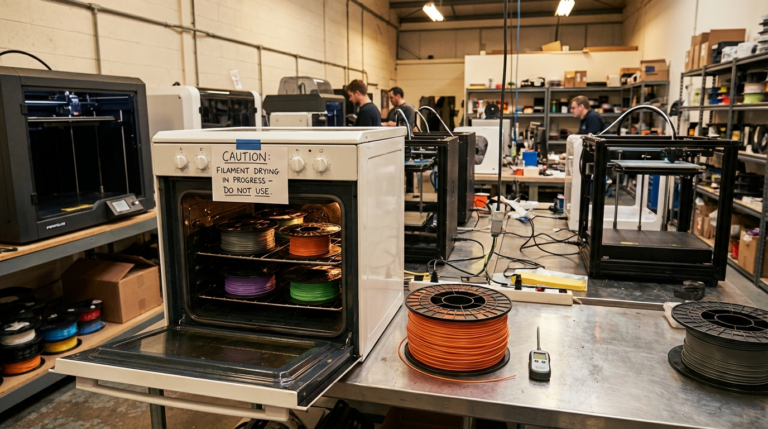
Even the best PLA absorbs moisture if you leave the spool exposed in a humid workshop, and a wet PLA spool prints like a low-tier value PLA regardless of what the label says. Store opened spools in sealed containers with desiccant, dry suspect spools at 45-50°C for 4-6 hours before long prints, and watch for the popping sound that signals moisture in the polymer. A premium spool stored badly performs worse than a value spool stored well; storage discipline is the cheapest upgrade to your filament’s effective tier.