Similar Posts
3D Printer Nozzle Size Guide: 0.4 vs 0.6 vs 0.8mm Compared
Why Nozzle Size Matters More Than You Think Most 3D printers ship with a 0.4mm nozzle, and most people never change it. That’s fine — the 0.4mm is the jack-of-all-trades size that handles everything reasonably well. But swapping to a 0.6mm or 0.8mm nozzle can dramatically change what your printer is capable of, and the…
3D Printer Maintenance Schedule: Complete Checklist Guide
Your 3D printer is a machine with moving parts, heated components, and tight tolerances. Like any machine, it needs regular maintenance to perform at its best. Skip it, and you’ll spend more time troubleshooting failed prints than actually printing — trust me, I’ve learned this the hard way. This guide lays out a complete maintenance…
How to Strengthen 3D Printed Parts: Settings, Materials & Post-Processing
Why 3D Printed Parts Break — And What You Can Do About It 3D printing gives you incredible design freedom, but let’s be honest: most prints straight off the bed aren’t winning any strength competitions. A standard PLA print with default slicer settings can snap, crack, or delaminate under loads that would barely register on…
3D Printing Batch Production: How to Print Multiple Parts Efficiently
Whether you’re running a small Etsy shop, fulfilling prototype orders, or just need 50 identical widgets for a project, printing multiple parts efficiently on a single build plate is a skill that separates casual hobbyists from productive makers. Done right, batch printing saves enormous amounts of time — you set it and forget it while…
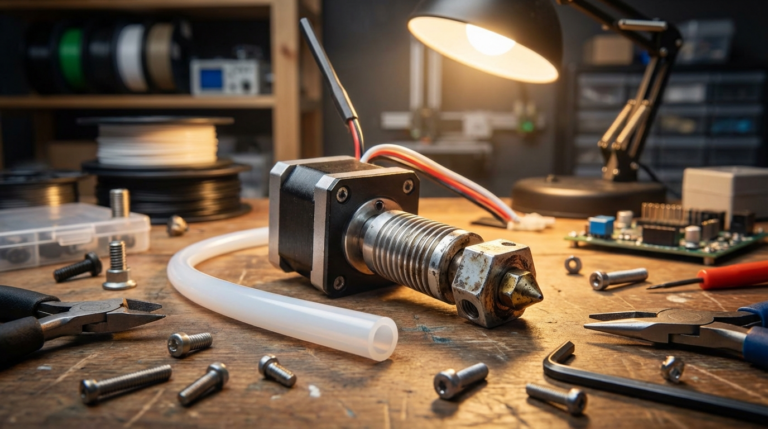
PTFE Tube Replacement for 3D Printers: When and How to Do It
What Does a PTFE Tube Do in a 3D Printer? The PTFE (polytetrafluoroethylene) tube — that small, white tube running from your extruder to the hotend — is one of the most critical components in any Bowden-style 3D printer. It guides the filament from the extruder motor to the melt zone with minimal friction, and…
Multi-Color 3D Printing: Every Method Explained (2026 Guide)
There’s something deeply satisfying about a 3D print that uses multiple colors. Whether it’s a topographic map with elevation-coded hues, a lithophane with perfect contrast, or just a Pikachu that’s actually yellow instead of gray — multi-color printing transforms your output from “cool prototype” to “actual finished product.” The good news: you don’t need a…