ABS vs ASA Enclosure Temperature and Cracking: Why Lower Shrinkage Needs Hotter Chambers
Why ABS and ASA need different enclosure thinking, not the same enclosure
The ABS vs ASA enclosure temperature cracking comparison usually gets handled badly because both materials get lumped together as “high-warp styrene-class filaments needing an enclosed printer.” That framing is half right. Both materials do warp without an enclosure. But the failure modes when the enclosure is wrong are different in important ways, and an enclosure setup that works perfectly for ABS can still produce cracked ASA prints, and vice versa. Understanding why means understanding what each material is actually doing thermally as it cools.
The shared piece is straightforward: both materials shrink significantly as they cool from print temperature down to room temperature. ABS shrinks roughly 0.8% from 240°C to 25°C; ASA shrinks roughly 0.6% in the same range. That shrinkage, when constrained by adhesion to the bed and by adjacent solidified layers, generates stress. If the stress exceeds the inter-layer bond strength, the part cracks. The enclosure exists to slow down the cooling and reduce the differential between the hot top layers and the cold bottom layers — keeping the whole part in a narrower temperature band as it builds.
The chamber temperature target — where ABS and ASA diverge
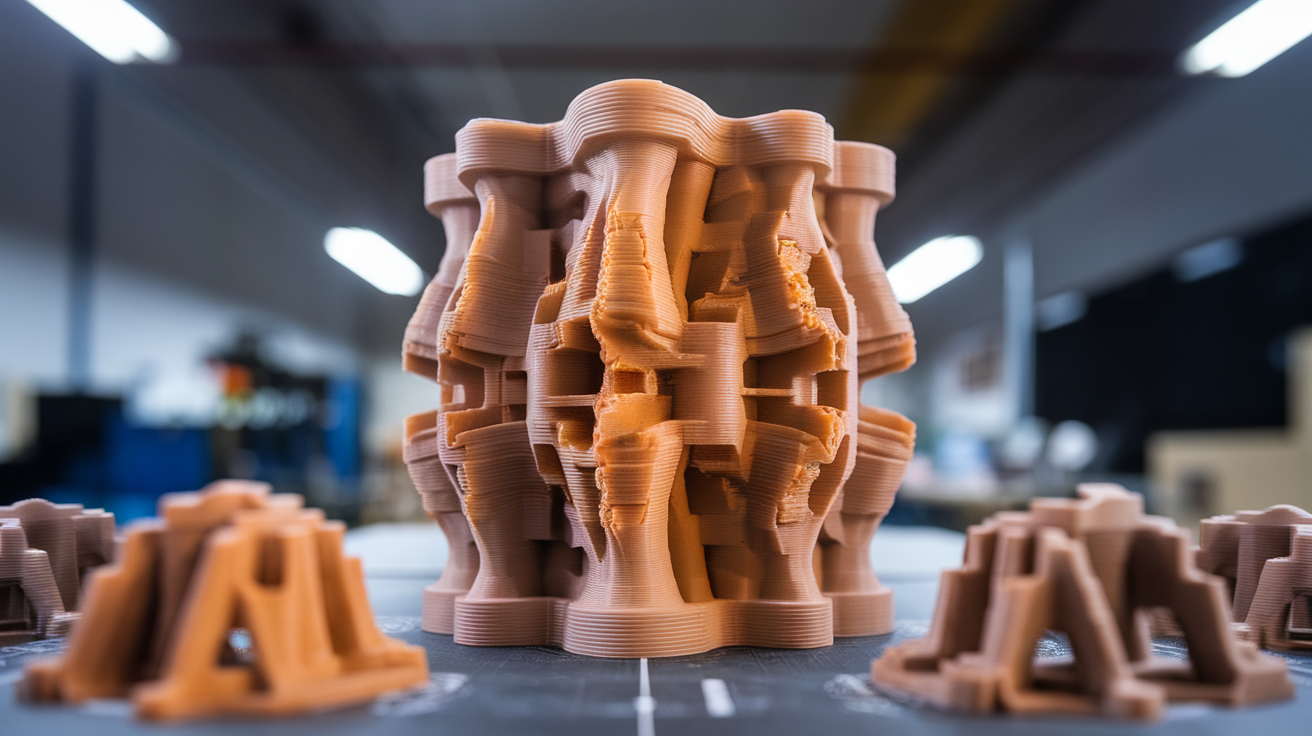
For ABS, the optimal chamber temperature is 50-60°C. Below this range, the part cools fast enough between layers that inter-layer adhesion suffers and warping returns. Above this range, the part stays hot enough that it can sag under its own weight on tall geometries, and the printer’s electronics start hitting their thermal limits. The 50-60°C window is wide enough that most enclosed printers (Bambu Lab P1S, Prusa MK4 with enclosure, Voron 2.4) hit it naturally with passive heat from the bed.
For ASA, the optimal chamber temperature is 60-70°C — meaningfully higher. ASA’s crystallization behavior is more sensitive to cooling rate, and it benefits from a hotter chamber that lets the polymer chains relax for longer before fully solidifying. ASA printed in a 50°C chamber prints visibly worse than ABS in the same chamber: more delamination at corners, more obvious layer lines, and surprisingly more cracking despite its lower overall shrinkage.
This is the most counterintuitive finding for people new to ASA: the lower-shrinkage material needs the hotter chamber. The reason is the crystallization dynamics, not the gross shrinkage number.
What “cracking” actually looks like for each material
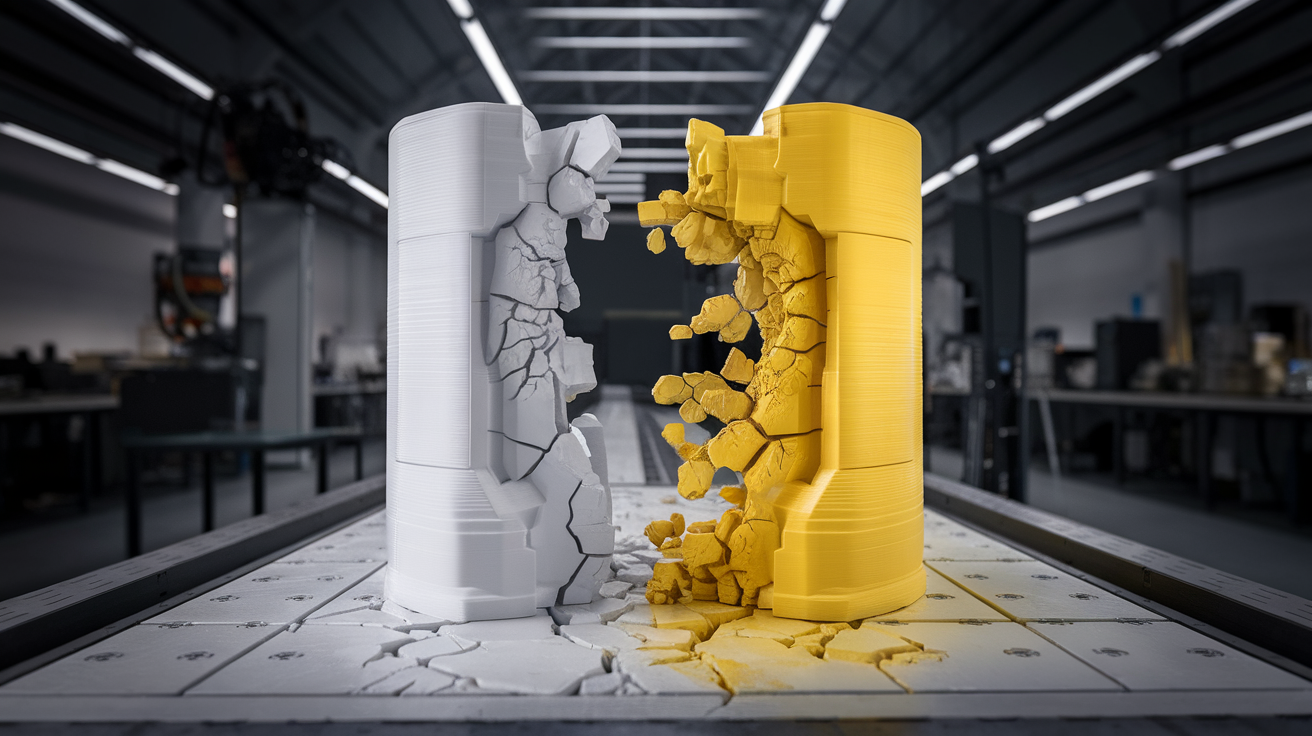
ABS cracking patterns are usually large and vertical. A bracket prints with what looks like a clean surface, then days later a vertical split appears running 30-50% up one face. The crack follows layer lines but propagates between several layers at once. The cause is internal stress that exceeded inter-layer adhesion strength somewhere along that face during cooling. The crack is not present at print finish; it grows over hours to days as residual stress relaxes.
ASA cracking patterns are usually small and clustered. The same bracket prints with a clean surface and develops a network of small surface cracks at corners and around features within hours of print finish. ASA cracks tend to be shorter (5-20 mm) but more numerous, and they often cluster at geometric stress concentrations like sharp inside corners or around holes. The cause is often the same — residual stress — but the crack propagation pattern is different because of ASA’s more flexible polymer matrix.
Practically: if you see one big crack in your print, suspect chamber temperature or cooling rate. If you see many small cracks, suspect both chamber temperature and geometric design (sharp corners that should be filleted).
The first-layer adhesion difference
ABS sticks aggressively to glass with a thin ABS-acetone slurry brushed on, or to PEI with a clean surface and a hot bed (110°C). ASA sticks similarly well to PEI but is more sensitive to bed surface contamination — a fingerprint that ABS prints over without issue can cause ASA to lift mid-print. ASA also benefits more from a glue stick layer on PEI than ABS does, because the glue layer evens out small surface variations.
Bed temperature for both materials should be 100-110°C. Lower bed temperatures (90°C and below) produce poor first-layer adhesion that releases mid-print as the part shrinks against constrained adhesion points. The exception: ASA prints with a brim or skirt rarely need 110°C if the brim provides enough adhesion area; 100°C plus brim works well.
Enclosure design — passive vs actively heated
Most desktop enclosures are passive — the enclosure traps heat radiated by the bed and the heated chamber temperature stabilizes wherever the heat input and heat loss balance out. For an enclosed Bambu Lab P1S printing ABS at 110°C bed, the chamber stabilizes around 45-55°C. This is in the lower acceptable range for ABS and below the optimal range for ASA.
Active heating adds a chamber heater that holds a target temperature regardless of bed temperature or ambient conditions. This is the difference between “enclosed printer” and “true high-temperature printer.” Active heating is overkill for ABS in most cases — the passive 45-55°C is good enough. Active heating starts to matter for ASA, where holding 60-70°C reliably is the difference between rare failures and common ones, and becomes mandatory for higher-temperature engineering filaments like CF-PA or PC where chamber temperatures of 80-90°C are needed.
For hobbyists upgrading from PLA to engineering filaments, the upgrade path tends to be: open printer → enclosed printer (Bambu P1S, Prusa with enclosure) → enclosed with chamber heater (Voron, modified Prusa) → industrial-grade enclosed (Stratasys, Markforged). ABS lives on the enclosed tier; ASA prefers the chamber-heated tier; PEEK and PEI need the industrial tier.
The fume picture — both bad, in different ways
ABS emits styrene and acrylonitrile at meaningful volumes when printed. ASA emits the same compounds at slightly lower concentrations because the formulation includes acrylic ester monomers that partially substitute for styrene. Neither material is safe to print in an unventilated room, and both should be vented outdoors or filtered through HEPA + activated carbon — see our ASA fume and ventilation guide for the detailed requirements.
The practical fume management is identical for both materials: enclosed printer, ducted exhaust to outside or through proper carbon filtration, and ideally a printer location separated from main living spaces. The fume difference between ABS and ASA is small enough that the same ventilation setup handles either, but it is large enough that print volumes matter — a casual hobbyist printing one ABS part per week is fine with passive room ventilation; a maker space running multiple ABS prints daily needs active ducted exhaust.
Outdoor durability — where ASA wins decisively
The single biggest functional difference between ABS and ASA is UV resistance. ABS yellows visibly within months of outdoor exposure and becomes brittle within a year. ASA was specifically engineered for outdoor durability and holds color and mechanical properties for years in direct sunlight. For any part that will live outside — outdoor enclosures, garden equipment brackets, automotive trim — ASA is the obvious choice and ABS is the wrong choice.
This is why automotive interior parts are often ABS (UV-protected behind glass) and exterior parts are often ASA (UV-exposed). The materials are otherwise close enough that the UV question dominates the selection. For indoor use cases (printer parts, organizers, prototypes that will not see sunlight), ABS is the slightly cheaper and more available option with no significant downside.
The printability and learning curve
ABS has been the standard high-temperature hobby material since 2010. The community knowledge base around ABS is enormous — every problem has been encountered, documented, and solved. Print profiles for popular printers are abundant; troubleshooting forums are active; the pattern of “ABS warps without an enclosure” is universally known. A new user moving from PLA to ABS finds resources easily.
ASA has a smaller community and less documentation, partly because it requires the chamber-heated printer tier that is less common in hobby setups. ASA print settings are more brand-dependent than ABS — what works for Polymaker ASA does not always work for SUNLU ASA, while ABS settings transfer between brands more reliably. This means ASA users typically need to invest more time in calibration when switching brands.
Concrete settings that work for both
ABS baseline: 240°C nozzle, 110°C bed, 50°C chamber (passive), 40 mm/s perimeter, 60% cooling fan disabled, 0.2 mm layer height, 3 walls, 20% gyroid infill, brim for any part with a small footprint.
ASA baseline: 245°C nozzle, 110°C bed, 65°C chamber (active heating preferred), 30 mm/s perimeter, cooling fan disabled, 0.2 mm layer height, 3 walls, 25% gyroid infill, brim mandatory for any part over 50 mm in any horizontal dimension.
The slower ASA print speed and lower infill ratio in actual practice are not random — they reflect ASA’s slightly more demanding processing window. Pushing ASA to ABS speeds produces more cracking. Pulling ABS to ASA speeds produces no benefit but takes longer. Match the settings to the material rather than trying to use one set for both.
Strength comparison in printed parts
ASA and ABS have nearly identical pure tensile strength when properly printed (35-45 MPa range). The differences are at the margins: ABS has slightly higher impact toughness, ASA has slightly better elevated-temperature performance and dramatically better UV durability. For most functional parts, choose based on outdoor use, not strength — both are strong enough for typical hobby applications, and the strength delta is dwarfed by the weatherability difference.
For applications where post-processing is involved, ABS uniquely supports acetone vapor smoothing — exposing the printed part to acetone vapor dissolves the surface slightly and produces a glossy, layer-line-free finish. ASA does not respond to acetone the same way; vapor-smoothing ASA requires more aggressive solvents that are harder to use safely. If acetone smoothing is part of your finishing workflow, ABS is the only realistic choice.
The decision tree
Print indoors, want acetone smoothing, on a passive enclosed printer? ABS. Print outdoors or any UV-exposed application? ASA. Have a chamber-heated printer and prefer the slightly more thermally stable material? ASA. Are still building up to engineering filaments and want the most documented learning curve? ABS first, ASA later as a step up. For most hobbyists, the practical path is to start with ABS for indoor functional parts, move to ASA for the outdoor parts that ABS would have failed at, and run both materials concurrently for different applications.
The enclosure investment matters more than the material choice for either one. A bad enclosure ruins both. A good passive enclosure handles ABS reliably and ASA acceptably. A chamber-heated enclosure handles both materials at their best and unlocks the engineering-filament tier above them. Plan the enclosure investment first; the material decision becomes much simpler once the chamber temperature you can reliably achieve is known.