Cosplay Armor PLA vs PETG: Which Holds Up Through a Full Convention Day
What “cosplay armor durability” actually means in practice
The cosplay armor PLA vs PETG durability convention day comparison is the question every cosplayer asks once they have printed their first piece and worn it for more than fifteen minutes. The marketing answers are useless. PLA is “easier to print.” PETG is “more flexible.” Neither phrase predicts how the helmet feels at the end of an eight-hour convention day in a hot exhibit hall, and neither predicts which material survives the inevitable bumps, brushes against doorframes, and strangers wanting hugs. The honest comparison comes from how each material fails over a real day of wear, not from the spec sheet.
A convention day puts armor through five distinct stress modes simultaneously: sustained low-grade load from gravity (the armor’s own weight), thermal load from body heat plus venue ambient, friction from clothing and skin contact at attachment points, sudden impact from incidental contact with strangers and surfaces, and UV exposure from outdoor walks between halls. Each of those stresses targets different weaknesses in PLA and PETG. The right material is the one that fails best across the specific mix you expect to encounter.
The strength comparison everybody starts with
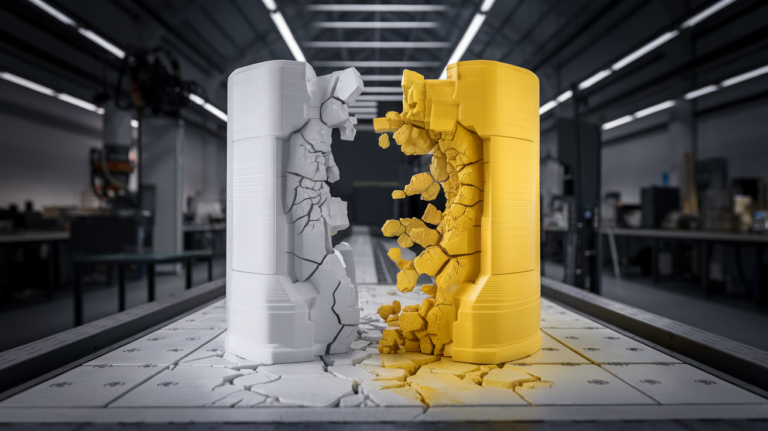
By the spec sheet, PLA wins on tensile strength (50-65 MPa vs PETG’s 45-55 MPa) and PETG wins on impact resistance and elongation at break. Translated to armor: PLA holds its shape better under sustained load, PETG bends rather than breaks under sudden impact. For a cosplayer who is going to crash through a doorway with their pauldron, PETG is the safer bet because the pauldron flexes and recovers. For a cosplayer carrying a large ornamental weapon prop that needs to look rigid all day, PLA holds the shape better.
This trade-off is real but it gets oversold. The actual modulus difference is small enough that wall thickness and infill choice dominate either material’s behavior. A 4 mm wall PLA pauldron at 25% gyroid infill is more impact-resistant than a 2 mm wall PETG pauldron at 10% infill, even though “PETG is the impact material.” Geometry beats material choice within reasonable design ranges.
Heat — the silent failure mode
This is where PLA cosplay armor most commonly fails on a convention day, and it is the failure that catches cosplayers most off guard. PLA’s glass transition temperature is approximately 60°C. A car parked in summer sun easily reaches 70-80°C interior temperature. A sealed convention exhibit hall in summer with poor air conditioning can hit 30-35°C ambient. Add direct sunlight through south-facing windows or skylights and surface temperatures on dark-colored armor reach 50-55°C — uncomfortably close to PLA’s softening point.
The failure mode looks like: the armor starts to droop slightly, attachment points sag where straps pull on them, curved sections lose their shape, and once the armor cools at the end of the day it does not return to original geometry. The cosplay piece is permanently warped. This is why PLA cosplay armor regularly comes home from outdoor cons looking different from how it left.
PETG’s glass transition is around 80°C — meaningfully higher. The same convention conditions that warp PLA leave PETG dimensionally stable. For armor that will see any outdoor wear, any walk through sunny passageways, or any car-trunk transport in warm weather, PETG is the categorically safer material on heat alone.
The flex test that predicts real-world durability
A useful test before a convention: take a printed test piece in your chosen material and bend it past 30 degrees by hand, then release. PLA at typical cosplay print settings (3-4 walls, 15-20% infill) cracks at the bend or develops a stress whitening line that becomes a future failure point. PETG bends, recovers most of the way, and shows minimal whitening. After three or four flex cycles, PLA pieces tend to snap; PETG pieces tend to fatigue gradually but stay together.
Cosplay armor experiences this kind of flex constantly throughout a day — every time you sit down, twist to look at something, hug a friend, or get bumped from behind. PETG’s behavior here means a small bend does not propagate into a visible crack the way it does in PLA. Over the course of one convention this difference is small. Over the course of three conventions in the same costume, PETG pieces look noticeably better than the PLA equivalents.
Print quality and finish — where PLA stays ahead
PLA prints cleaner. The surface finish straight off the printer requires less post-processing, the layer lines are subtler, and the material accepts paint, primer, and adhesives more predictably. For high-detail cosplay pieces where surface aesthetics matter (a smooth helmet surface, intricate filigree details, anything that will be seen close-up in photos), PLA is meaningfully easier to work with than PETG.
PETG produces stringier prints by default, especially on bridges and overhangs that are common in armor geometry. Calibrating PETG retraction and pressure advance well removes most of this problem, but the calibration burden is real. PETG also has slightly more issues with first-layer adhesion if the bed temperature is wrong — a cold start on PETG that “looks fine” but lifts at hour six of printing has wrecked many late-night cosplay print runs.
Our guide on 3D printing for cosplay covers the broader workflow including supports and finishing; this article focuses on the material choice itself.
Weight matters more than people think
A full-body PLA cosplay set weighs approximately 12-18% less than the same set in PETG (PLA density 1.24 g/cc, PETG 1.27 g/cc, with PLA also typically printed at slightly lower infill because it does not need the impact toughness). For a casual one-day wear, this difference is invisible. For an eight-hour convention with a maximalist armor set, the cumulative weight difference is the difference between a fun day and a sore-shoulders day.
If your build is large enough that weight matters, PLA’s lower density is a real advantage. Combine that with the heat warning above by transporting and storing the armor in a climate-controlled environment, only wearing it during the actual con hours, and removing pieces during downtime — this minimizes the heat exposure that PLA fails on while keeping the weight benefit.
The hybrid build approach
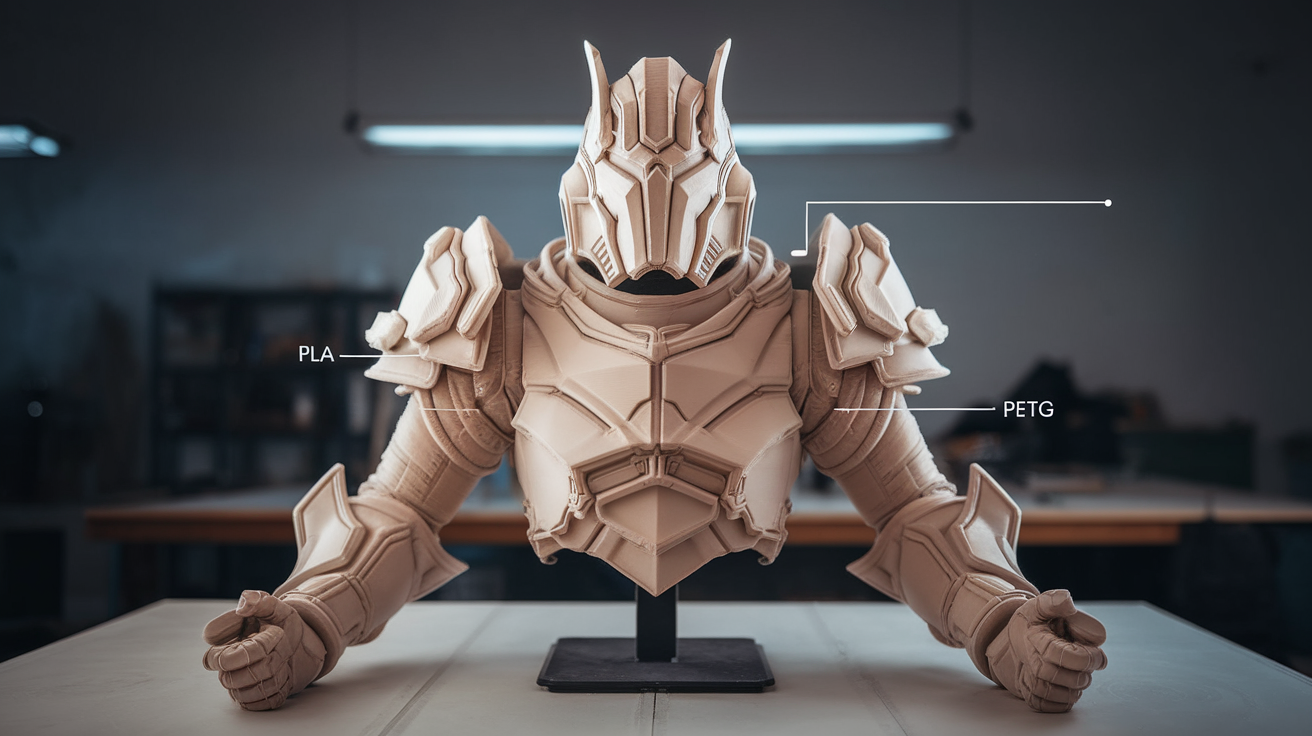
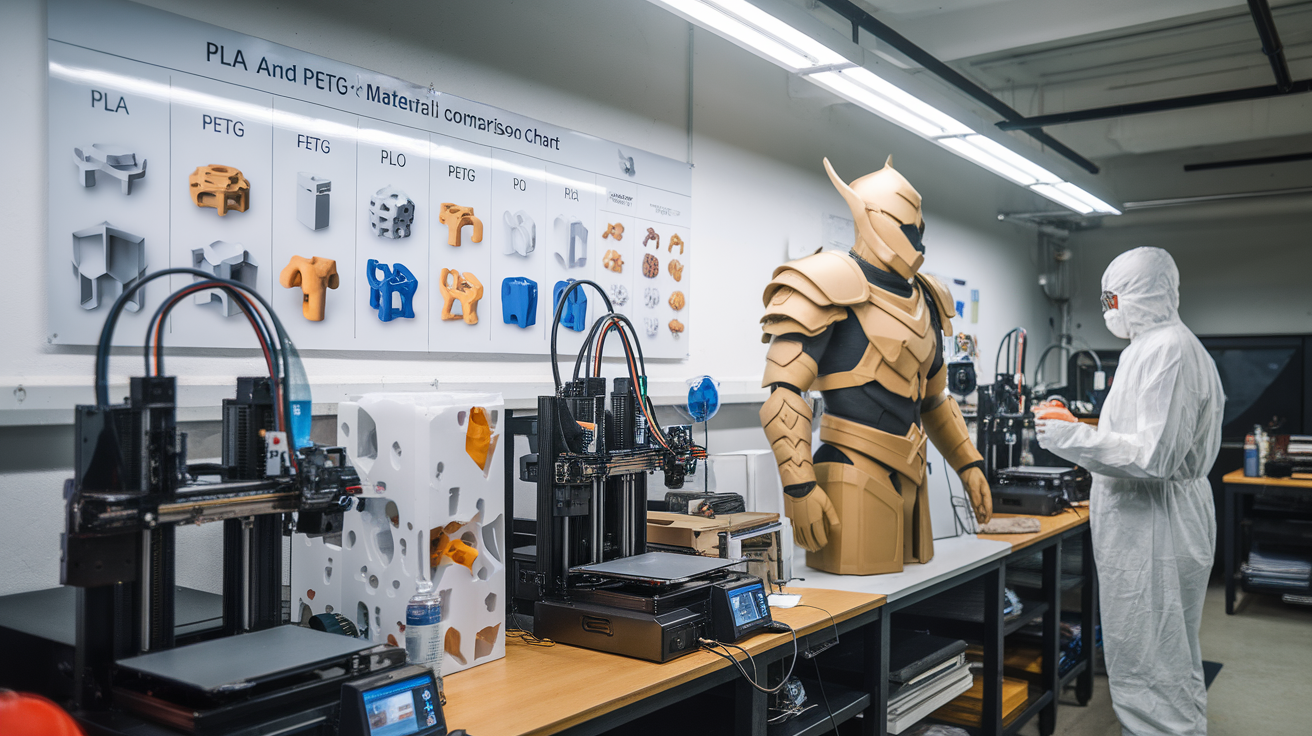
Many experienced cosplayers do not pick one material — they print structural pieces that need to flex (chest plate edges, bicep cuffs, helmet jaw sections) in PETG and finish-critical pieces (helmet faceplates, ornamental medallions, weapon prop bodies) in PLA. The hybrid approach takes advantage of each material’s strengths and accepts the slight workflow complexity of running two filaments through the print queue.
The seam between PLA and PETG sections needs to handle the slightly different surface chemistry. CA glue (cyanoacrylate) bonds both materials acceptably; epoxy works well; hot-melt glue holds initially but creeps under sustained load. For permanent joins between PLA and PETG sections, mechanical fasteners through both materials and CA-glue reinforcement is the most reliable approach.
Painting and finishing differences
PLA primes and paints more predictably. Standard rattle-can filler primer adheres well after a light sanding, and most acrylic paints stick to a primed PLA surface without special prep. PETG is glossier and has a slightly more chemically resistant surface that paint adheres to less aggressively. Sanding to a key is more important on PETG, and a self-etching primer for plastic is a worthwhile investment if your build relies on PETG with painted detailing.
The finishing decision affects material choice more than people realize. If your aesthetic depends on heavily painted details with crisp color separation, PLA is the easier path. If your aesthetic depends on chrome-look details, vacuum-metallized films, or transparent colored sections (PETG can be printed in clear or tinted formulations), PETG opens design options that PLA cannot match.
UV resistance — the long-term consideration
If your armor lives at an indoor con and gets photographed mostly under interior lighting, UV resistance does not matter. If your armor includes outdoor photo shoots or appears at outdoor events, it does. PLA degrades meaningfully under sustained UV — colors fade, the surface chalks, and structural strength reduces over months of cumulative exposure. PETG holds up much better. Neither material is ideal for outdoor cosplay durability over years; for that you would step up to ASA, which is the topic of our ASA vs PETG comparison.
For convention-only use indoors, both PLA and PETG hold up across a typical hobby cosplay lifecycle of 5-15 wears before retirement. For serious competitive cosplay or display pieces that will live for years, PETG (or ASA for outdoor display) is the longer-lasting choice.
What to actually pick for your next build
If your costume is for indoor cons only, you transport in air-conditioned vehicles, the armor is not load-bearing, and surface finish matters more than mechanical durability — print in PLA and you will be fine for normal convention wear. If your costume sees outdoor wear, summer heat, car trunks, frequent travel, or you are tall enough that you will bash the pauldrons through doorways daily — print in PETG and accept the slightly harder finishing workflow.
For most builds, the hybrid approach gives the best result: PETG for the structural skeleton, PLA for the cosmetic skin pieces, joined with mechanical fasteners and CA glue. This combines the durability of PETG with the finish quality of PLA at the cost of running two filaments through the print queue. The complexity is worth it for any armor that will be worn more than three or four times.
The decisive question
The honest framing of this entire decision is one question: how much do you care if this piece looks the same in a year as it does today? PLA armor a year later, after summer transport and a few outdoor cons, looks tired. PETG armor a year later looks roughly the same as it did at finish. For cosplay you wear once and retire, this does not matter. For a costume you will reuse and repair across many events, PETG is the durability winner — and PLA’s edge in finish quality matters less than PETG’s edge in lasting through a real wear cycle.