High Temperature Filament Types Ranked: 2026 Comparison Guide
What “High Temperature Filament” Actually Means in 2026
The phrase “high temperature filament” gets used for everything from heat-resistant PLA to PEEK, which is unhelpful because those materials live in different worlds. A useful definition: a high temperature filament is one whose part stays dimensionally stable above 80 degrees Celsius — the temperature inside a parked car in the sun. By that standard, PLA does not qualify, regardless of how the marketing copy describes “high temp PLA” variants. The materials that actually qualify are ABS, ASA, polycarbonate (PC), nylon (PA), polyetherimide (PEI / Ultem), and polyetheretherketone (PEEK / PEKK).
This article ranks those materials by real-world heat resistance, what machine you need to print them, and what each is genuinely useful for in 2026. The ranking is not “best to worst” — it is a map of which material to pick for which job.

ABS: The Baseline High-Temperature Material
ABS holds its shape up to about 95 degrees Celsius continuous, with a glass transition temperature of 105°C. Short-term excursions to 110°C are tolerable. ABS is the material to use when you need heat resistance, mechanical strength, and the ability to glue or solvent-weld parts together — acetone vapor smoothing is unique to ABS in the high-temperature material family.
ABS prints in 240-260°C nozzle, 100-110°C bed, and an enclosed chamber at 40-60°C is required to prevent warping on parts larger than about 80 mm. ABS produces strong fumes during printing; the styrene component is a known irritant, and any ABS workflow needs either an enclosed printer with active carbon filtration or printing in a ventilated room you do not occupy. ABS is the cheapest of the high-temperature materials at $20-25 per kg and remains the default choice for functional parts that need heat resistance without exotic properties.
ASA: ABS for Outdoor Applications
ASA shares ABS’s mechanical and thermal properties almost exactly — same glass transition, same heat deflection, same enclosure requirement. The difference is UV resistance: ASA does not yellow or become brittle under sunlight exposure, while ABS does so noticeably within months outdoors. For any outdoor application where heat resistance is needed alongside weatherability, ASA is the right choice.
ASA prints at almost identical settings to ABS — 245-265°C nozzle, 100-110°C bed, enclosed chamber at 40-60°C. ASA fumes are slightly less harsh than ABS but ventilation is still recommended. Cost is 20-30 percent higher than ABS at $25-32 per kg. For indoor functional parts ASA does not offer anything over ABS; for outdoor functional parts ASA is the only sensible choice in this family.
Polycarbonate (PC): Strength Plus Temperature
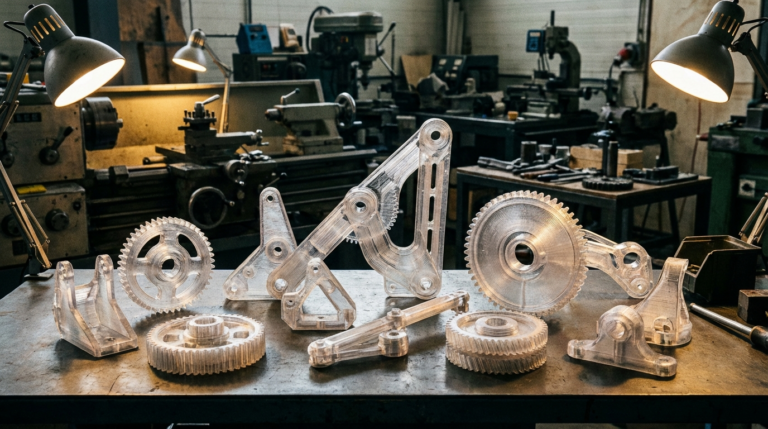
Polycarbonate is the material to use when you need impact resistance plus heat resistance — the combination is the defining property of PC that nothing else in this family matches. Glass transition is around 145°C, and PC parts retain useful strength up to 120°C. PC is also optically transparent, which is unique in high-temperature filaments and useful for light pipes or visible enclosures.
The catch is that PC is one of the hardest filaments to print well. Nozzle temperature needs to be 260-290°C, bed 110-120°C, chamber 70-90°C ideally, with very tight first-layer adhesion control. PC absorbs moisture aggressively from the air, and a PC roll that has been open for a week without active drying will print as if it were a different material — bubbles, popping, weak interlayer adhesion, surface frosting. PC needs active drying during printing for any roll older than a few days from opening. PC is the most expensive of the everyday high-temperature materials at $40-55 per kg, with PC-blend variants (PC-ABS, PC-PETG) sitting between PC and the source material in both performance and price.
Nylon (PA): The Wear and Chemical Material
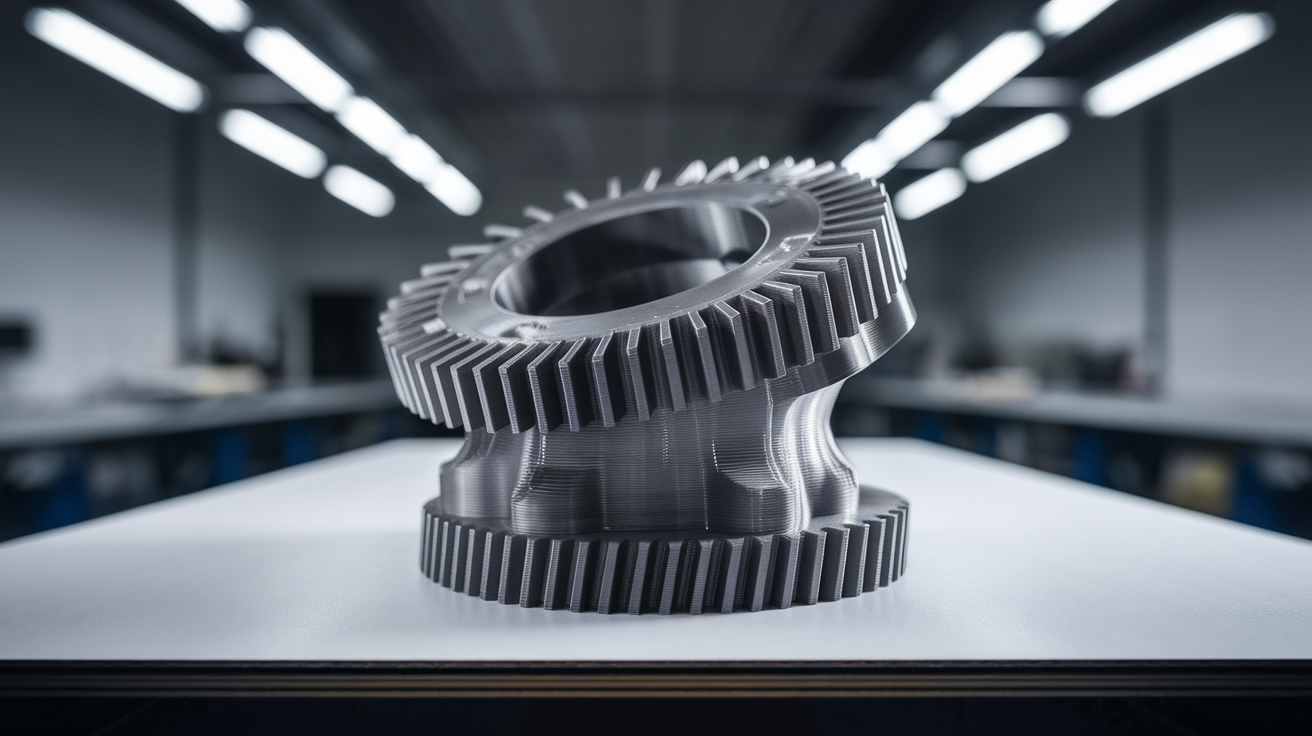
Nylon does not have the highest glass transition in this family (PA6 is around 70°C, PA12 around 55°C), but unfilled nylon retains useful mechanical properties up to 100-120°C because of its semi-crystalline structure. The reason to print nylon is not heat resistance per se — it is wear resistance, chemical resistance, and fatigue resistance. Gear teeth, threaded fittings, repeatedly flexed parts, and parts exposed to oils or solvents are nylon’s domain.
Nylon prints at 250-280°C nozzle and 80-110°C bed depending on the grade, with chamber temperature less critical than for PC or PEI. Nylon’s defining processing challenge is moisture absorption — nylon can absorb up to 10 percent of its weight in water from humid air within days, and wet nylon prints with severe popping and weak layers. A heated dry box during printing is functionally required for any serious nylon work. Cost varies wildly: PA12 is $40-60 per kg, glass-filled PA-CF and PA-GF run $80-150 per kg, and high-grade specialty nylons hit $200+ per kg.
PEI / Ultem: The Engineering-Grade Tier
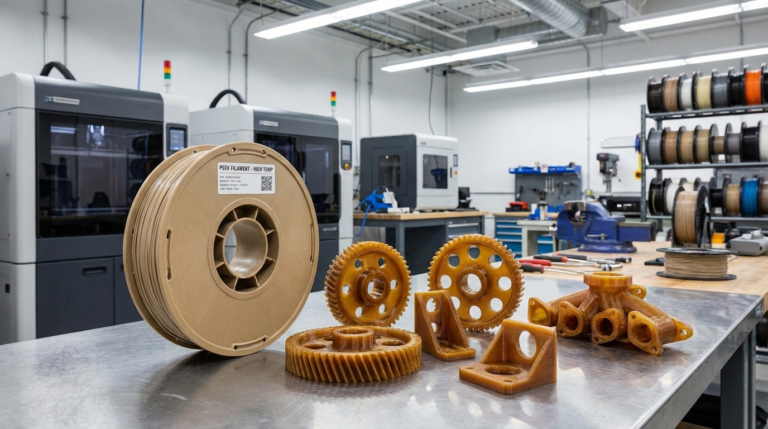
PEI (Ultem 1010, Ultem 9085) is where filament starts to behave like an industrial polymer rather than a consumer 3D printing material. Glass transition is 217°C, continuous use temperature is 170°C, and PEI is flame-retardant by default. PEI is the material for aerospace brackets, medical fixtures, and anything that needs to survive autoclaving or sustained high-temperature operation.
The cost of those properties is a printer with 350°C-capable hotend, a heated chamber at 100-180°C, and a bed surface compatible with PEI’s print requirements. Most consumer-grade machines cannot run PEI; you are looking at Stratasys F-series, Intamsys Funmat, Roboze, or modified Voron 2.4 setups with all-metal hot ends and chamber heating. Filament cost is $200-400 per kg. PEI is not “level up from PC” — it is a different category of machine and workflow.
PEEK / PEKK: The Top Tier
PEEK has a glass transition of 143°C and a melt temperature of 343°C, with continuous use temperature of 250°C. PEEK is used in aerospace, medical implant, oil and gas, and high-end industrial applications. PEEK is the closest 3D printable material to “this part will not melt under any reasonable use condition.”
Printing PEEK requires a 400+°C nozzle, a 150-200°C heated chamber, a heated bed compatible with PEEK adhesion (specialized coatings or PEI sheets), and absolute moisture control. The machine cost starts at $30,000 for a real PEEK printer; filament cost is $400-800 per kg. PEEK is mentioned in this guide for completeness, but for almost all readers it is not a feasible material — outsource PEEK parts to a service bureau rather than building a machine.
The Practical Ranking by Application
For functional indoor parts that need heat resistance up to 90°C: ABS is the right answer. It is cheap, well-understood, and most enclosed printers can run it.
For outdoor functional parts in this temperature range: ASA. The cost premium over ABS is worth it; the UV degradation of ABS outdoors is severe and not worth fighting.
For parts that need 100-120°C plus impact resistance or transparency: PC. The printing difficulty is real, but the property combination is unique.
For wear parts, fittings, and chemical-exposed parts: nylon. Even though nylon’s heat resistance is not the highest, it covers a property niche the others cannot fill.
For 150°C+ continuous operation, autoclave compatibility, or flame-retardant requirements: PEI. Industrial machine and budget required.
For PEEK-tier requirements: outsource. Not feasible to print at home in 2026 for almost any reader.
Common Mistakes in High-Temperature Filament Selection
The first mistake is overspecifying — picking PC or nylon when ABS would serve. A part rated for 70°C use does not need a 145°C glass transition material, and the printing difficulty of PC for a part that ABS would handle is purely wasted effort. Match the material to the actual use temperature with about 30°C of headroom, not to the marketing spec.
The second mistake is ignoring moisture. PC and nylon are both moisture-sensitive enough that a casual workflow guarantees subpar prints. If your workflow does not include active drying, do not pick a moisture-sensitive material. ABS and ASA tolerate moisture better than the engineering filaments and are forgiving choices for users without dry-box workflows.
The third mistake is buying a printer for a material rather than building a workflow. A 350°C hotend modification on a stock Ender 3 does not make it a PC machine, because the chamber heat and bed adhesion are not solved by the hotend alone. If you want to print PC, plan the chamber, the bed, the moisture control, and the ventilation as a single system — and budget for it as a system.
The Useful 2026 Strategy
For most users in 2026, the practical high-temperature strategy is: ABS or ASA as the daily driver for heat-resistant functional parts, with one of the engineering filaments (PC or nylon) added only when a specific use case demands it. Skipping the ABS step and going straight to PC is the most common over-investment in the hobby — PC is harder to print, more expensive, and not always actually better for the part you are making. Build the ABS workflow first, learn what its limits are in your application, and graduate to engineering filaments when those limits matter.
Another useful framing: think of these materials in terms of the workflow they demand, not just their published heat numbers. ABS and ASA share a workflow (enclosed printer, moderate temperatures, fume management) so adding the second to a shop that runs the first is essentially free. PC adds a moisture-control workflow, which is also where nylon lives, so the second engineering filament is much cheaper to add once the first is in place. PEI and PEEK each demand their own machine class and are essentially separate operations. Plan the material progression around shared workflows, and the cost of expanding your high-temperature capability stays manageable. Trying to add one material at a time on a single bargain printer, by contrast, almost always ends in a quality plateau that is not the filament’s fault.