Bowden Extruders Explained: How They Work, What They’re Good For, and When to Convert
What a Bowden extruder actually is, mechanically
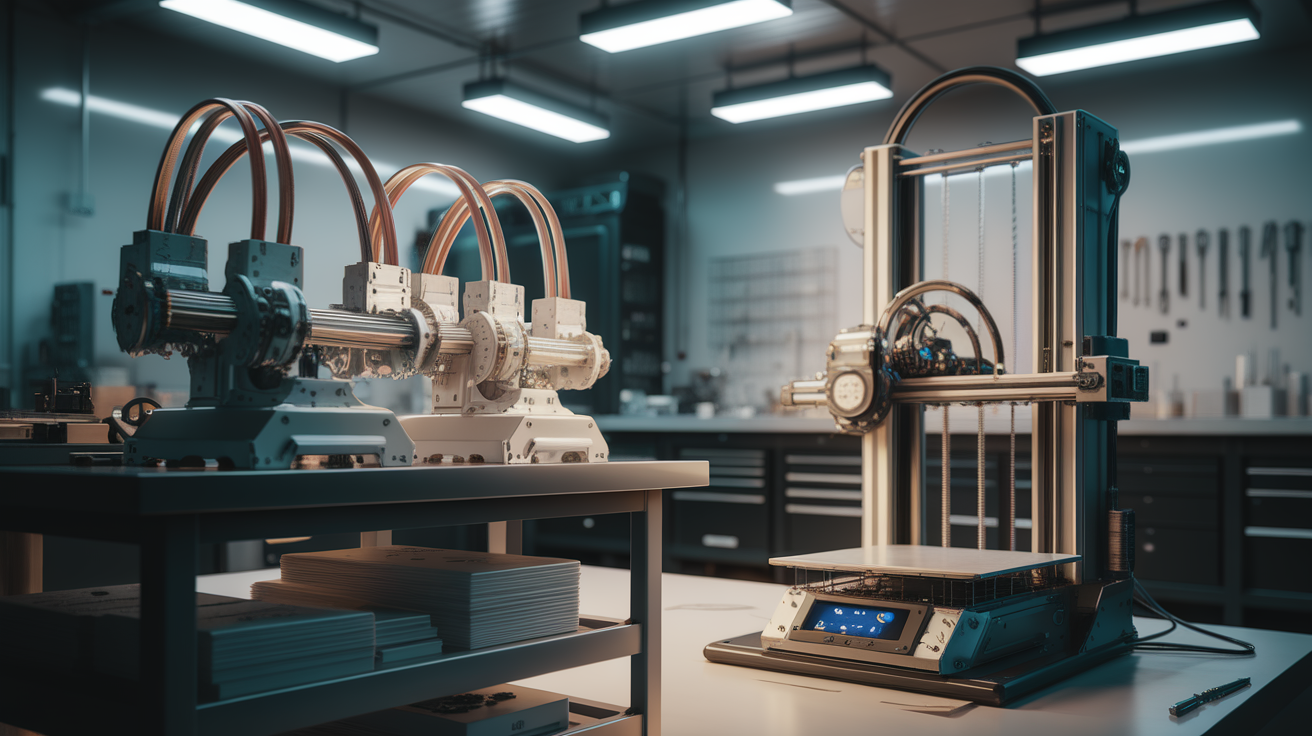
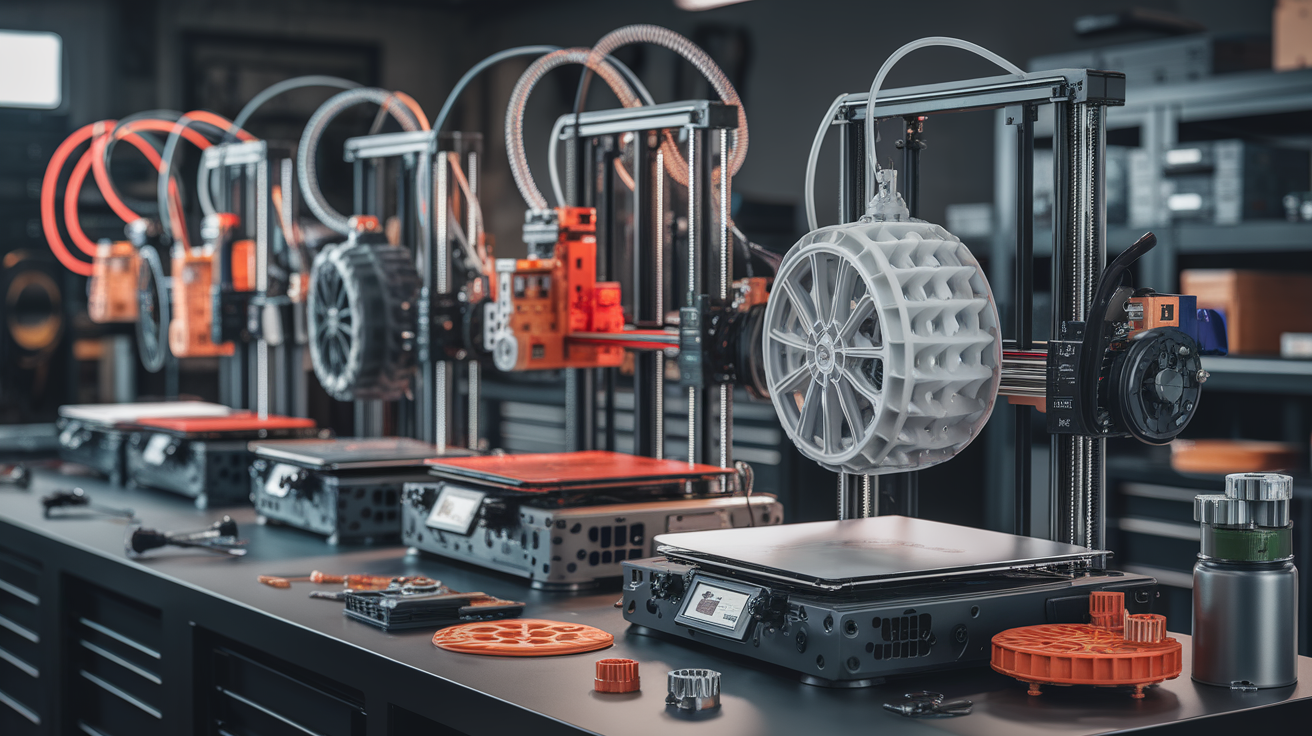
A Bowden extruder is a 3D printer extruder configuration where the stepper motor and gears that push the filament are mounted on the printer’s frame, not on the moving toolhead. The filament is fed through a long PTFE (Teflon) tube — the Bowden tube — that connects the extruder motor to the hot end mounted on the toolhead. The toolhead itself only carries the hot end and the cooling fan, making it dramatically lighter than a direct-drive setup.
This separation is the entire engineering point of bowden extruders. By moving the heaviest mechanical component (the stepper motor) off the toolhead, the printer can accelerate and decelerate the toolhead faster without inducing vibrations that show up as ringing or ghosting on the print surface. The Ender 3, Ender 5, original Prusa i3 (in some configurations), and most Cartesian printers under $300 in 2025-2026 all use Bowden extruders for this reason.
The trade-off is that the Bowden tube introduces compressibility into the filament path. When the extruder pushes filament forward, the filament has to overcome friction in the tube before the hot end actually receives it. When the extruder retracts, the filament has to be pulled back through the same friction. This delay between extruder motion and hot end response is the central operational characteristic of every Bowden setup, and it is the source of every Bowden-specific tuning challenge.
How a Bowden tube works under print conditions
The PTFE tube is typically 60-90 cm long depending on printer size, with an internal diameter of 1.9-2.0mm to accommodate 1.75mm filament with a small clearance. Standard Bowden tubes are made from regular PTFE; premium tubes (Capricorn, BondTech) use modified PTFE with a tighter internal diameter, smoother bore, and better dimensional consistency. The tube is held in place at each end by pneumatic push-fit collets that grip the tube against axial movement.
During printing, the filament moves through this tube in a fairly continuous stream. The friction is mostly static — once the filament is moving, it slides smoothly until the next directional change. At directional changes (retractions, layer changes, travel moves), the filament has to overcome static friction again. This is why Bowden printers need much longer retraction distances than direct-drive: typically 5-7 mm to compensate for the 2-3 mm of compressibility introduced by the tube length.
Tube wear is a real consideration. PTFE softens above 240°C and standard Bowden tubes start to deform if the hot end is hotter than that. The tube end nearest the hot end, where the filament passes through the heat break, sees temperatures close to the nozzle and slowly degrades. Most users replace this end of the Bowden tube every 3-6 months of heavy use; the rest of the tube can last years.
What Bowden extruders are good for
Bowden extruders excel at high travel speeds. Because the toolhead is light, it can accelerate and decelerate aggressively without inducing the ringing that a heavy direct-drive toolhead would produce. Most Bowden printers cruise at 80-150 mm/s and accelerate at 1500-3000 mm/s²; comparable direct-drive printers cruise at 60-120 mm/s with 800-1500 mm/s² acceleration to avoid ringing. The speed advantage shows up on travel moves between extrusions, which on a typical print account for 15-25% of total print time.
Bowden extruders are simpler to assemble and cheaper to manufacture. The motor mount is a static frame component rather than a moving assembly. Belts and pulleys for the toolhead are smaller because they move less mass. This is why every entry-level printer in the under-$300 tier ships with Bowden extruders — the cost saving versus a direct-drive equivalent is around $50-100 per printer, which the manufacturer can pass through as either savings or higher build quality elsewhere.
For rigid filaments at moderate speeds — PLA, PETG, ABS at 60-120 mm/s — Bowden setups produce excellent prints with minimal tuning beyond retraction distance and pressure advance. New users with Ender 3-class printers rarely encounter Bowden-specific problems because the typical print conditions stay well within the system’s strengths. The challenges appear when users push beyond those conditions.
What Bowden extruders are bad for
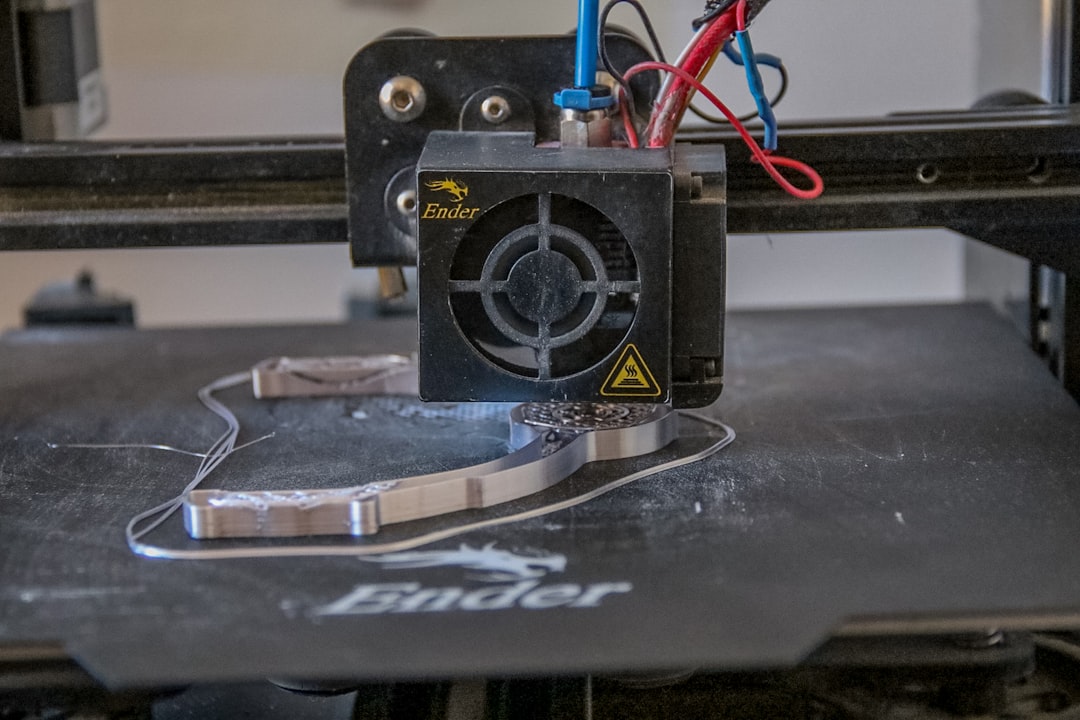
Flexible filaments are the canonical Bowden weakness. TPU, TPE, and other rubbery materials cannot be reliably pushed through a long Bowden tube because the filament compresses and buckles under the pushing force, especially at retractions. The result is unreliable extrusion, jams, and prints that fail mid-way through. TPU 95A is the borderline case — it works on Bowden setups with very slow print speeds (15-30 mm/s) and minimal retraction. Softer flexibles like TPU 85A or TPE require direct-drive extruders.
Filaments with high friction or stickiness are similarly difficult. Glow-in-the-dark PLA, certain wood-fill filaments, and abrasive carbon-fibre filaments all introduce extra friction in the Bowden tube that compounds the system’s existing compressibility issues. These filaments often work but require careful retraction tuning and may eat through Bowden tubes faster than standard PLA.
Very fast retraction-heavy prints expose Bowden’s response delay. A vase or other low-retraction model prints fine at 200 mm/s on Bowden hardware. A part with many small features and frequent direction changes — miniatures, lattice structures, organic models — develops stringing and oozing artefacts at the same speed because the retractions cannot keep up with the rapid extrusion changes. This is why most miniature-focused 3D printing communities recommend direct-drive printers for that specific use case.
Brands and tube quality differences
The standard PTFE Bowden tube that ships with most printers is functional but not great. Internal diameter varies between 1.9-2.0mm spool-to-spool, the bore surface is rougher than premium options, and the tube degrades faster under heat. Most users print fine with the stock tube for the first 6-12 months and upgrade only when they notice problems.
Capricorn XS-tube is the recognised premium upgrade. Tighter dimensional tolerance (1.9mm ID), smoother PTFE-PFA blend bore, better high-temperature resistance, and clear blue colouring for visual identification. Costs $15-25 for a 1-metre length, which usually replaces the entire Bowden run on any printer. Reduces stringing and improves retraction response on most printers; the improvement is real but modest. Worth doing as part of a general printer tuning pass; not a magical fix for unrelated problems.
Bondtech Push-Fit tubes are similar in quality to Capricorn but at slightly higher cost. Some users report better long-term consistency from Bondtech; others see no measurable difference. Either premium option is a fine upgrade choice, and the difference between them is smaller than the difference between standard PTFE and either premium tube.
Tuning a Bowden setup for clean prints
The two settings that matter most are retraction distance and retraction speed. For a 70cm Bowden tube on PLA, start at 5mm retraction at 25 mm/s. PETG usually needs 4mm at 30 mm/s — slightly less distance because PETG flows back into the nozzle reluctantly and longer retractions cause filament tangling at the extruder gear. Calibrate using a retraction tower test print specifically designed for the Bowden length your printer has.
Pressure advance (or linear advance, depending on firmware) is the other critical Bowden tuning parameter. Bowden setups need higher pressure advance values than direct-drive — typically 0.12-0.25 versus 0.04-0.08 for direct-drive. Without proper pressure advance tuning, Bowden prints develop visible blobs at corners where the filament continues to ooze after the extruder has stopped pushing. Modern slicers (Bambu Studio, OrcaSlicer, PrusaSlicer) include pressure advance calibration patterns that make tuning straightforward.
Hot end temperature matters more on Bowden than direct-drive. Higher nozzle temperatures reduce melt viscosity and let the filament flow with less resistance through the tube friction. Most Bowden users find their PLA prints come out cleaner at 215°C than at 200°C, and PETG at 245°C than at 235°C. The temperature-quality curve is steeper on Bowden because the system tolerates less under-extrusion than direct-drive does.
When to convert from Bowden to direct-drive
The conversion is straightforward and reversible on most Cartesian printers. Direct-drive conversion kits cost $40-100 and take 30-90 minutes to install. The decision to convert hinges on what the user prints. Users who mostly print PLA and PETG at moderate speeds rarely benefit from conversion; Bowden does that job fine. Users who frequently print TPU, miniatures with retraction-heavy geometry, or push speeds above 200 mm/s with lots of direction changes see real benefits from direct-drive.
The downside of conversion is reintroducing the toolhead mass. A direct-drive Ender 3 has 200-300g more weight on the toolhead than the original Bowden, which means lowered acceleration limits, more visible ringing on prints, and the need to recalibrate input shaping. Most users who convert end up running 60-100 mm/s instead of 100-150 mm/s, which is a 30-40% speed reduction in exchange for the flexible-filament capability.
The Bowden future and why it is not going away
CoreXY printers — the high-speed performance tier of 2026 — almost universally use direct-drive because the toolhead-mass penalty is offset by the kinematic system’s other speed advantages. This has led some commentators to predict that Bowden setups will fade out. They are wrong: Bowden remains the right architecture for low-cost Cartesian printers, large-format machines where toolhead mass is already substantial, and any setup where the user prints rigid filaments at moderate speeds and wants the simplest possible mechanical design.
The Bowden architecture has been refined, not replaced. Better tube materials, better extruder gear designs (BMG, Sherpa Mini, Orbiter), and better firmware compensation (pressure advance, input shaping) have collectively made modern Bowden setups print quality comparable to direct-drive at moderate speeds. The trade-offs are the same trade-offs that existed five years ago, but each side of the trade is much better-tuned now than it was. For new printer buyers in 2026, Bowden remains a perfectly reasonable choice as long as you understand what you are buying — a printer optimised for travel speed and simplicity rather than for filament flexibility and retraction responsiveness.